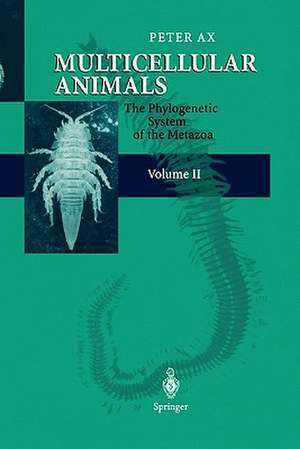
Multicellular Animals
Autor Peter Ax Traducere de S. Kinseyen Limba Engleză Paperback – dec 2010
Preț: 1195.41 lei
Preț vechi: 1457.82 lei
-18%
Puncte Express: 1793
Carte tipărită la comandă
Livrare economică 07-21 decembrie
Livrare prin curier în România Termenul estimat este afișat lângă disponibilitate.
Transport gratuit pentru acest produs Plată online sau ramburs, în funcție de opțiunile comenzii.
Retur gratuit în 14 zile Comandă securizată și suport în română.
Specificații
ISBN-13: 9783642086816
ISBN-10: 3642086810
Pagini: 424
Ilustrații: XXIV, 396 p.
Dimensiuni: 155 x 235 x 23 mm
Greutate: 0.64 kg
Ediția:Softcover reprint of hardcover 1st ed. 2000
Editura: Springer
Locul publicării:Berlin, Heidelberg, Germany
ISBN-10: 3642086810
Pagini: 424
Ilustrații: XXIV, 396 p.
Dimensiuni: 155 x 235 x 23 mm
Greutate: 0.64 kg
Ediția:Softcover reprint of hardcover 1st ed. 2000
Editura: Springer
Locul publicării:Berlin, Heidelberg, Germany
V-ar putea interesa
-
 Creative Haven Birds Color by Number Coloring BookGeorge ToufexisPreț: 64.15 lei
 -
 Bacterial Fish PathogensB. Austin-18%Preț: 1290.92 lei1574.29 lei
 -
 -43%Preț: 68.98 lei121.26 lei
 -
 -27%Preț: 1215.63 lei1658.28 lei
 -
 My Book of Baby AnimalsArmadilloPreț: 57.52 lei
 -
 The Biology of Hover WaspsStefano Turillazzi-18%Preț: 984.44 lei1200.53 lei
 -
 -5%Preț: 688.29 lei724.52 lei
 -
 A Colour Atlas of Salmonid DiseasesDavid W. Bruno-23%Preț: 1302.80 lei1691.94 lei
Public țintă
ResearchDescriere
Those who wish for permanence in classifi cation must pay the price of stasis - as if for ever condemned to confound whales with fish. M. T. Ghiselin 1981, p. 283 Scientific argument is a debate concerned with the solution of unresolved problems. Before continuing with the phylogenetic system of the Metazoa this foreword gives me the opportunity to discuss some controversial ques tions, to state selected positions more precisely and to remedy omissions. I would like to draw special attention to serious problems for phylogenetic systematics resulting from the inevitable confrontation with the current rules of nomenclature 1. In carrying out this debate, I hope not to lose the goodwill of those readers who are experts within the first few pages. A textbook for students? - Critics who ask that question and answer in the negative probably underestimate the open-mindedness of young people who are not troubled by, or can easily free themselves from, the restraints and arbitrariness of traditional classifications - and to whom systematics is offered as a scientific product in such a form that arguments for every single decision are comprehensible and checkable and can therefore be fully analyzed.
Cuprins
Trochozoa.- Lacunifera.- Kamptozoa — Mollusca.- Aplacophora — Eumollusca.- Solenogastres — Caudofoveata.- Polyplacophora — Conchifera.- Neopilinida — Ganglioneura.- Rhacopoda — Ancyropoda.- Gastropoda — Cephalopoda.- Scaphopoda — Bivalvia.- Sipunculida — Articulata.- Annelida — Arthropoda.- Polychaeta — Clitellata.- Scolecida — Palpata.- Aciculata — Canalipalpata.- Branchiobdellida — Hirudinea.- Acanthobdella peledina — Autobdella.- Rhynchobdellida — Arhynchobdellida.- Onychophora — Euarthropoda.- Chelicerata — Mandibulata.- Pantopoda — Euchelicerata.- Xiphosura — Arachnida.- Scorpiones — Lipoctena.- Megoperculata — Apulmonata.- Uropygi — Labellata.- Amblypygi — Araneae.- Mesothelae — Opisthothelae.- Mygalomorphae — Araneomorphae.- Palaeocribellatae — Neocribellatae.- Austrochiloidea — Araneoclada.- Haplogynae — Entelegynae.- Palpigradi — Holotracheata.- Haplocnemata — ? Cryptoperculata.- Pseudoscorpiones — Solifugae.- Opiliones — Acarinomorpha.- Ricinulei — Acari.- Crustacea — Tracheata.- Remipedia — Eucrustacea.- Thoracopoda — Maxillopoda.- Cephalocarida — Phyllopodomorpha.- Anostraca — Ostraca.- Phyllopoda — Malacostraca.- Onychura — Notostraca.- Cyclestheria hislopi — Cladocera.- Leptostraca — Eumalacostraca.- Stomatopoda — Caridoida.- Decapoda — Xenommacarida.- Syncarida — N. N. (Euphausiacea, Pancarida+Peracarida).- N. N.: Euphausiacea, Pancarida+Peracarida.- Pancarida — Peracarida.- Copepodomorpha — Progonomorpha.- Copepoda — Mystacocarida.- Tantulocarida — Thecostracomorpha.- Thecostraca — Ostracoda.- Ascothoracida — Cirripedia.- Myriapoda — Insecta.- Chilopoda — Progoneata.- Geophilomorpha — Heteroterga.- Scolopendromorpha — Triakontapoda.- Craterostigmomorpha — Gonopodophora.- Lithobiomorpha — Scutigeromorpha.- Symphyla — Dignatha.- Pauropoda — Diplopoda.- Penicillata — Chilognatha.- Pentazonia — Helminthomorpha.- Entognatha — Ectognatha.- Diplura — Ellipura.- Protura — Collembola.- Archaeognatha — Dicondylia.- Zygentoma — Pterygota.- Palaeoptera — Neoptera.- Ephemeroptera — Odonata.- Plecoptera — N. N. (All Other Neoptera).- Paurometabola — Eumetabola.- Embioptera — Orthopteromorpha.- Blattopteriformia — Orthopteroidea.- Notoptera — N. N. (All Other Roach-Like Paurometabola).- Dermaptera — Dictyoptera.- Mantodea — Blattodea.- Saltatoria — Phasmatodea.- Ensifera — Caelifera.- Paraneoptera — Holometabola.- Zoraptera — Acercaria.- Psocodea — Condylognatha.- “Psocoptera” — Phthiraptera.- Thysanoptera — Hemiptera.- Aphidomorpha — Psyllomorpha.- Cicadomorpha — N. N. (Fulgoromorpha+Heteropteroidea).- N. N.: Fulgoromorpha+Heteropteroidea.- Coleorrhyncha — Heteroptera.- Neuropteriformia — Mecopteriformia.- Neuropteroidea — Coleopteroidea.- Planipennia — N. N. (Megaloptera+Raphidioptera).- N. N.: Megaloptera+Raphidioptera.- Coleoptera — ? Strepsiptera.- Hymenoptera — Mecopteroidea.- Amphiesmenoptera — Antliophora.- Trichoptera — Lepidoptera.- N. N. (Mecoptera+Siphonaptera) — Diptera.- References.
Textul de pe ultima copertă
The system of multicellular animals presented here is an alternative to the traditional classification which still operates with the categories of Carl v. Linné, including typological divisions in artificial species groups. In a new approach to the phylogenetic order in nature this book strives for an objective systematization of the Metazoa. It seeks a new path in the field of academic research and teaching based on the theory and methodology of phylogenetic systematics. This volume covers the Metazoa from the Mollusca up to the Arthropoda; the last volume III will treat the Nemathelminthes and the Deuterostomia.
Caracteristici
The second volume of Professor Ax' revised systematics of all multicellular animals.
Includes supplementary material: sn.pub/extras
Includes supplementary material: sn.pub/extras