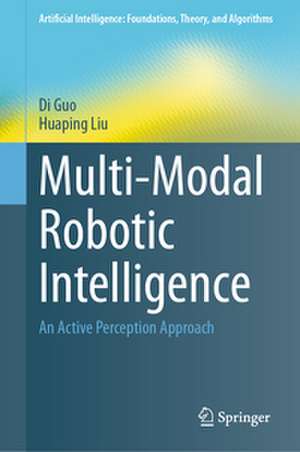
Multi-Modal Robotic Intelligence: Artificial Intelligence: Foundations, Theory, and Algorithms
Autor Di Guo, Huaping Liuen Limba Engleză Hardback – 25 noi 2025




Preț: 1263.89 lei
Preț vechi: 1541.33 lei
-18%
Puncte Express: 1896
Carte tipărită la comandă
Livrare economică 05-19 decembrie
Livrare prin curier în România Termenul estimat este afișat lângă disponibilitate.
Transport gratuit pentru acest produs Plată online sau ramburs, în funcție de opțiunile comenzii.
Retur gratuit în 14 zile Comandă securizată și suport în română.
Specificații
ISBN-13: 9789819530434
ISBN-10: 9819530431
Pagini: 232
Ilustrații: XXIX, 201 p. 1 illus.
Dimensiuni: 160 x 241 x 19 mm
Greutate: 0.47 kg
Editura: Springer
Colecția Artificial Intelligence: Foundations, Theory, and Algorithms
Seria Artificial Intelligence: Foundations, Theory, and Algorithms
ISBN-10: 9819530431
Pagini: 232
Ilustrații: XXIX, 201 p. 1 illus.
Dimensiuni: 160 x 241 x 19 mm
Greutate: 0.47 kg
Editura: Springer
Colecția Artificial Intelligence: Foundations, Theory, and Algorithms
Seria Artificial Intelligence: Foundations, Theory, and Algorithms
Notă biografică
Bin Fang is an Assistant Researcher at the Department of Computer Science and Technology, Tsinghua University. His main research interests include wearable devices and human-robot interaction. He is a leader guest editor for a number of journals, including Frontiers in Neurorobotics, and Frontiers in Robotics and AI, and has served as an associate editor for various journals and conferences, e.g. the International Journal of Advanced Robotic Systems, and the IEEE International Conference on Advanced Robotics and Mechatronics.
Fuchun Sun is a Full Professor at the Department of Computer Science and Technology, Tsinghua University. A recipient of the National Science Fund for Distinguished Young Scholars, his main research interests include intelligent control and robotics. He serves as an associate editor for a number of international journals, including IEEE Transactions on Systems, Man and Cybernetics: Systems, IEEE Transactions on Fuzzy Systems, and Mechatronics, Robotics and Autonomous Systems.
Huaping Liu is an Associate Professor at the Department of Computer Science and Technology, Tsinghua University. His main research interests include robotic perception and learning. He serves as an associate editor for various journals, including IEEE Transactions on Automation Science and Engineering, IEEE Transactions on Industrial Informatics, IEEE Robotics & Automation Letters, Neurocomputing, and Cognitive Computation.
¿Chunfang Liu is an Assistant Professor at the Department of Artificial Intelligence and Automation, Beijing University of Technology. Her research interests include intelligent robotics and vision.
Di Guo received her Ph.D. degree from the Department of Computer Science and Technology, Tsinghua University, Beijing, in 2017. Her research interests include robotic manipulation and sensor fusion.