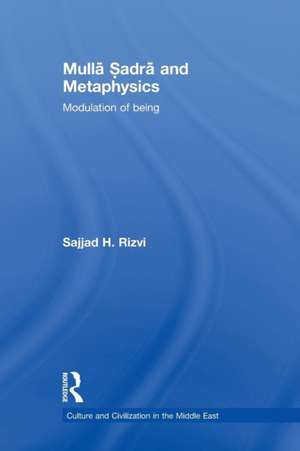
Mulla Sadra and Metaphysics: Modulation of Being: Culture and Civilization in the Middle East
Autor Sajjad H. Rizvien Limba Engleză Paperback – 25 apr 2013
Reading and critiquing the works of Mulla Sadra from an analytical perspective, this book pays particular attention to his text the Asfar, a work which, due to its complexity, is often overlooked. Looking at the concept of philosophy as a way of life and a therapeutic practice, this book explores the paradigm of the modulation of being in the philosophical method and metaphysics of Mulla Sadra and considers its different manifestations. Rizvi relates his philosophy to larger trends and provides a review of the field, charting and critiquing the discussion on the topic to date and exploring recent thought in this direction, to show how Sadrian thought was addressed well into the 19th and 20th centuries.
This major contribution to the study of Mulla Sadra and the intellectual life of the Safavid period fills an important gap in the field of Sadra studies and Islamic philosophy, and is indispensable to students of philosophy, religion and Islamic studies, and Islamic philosophy in particular.
Din seria Culture and Civilization in the Middle East
- 15%
 Preț: 468.59 lei
 - 15%
 Preț: 458.46 lei
 - 18%
 Preț: 1308.72 lei
 - 15%
 Preț: 466.42 lei
 - 18%
 Preț: 1255.17 lei
 - 18%
 Preț: 1261.45 lei
 - 18%
 Preț: 1308.02 lei
 - 18%
 Preț: 1253.42 lei
 - 15%
 Preț: 464.73 lei
 - 15%
 Preț: 470.77 lei
 - 18%
 Preț: 1261.45 lei
 - 15%
 Preț: 455.93 lei
 -
 Preț: 469.66 lei
 - 18%
 Preț: 1253.07 lei
 - 15%
 Preț: 459.20 lei
 - 18%
 Preț: 1286.63 lei
 - 15%
 Preț: 456.81 lei
 - 18%
 Preț: 1343.95 lei
 - 18%
 Preț: 1347.43 lei
 - 18%
 Preț: 1115.17 lei
 - 18%
 Preț: 1256.91 lei
 - 18%
 Preț: 1292.50 lei
 -
 Preț: 461.15 lei
 - 18%
 Preț: 1246.44 lei
 - 18%
 Preț: 1261.79 lei
 - 15%
 Preț: 466.06 lei
 - 18%
 Preț: 1116.90 lei
 -
 Preț: 480.11 lei
 - 18%
 Preț: 1249.58 lei
 - 15%
 Preț: 458.10 lei
 - 18%
 Preț: 1110.62 lei
 - 18%
 Preț: 1253.07 lei
 - 18%
 Preț: 1262.49 lei
 - 18%
 Preț: 1396.82 lei
 - 15%
 Preț: 424.54 lei
 - 18%
 Preț: 1257.26 lei
 - 18%
 Preț: 1253.77 lei
 - 18%
 Preț: 1251.35 lei
 - 18%
 Preț: 1364.38 lei
 - 18%
 Preț: 1287.20 lei
Preț: 433.79 lei
Preț vechi: 510.33 lei
-15%
Puncte Express: 651
Carte tipărită la comandă
Livrare economică 28 noiembrie-12 decembrie
Livrare prin curier în România Termenul estimat este afișat lângă disponibilitate.
Transport gratuit pentru acest produs Plată online sau ramburs, în funcție de opțiunile comenzii.
Retur gratuit în 14 zile Comandă securizată și suport în română.
Specificații
ISBN-13: 9780415849005
ISBN-10: 0415849004
Pagini: 240
Dimensiuni: 156 x 234 x 13 mm
Greutate: 0.44 kg
Ediția:1
Editura: Taylor & Francis
Colecția Routledge
Seria Culture and Civilization in the Middle East
Locul publicării:Oxford, United Kingdom
ISBN-10: 0415849004
Pagini: 240
Dimensiuni: 156 x 234 x 13 mm
Greutate: 0.44 kg
Ediția:1
Editura: Taylor & Francis
Colecția Routledge
Seria Culture and Civilization in the Middle East
Locul publicării:Oxford, United Kingdom
V-ar putea interesa
-
 Spiritual WritingsGeorge PattisonPreț: 105.63 lei
 -
 AvicennaJon McGinnis-11%Preț: 390.13 lei438.25 lei
 -
 -31%Preț: 708.00 lei1029.34 lei
 -
 Monotheism and ToleranceRobert ErlewinePreț: 170.96 lei
 -
 Preț: 199.11 lei
 -
 A Genealogy of Marion`s Philosophy of Religion – Apparent DarknessTamsin Jones FarmerPreț: 158.50 lei
 -
 Simone WeilRobert ChenavierPreț: 144.51 lei
 -
 Preț: 267.41 lei
 -
 On the Meaning of LifeJohn CottinghamPreț: 326.88 lei
 -
 Islamic Thought: An IntroductionAbdullah SaeedPreț: 392.61 lei
 -
 Early Polemical WritingsSøren KierkegaardPreț: 399.24 lei
 -
 The Philosopher and the GospelsKeith WardPreț: 83.67 lei
 -
 Self-Reliance, the Over-Soul, and Other EssaysRalph Waldo EmersonPreț: 71.60 lei
 -
 The Twelve Conditions of a MiracleTodd MichaelPreț: 145.07 lei
 -
 The Age of Reason - Thomas PaineThomas PainePreț: 69.01 lei
 -
 The Temptation to ExistE. M. CioranPreț: 110.09 lei
 -
 The Enchiridion of EpictetusEpictetusPreț: 42.72 lei
 -
 Williams, A: The Vision of RumiAlan Williams-26%Preț: 174.30 lei235.20 lei
 -
 The God QuestionAndrew Pessin-66%Preț: 80.87 lei241.14 lei
Public țintă
Postgraduate and UndergraduateCuprins
Introduction 1. Methodological concerns 2. The Modulation of Being 3. The semantics of modulation of being 4. Mental Being 5. Reality and the Circle of being. Conclusion
Notă biografică
Sajjad H. Rizvi is Senior Lecturer in Islamic Studies and Director of the Centre of Islamic Philosophy at the Institute of Arab and Islamic Studies at the University of Exeter, specialising in Islamic philosophical and hermeneutical traditions.
Recenzii
"Rizvi, in Mulla Sadra and Metaphysics, focuses on the heart of the whole system with a rigorous philosophical and logical analysis from the perspectives of classical Islamic philosophy and the contemporary global philosophical outlook both Western and Eastern. Moreover, on a number of issues he significantly contributes to our understanding of Sadra's philosophical system within its own authentic context. In face one must admit that many of his anlyses are full of original insights, thought provoking and thus opening new horizons to any future Sadra studies." - Alparslan Acikgenc, Journal of Shi'a Islamic Studies, Summer 2010. Vol III. No 3
"A book such as the one under review presents a refreshing contrast to the many rather mediocre works which seem to cater more for the presumed needs of undergraduate students than to a serious continuation of academic discourse... Sajjad Rizvi has presented us with a highly commendable work, essential for anyone with a deeper interest in later Islamic philosophy in general and Mulla Sadra in particular." - Jan-Peter Hartung, School of Oriental and African Studies, University of London, The Journal of JRAS, Series 3 - Volume 20/3 - 2010
"When reading a thinker like Mulla Sadra one is faced with several major difficulties at the outset: first there is the question of understanding his ontology. If one can surmount this hurdle, then one has to make sense of how Sadra treats particular problems in conversation with disciplines ranging from philosophy and theology, to Sufism and scriptural exegesis. Without passing this barrier, one may be misled into thinking that Sadra’s originality lies where it likely does not. So a great deal of historical knowledge and philosophical skill is also required in order to discern the various kinds of discourse at work in Sadra’s writings. If one can overcome this challenge and see how Sadra’s creative appropriations on any given topic fit into his worldview, then one may be able effectively to demonstrate his innovativeness and significance. Sajjad Rizvi’s Mulla Sadra and Metaphysics is indeed successful on all of these fronts. It is therefore a fine addition to the field of Islamic philosophy in general, and Sadra studies in particular." - Mohammed Rustom, Carleton University; Journal of Islamic Studies, vol 22, no 3, September 2011
"A book such as the one under review presents a refreshing contrast to the many rather mediocre works which seem to cater more for the presumed needs of undergraduate students than to a serious continuation of academic discourse... Sajjad Rizvi has presented us with a highly commendable work, essential for anyone with a deeper interest in later Islamic philosophy in general and Mulla Sadra in particular." - Jan-Peter Hartung, School of Oriental and African Studies, University of London, The Journal of JRAS, Series 3 - Volume 20/3 - 2010
"When reading a thinker like Mulla Sadra one is faced with several major difficulties at the outset: first there is the question of understanding his ontology. If one can surmount this hurdle, then one has to make sense of how Sadra treats particular problems in conversation with disciplines ranging from philosophy and theology, to Sufism and scriptural exegesis. Without passing this barrier, one may be misled into thinking that Sadra’s originality lies where it likely does not. So a great deal of historical knowledge and philosophical skill is also required in order to discern the various kinds of discourse at work in Sadra’s writings. If one can overcome this challenge and see how Sadra’s creative appropriations on any given topic fit into his worldview, then one may be able effectively to demonstrate his innovativeness and significance. Sajjad Rizvi’s Mulla Sadra and Metaphysics is indeed successful on all of these fronts. It is therefore a fine addition to the field of Islamic philosophy in general, and Sadra studies in particular." - Mohammed Rustom, Carleton University; Journal of Islamic Studies, vol 22, no 3, September 2011
Descriere
Mulla Sadra is, alongside Avicenna, probably the most important Islamic philosopher. In this exploration of his metaphysics the author examines the central doctrine of the modulation of being, and makes a major contribution to the study of Mulla Sadra and the intellectual life of the Safavid period.