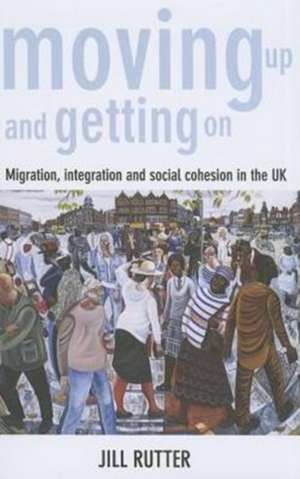
Moving Up and Getting On: Migration, Integration and Social Cohesion in the UK
Autor Jill Rutteren Limba Engleză Paperback – 15 sep 2015
The question of immigration is a perennial hot topic in politics around the world. What gets far less attention is what happens to immigrants after their arrival—how they integrate into their newly chosen societies. This book draws on fieldwork in London and eastern England, analyzing and critiquing the effectiveness of recent policies that aim to promote integration and social cohesion. Successful management of immigration, Jill Rutter argues, requires a greater emphasis on the social aspects of integration and opportunities for meaningful social interactions between migrants and long-settled residents, particularly in workplaces.
Preț: 274.88 lei
Puncte Express: 412
Carte disponibilă
Livrare economică 28 octombrie-11 noiembrie
Livrare prin curier în România Termenul estimat este afișat lângă disponibilitate.
Transport gratuit de la 400.00 lei Plată online sau ramburs, în funcție de opțiunile comenzii.
Retur gratuit în 14 zile Comandă securizată și suport în română.
Specificații
ISBN-13: 9781447314622
ISBN-10: 144731462X
Pagini: 256
Dimensiuni: 152 x 229 x 20 mm
Greutate: 0.43 kg
Editura: Bristol University Press
Colecția Policy Press
ISBN-10: 144731462X
Pagini: 256
Dimensiuni: 152 x 229 x 20 mm
Greutate: 0.43 kg
Editura: Bristol University Press
Colecția Policy Press
V-ar putea interesa
-
 Places Left Unfinished at the Time of CreationJohn Phillip SantosPreț: 135.83 lei
 -
 OrientalismEdward W. Said-30%Preț: 66.05 lei94.17 lei
 -
 EthnicityJohn Hutchinson-11%Preț: 389.11 lei435.00 lei
 -
 -28%Preț: 481.87 lei670.58 lei
 -
 Inequality, Globalization, and World PoliticsAndrew Hurrell-28%Preț: 405.77 lei566.24 lei
 -
 -22%Preț: 392.15 lei502.44 lei
 -
 Ethnicity and GlobalizationStephen Castles-15%Preț: 480.60 lei565.41 lei
 -
 Transcultural Counselling in Action (Second Edition)Patricia D'Ardenne-15%Preț: 583.38 lei686.34 lei
 -
 Love's RiteR. Vanita-15%Preț: 659.23 lei775.56 lei
 -
 No Equal JusticeDavid ColePreț: 120.92 lei
 -
 Black Rednecks & White LiberalsThomas SowellPreț: 140.74 lei
 -
 Managing People Across CulturesFons TrompenaarsPreț: 205.87 lei
 -
 Preț: 419.38 lei
 -
 Faith-Based Organisations and Exclusion in European CitiesJustin Beaumont-23%Preț: 689.84 lei895.90 lei
 -
 Benchmarking Muslim Well-Being in Europe: Reducing Disparities and PolarizationsPamela Irving Jackson-23%Preț: 682.73 lei886.66 lei
 -
 The Future Of Multi-Ethnic BritainThe Parekh Report-33%Preț: 86.34 lei128.40 lei
Notă biografică
Jill Rutter is head of research and policy at the Family and Childcare Trust and vice-chair of the Migration Museum Project.
Cuprins
Part One: Setting the scene
Introduction
The nature of immigration into the UK and how it affects integration and social cohesion
The emergence of modern policies
Redefining integration and social cohesion
Part Two: Moving up: migrant integration
Integration: an incomplete evidence base
Integration and employment
Bumpy integration: children and schooling
Portuguese and Tamils: case studies in the nuances of integration
Irregular migration: the greatest integration challenge of all
Part Three: Getting on: social cohesion, conflict and change
Mainly about attitudes
Meeting and mixing in Peterborough, Wisbech and London
Transversal space, meaningful social contact and social cohesion
Social cohesion and political leadership
Part Four: Developing the capabilities of people and places
Conclusions: new visions for integration and social cohesion
Introduction
The nature of immigration into the UK and how it affects integration and social cohesion
The emergence of modern policies
Redefining integration and social cohesion
Part Two: Moving up: migrant integration
Integration: an incomplete evidence base
Integration and employment
Bumpy integration: children and schooling
Portuguese and Tamils: case studies in the nuances of integration
Irregular migration: the greatest integration challenge of all
Part Three: Getting on: social cohesion, conflict and change
Mainly about attitudes
Meeting and mixing in Peterborough, Wisbech and London
Transversal space, meaningful social contact and social cohesion
Social cohesion and political leadership
Part Four: Developing the capabilities of people and places
Conclusions: new visions for integration and social cohesion
Recenzii
“This is an essential book for policy makers. Based on a decade’s research it offers rigorous analysis and practical solutions.”
“There are few more pressing issues than making integration work in the United Kingdom, and few better authors to explain how to achieve this goal. Rutter has written an indispensable book: let us hope our political leaders take note.”
“This book takes an important step forward, rejecting simplistic ideas about ‘integration,’ and by recognizing that cohesion revolves around the ability of all people—not just migrants—to manage conflict and change. Rutter also suggests practical ways in which societies can invest in this learning process.”