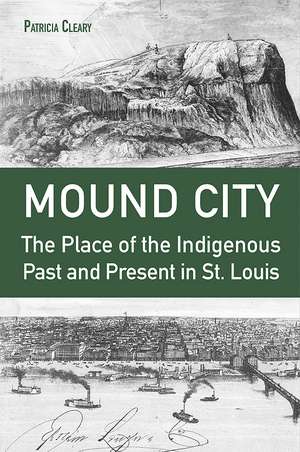
Mound City: The Place of the Indigenous Past and Present in St. Louis
Autor Patricia Clearyen Limba Engleză Paperback – 18 apr 2025
Nearly one thousand years ago, Native peoples built a satellite suburb of America's great metropolis on the site that later became St. Louis. At its height, as many as 30,000 people lived in and around present-day Cahokia, Illinois. While the mounds around Cahokia survive today (as part of a state historic site and UNESCO world heritage site), the monumental earthworks that stood on the western shore of the Mississippi were razed in the 1800s. But before and after they fell, the mounds held an important place in St. Louis history, earning it the nickname “Mound City.” For decades, the city had an Indigenous reputation. Tourists came to marvel at the mounds and to see tribal delegations in town for trade and diplomacy. As the city grew, St. Louisans repurposed the mounds—for a reservoir, a restaurant, and railroad landfill—in the process destroying cultural artifacts and sacred burial sites. Despite evidence to the contrary, some white Americans declared the mounds natural features, not built ones, and cheered their leveling. Others espoused far-fetched theories about a lost race of Mound Builders killed by the ancestors of contemporary tribes. Ignoring Indigenous people's connections to the mounds, white Americans positioned themselves as the legitimate inheritors of the land and asserted that modern Native peoples were destined to vanish. Such views underpinned coerced treaties and forced removals, and—when Indigenous peoples resisted—military action. The idea of the “Vanishing Indian” also fueled the erasure of Indigenous peoples’ histories, a practice that continued in the 1900s in civic celebrations that featured white St. Louisans “playing Indian” and heritage groups claiming the mounds as part of their own history. Yet Native peoples endured and in recent years, have successfully begun to reclaim the sole monumental mound remaining within city limits.
Drawing on a wide range of sources, Patricia Cleary explores the layers of St. Louis’s Indigenous history. Along with the first in-depth overview of the life, death, and afterlife of the mounds, Mound City offers a gripping account of how Indigenous histories have shaped the city’s growth, landscape, and civic culture.
Preț: 218.79 lei
Puncte Express: 328
Carte disponibilă
Livrare economică 09-23 noiembrie
Livrare prin curier în România Termenul estimat este afișat lângă disponibilitate.
Transport gratuit de la 400.00 lei Plată online sau ramburs, în funcție de opțiunile comenzii.
Retur gratuit în 14 zile Comandă securizată și suport în română.
Specificații
ISBN-13: 9780826223364
ISBN-10: 0826223362
Pagini: 462
Ilustrații: 83 color and B&W illus.
Dimensiuni: 152 x 229 x 28 mm
Greutate: 0.85 kg
Editura: University of Missouri Press
Colecția University of Missouri
ISBN-10: 0826223362
Pagini: 462
Ilustrații: 83 color and B&W illus.
Dimensiuni: 152 x 229 x 28 mm
Greutate: 0.85 kg
Editura: University of Missouri Press
Colecția University of Missouri
Recenzii
“Patricia Cleary’s artfully crafted account of St. Louis’s iconic Indian mounds skillfully redresses the systematic erasure of indigenous people and their stories from historical narratives past and present. The book’s superb scholarship and its engaging storyline will make it a must read for academic specialists and history buffs alike and a model for future such studies.”—William E. Foley, author of Wilderness Journey: The Life of William Clark and The Genesis of Missouri: From Wilderness Outpost to Statehood
“A powerfully hard-hitting historical rescue operation.”—Robert Michael Morrissey, University of Illinois, author of People of the Ecotone: Environment and Indigenous Power at the Center of Early America
"In Mound City, Cleary has written an urban history that every American and Canadian city needs, a history that restores the Indigenous past and continuing presence in the urban landscape. As Cleary reminds us, we were all taught to think and see like settlers. With this dense, beautifully written, and impeccably researched history, Cleary helps us all to take off those blinders. She does so with an unsparingly critical eye without ever losing the familial affection for her home city. We expect there to be the opening chapter about the Indigenous past, but in this book Cleary not only brings the Indigenous history of St. Louis into the twentieth century, she shows us how memory and history have shaped each other throughout the centuries. Even as the mounds of this metropolitan region were destroyed and built over, they were appropriated as part of the city’s civic identity. In short, razing and naming have been two sides of the same coin of development. With this book by Cleary and Ned Blackhawk’s recent book, we begin the process of rediscovering America and acknowledging—in Cleary’s words—“its deep and profound connection to Indigenous peoples, distant, recent, and present."—Jay Gitlin, Yale University, author of TheBourgeois Frontier: French Towns, French Traders, and American Expansion
“Although Patricia Cleary’s superb and significant book does not restore the man-made elevations that gave St. Louis its nickname, Mound City allows readers to see what has been cleared from the cityscape: the mounds built by Indians many centuries ago and the more recent history of Indigenous peoples in the creation of the city, their displacement from it, and their continuing struggle against the erasure of their past and presence. Mound City is a major contribution to St. Louis history and a model for how to rewrite urban histories that defy the nineteenth-century myth of ‘vanishing Indians.’”—Stephen Aron, President and CEO, Autry Museum of the American West, author of Peace and Friendship: An Alternative History of the American West
"This groundbreaking book will surprise readers who believe that Indigenous peoples and cultures had little to do with urban development in the United States. With fresh insight, Cleary shows how the ascendance of St. Louis as a major metropolis proceeded hand in hand with a relentless and only partly successful drive among European colonists and their descendants to expunge Native inhabitants and their material traces from the rapidly growing city. Ultimately, Mound City stands as a testament to the enduring Native American presence in an important American city. Cleary brilliantly recounts the desecration and destruction of Indian mounds, but the book is about much more, underscoring America’s failure to come to terms with its Indigenous past. It deserves a place alongside Walter Johnsons’ The Broken Heart of America on your bookshelf."—Andrew Hurley, University of Missouri-St. Louis, author of Beyond Preservation: Using Public History to Revitalize Inner Cities
"Mound City an enlightening, well-researched history that provides readers with a complete view of the creation, use, loss, and legacy of the mounds, alongside dozens of illustrations and images. Whether you’re an avid historian or haven’t encountered the story of the mounds since a grade school field trip, you’ll find interesting details and illuminating narratives in this exhaustive new work.” —St. Louis Magazine
“Drawing on extensive secondary and primary research and including full-color pictures, Cleary brings this history to life.”—Missouri Historical Review
“This book is a wonderful history of St. Louis and settler colonialism and is a thoughtful and well-researched contribution to the literature that documents the extent and nature of white American dispossession of Indigenous peoples.”—H-Net
"Profusely illustrated, this volume by Cleary chronicles the development of the Gateway City and its arch, both of which replaced the mounds."—CHOICE
“Mound City represents a painstaking effort to return Indigenous peoples to the narrative history of St. Louis by examining how the Indigenous presence, human and material, shaped the city even as that presence was appropriated or ignored by the American settler regime.”—American Historical Review
“A powerfully hard-hitting historical rescue operation.”—Robert Michael Morrissey, University of Illinois, author of People of the Ecotone: Environment and Indigenous Power at the Center of Early America
"In Mound City, Cleary has written an urban history that every American and Canadian city needs, a history that restores the Indigenous past and continuing presence in the urban landscape. As Cleary reminds us, we were all taught to think and see like settlers. With this dense, beautifully written, and impeccably researched history, Cleary helps us all to take off those blinders. She does so with an unsparingly critical eye without ever losing the familial affection for her home city. We expect there to be the opening chapter about the Indigenous past, but in this book Cleary not only brings the Indigenous history of St. Louis into the twentieth century, she shows us how memory and history have shaped each other throughout the centuries. Even as the mounds of this metropolitan region were destroyed and built over, they were appropriated as part of the city’s civic identity. In short, razing and naming have been two sides of the same coin of development. With this book by Cleary and Ned Blackhawk’s recent book, we begin the process of rediscovering America and acknowledging—in Cleary’s words—“its deep and profound connection to Indigenous peoples, distant, recent, and present."—Jay Gitlin, Yale University, author of TheBourgeois Frontier: French Towns, French Traders, and American Expansion
“Although Patricia Cleary’s superb and significant book does not restore the man-made elevations that gave St. Louis its nickname, Mound City allows readers to see what has been cleared from the cityscape: the mounds built by Indians many centuries ago and the more recent history of Indigenous peoples in the creation of the city, their displacement from it, and their continuing struggle against the erasure of their past and presence. Mound City is a major contribution to St. Louis history and a model for how to rewrite urban histories that defy the nineteenth-century myth of ‘vanishing Indians.’”—Stephen Aron, President and CEO, Autry Museum of the American West, author of Peace and Friendship: An Alternative History of the American West
"This groundbreaking book will surprise readers who believe that Indigenous peoples and cultures had little to do with urban development in the United States. With fresh insight, Cleary shows how the ascendance of St. Louis as a major metropolis proceeded hand in hand with a relentless and only partly successful drive among European colonists and their descendants to expunge Native inhabitants and their material traces from the rapidly growing city. Ultimately, Mound City stands as a testament to the enduring Native American presence in an important American city. Cleary brilliantly recounts the desecration and destruction of Indian mounds, but the book is about much more, underscoring America’s failure to come to terms with its Indigenous past. It deserves a place alongside Walter Johnsons’ The Broken Heart of America on your bookshelf."—Andrew Hurley, University of Missouri-St. Louis, author of Beyond Preservation: Using Public History to Revitalize Inner Cities
"Mound City an enlightening, well-researched history that provides readers with a complete view of the creation, use, loss, and legacy of the mounds, alongside dozens of illustrations and images. Whether you’re an avid historian or haven’t encountered the story of the mounds since a grade school field trip, you’ll find interesting details and illuminating narratives in this exhaustive new work.” —St. Louis Magazine
“Drawing on extensive secondary and primary research and including full-color pictures, Cleary brings this history to life.”—Missouri Historical Review
“This book is a wonderful history of St. Louis and settler colonialism and is a thoughtful and well-researched contribution to the literature that documents the extent and nature of white American dispossession of Indigenous peoples.”—H-Net
"Profusely illustrated, this volume by Cleary chronicles the development of the Gateway City and its arch, both of which replaced the mounds."—CHOICE
“Mound City represents a painstaking effort to return Indigenous peoples to the narrative history of St. Louis by examining how the Indigenous presence, human and material, shaped the city even as that presence was appropriated or ignored by the American settler regime.”—American Historical Review
Notă biografică
Patricia Cleary is Professor of History at California State University, Long Beach, where she teaches early American history. She is the author of two other books: The World, the Flesh, and the Devil: A History of Colonial St. Louis and Elizabeth Murray: A Woman’s Pursuit of Independence in Eighteenth-Century America.
Cuprins
List of Illustrations/ ix
Acknowledgements/ xiii
List of Abbreviations/ xxi
Introduction/ 3
Chapter One: Metropolis on the Mississippi/ 19
Chapter Two: Indigenous Migration and Early Europeans/ 41
Chapter Three: War and the Missouria Foundation of St. Louis/ 61
Chapter Four: The Indigenous World of Eighteenth-Century St. Louis/ 79
Chapter Five: Claiming the Mounds for the Nation/ 99
Chapter Six: The Indigenous Reputation of “Red-Head’s Town”/ 123
Chapter Seven: Repurposing the Mounds for Urban Development/ 149
Chapter Eight: “Little Hope of Its Standing Fast”: The Big Mound in the 1850s/ 175
Chapter Nine: The Destruction of the Big Mound/ 203
Chapter Ten: Writing the Afterlife of the Mounds/ 225
Chapter Eleven: The Indigenous Past and Present as Local History/ 249
Chapter Twelve: Celebrating Mounds and their Buildersin the Pageant and Masque/ 275
Chapter Thirteen: Commemoration and Preservation/ 297
Chapter Fourteen: Layers of Indigenous Histories/ 315
Afterword/ 343
Notes/ 345
Bibliography/ 399
Index/ 425
Acknowledgements/ xiii
List of Abbreviations/ xxi
Introduction/ 3
Chapter One: Metropolis on the Mississippi/ 19
Chapter Two: Indigenous Migration and Early Europeans/ 41
Chapter Three: War and the Missouria Foundation of St. Louis/ 61
Chapter Four: The Indigenous World of Eighteenth-Century St. Louis/ 79
Chapter Five: Claiming the Mounds for the Nation/ 99
Chapter Six: The Indigenous Reputation of “Red-Head’s Town”/ 123
Chapter Seven: Repurposing the Mounds for Urban Development/ 149
Chapter Eight: “Little Hope of Its Standing Fast”: The Big Mound in the 1850s/ 175
Chapter Nine: The Destruction of the Big Mound/ 203
Chapter Ten: Writing the Afterlife of the Mounds/ 225
Chapter Eleven: The Indigenous Past and Present as Local History/ 249
Chapter Twelve: Celebrating Mounds and their Buildersin the Pageant and Masque/ 275
Chapter Thirteen: Commemoration and Preservation/ 297
Chapter Fourteen: Layers of Indigenous Histories/ 315
Afterword/ 343
Notes/ 345
Bibliography/ 399
Index/ 425