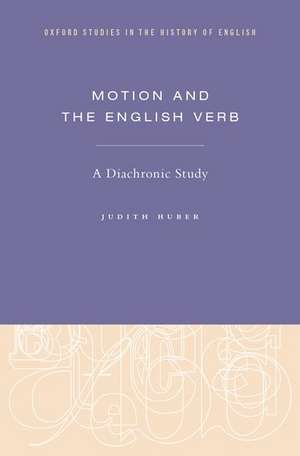
Motion and the English Verb: A Diachronic Study: Oxford Studies in the History of English
Autor Judith Huberen Limba Engleză Hardback – 26 oct 2017
Ne-a atras atenția, în primul rând, rigoarea cu care Judith Huber propune inventare exhaustive de verbe pentru exprimarea mișcării în engleza veche și medie. Volumul Motion and the English Verb nu se limitează la o simplă enumerare, ci oferă studii de caz aplicate pe texte medievale selectate, analizând cum verbe care, la origine, nu denotă deplasarea, capătă sensuri contextuale de mișcare prin utilizarea în construcții intranzitive. Această abordare practică demonstrează stabilitatea modelului „satellite-framing”, în timp ce evidențiază modul în care stilul și tipul de text influențează fuziunea modalităților de exprimare.
Remarcăm metodologia inovatoare prin care sunt analizate verbele de origine franceză, precum „entrer” sau „descendre”. Spre deosebire de studiile tradiționale axate pe traduceri, Huber cercetează integrarea acestora în texte englezești autonome, explicând cum împrumuturile au servit inițial unor contexte metaforice sau abstracte, înainte de a fi asimilate pentru mișcarea literală. Lucrarea reprezintă o alternativă solidă la Carrying Verbs Across the Channel pentru cursurile de lingvistică diacronică, având avantajul unei analize axate pe semantica istorică și pe mecanismele cognitive de împrumut lexical, dincolo de simpla copiere structurală.
Apreciem structura densă a celor 382 de pagini, care transformă o cercetare tipologică într-un instrument de lucru pentru specialiștii în istoria limbii engleze. Publicată sub egida Oxford University Press în seria Oxford Studies in the History of English, această monografie în format hardback clarifică procesul complex prin care contactul multilingv din Evul Mediu a modelat sistemul verbal englez contemporan.


Preț: 768.84 lei
Preț vechi: 1144.37 lei
-33%
Carte tipărită la comandă
Livrare economică 10-16 decembrie
Specificații
ISBN-10: 0190657804
Pagini: 382
Dimensiuni: 241 x 175 x 33 mm
Greutate: 0.66 kg
Editura: Oxford University Press
Colecția OUP USA
Seria Oxford Studies in the History of English
Locul publicării:New York, United States
V-ar putea interesa
-
 A Theory of Linguistic SignsRudi Keller-18%Preț: 370.05 lei449.53 lei
 -
 Approaches to Language TypologyMasayoshi Shibatani-27%Preț: 368.19 lei502.49 lei
 -
 -22%Preț: 148.35 lei191.09 lei
 -
 Secondary Predication and Adverbial Modification: The Typology of DepictivesNikolaus P. Himmelmann-27%Preț: 512.27 lei701.66 lei
 -
 Reflections on MeaningPaul Horwich-18%Preț: 346.99 lei423.98 lei
 -
 Semantics versus PragmaticsZoltan Gendler Szabo-26%Preț: 377.38 lei513.31 lei
 -
 Genetic Linguistics: Essays on Theory and MethodJoseph H. Greenberg-20%Preț: 464.25 lei578.73 lei
 -
 -27%Preț: 437.28 lei603.13 lei
 -
 Real ConditionalsWilliam G. Lycan-18%Preț: 331.69 lei405.07 lei
 -
 I: The Meaning of the First Person TermMaximilian de Gaynesford-32%Preț: 666.98 lei974.96 lei
 -
 Analyzing GrammarPaul R. KroegerPreț: 528.45 lei
 -
 The World of RomePeter V. JonesPreț: 324.19 lei
De ce să citești această carte
Această lucrare este esențială pentru cercetătorii și studenții la filologie interesați de evoluția limbii engleze. Cititorul câștigă o înțelegere profundă a modului în care contactul cu franceza medievală a transformat radical exprimarea mișcării. Este un instrument metodologic impecabil pentru studiul semanticii istorice și al integrării împrumuturilor lexicale în sistemul verbal englez.
Despre autor
Judith Huber este o cercetătoare specializată în lingvistică diacronică și istoria limbii engleze. Prin contribuția sa în cadrul seriei Oxford Studies in the History of English, ea s-a impus ca o voce autoritară în studiul tipologiei mișcării și al contactului lingvistic medieval. Lucrarea de față, publicată de Oxford University Press, reflectă expertiza sa în analiza textelor în engleză veche și medie, concentrându-se pe intersecția dintre semantică, sintaxă și contextul socio-cultural al perioadei medievale.
Descriere
Recenzii
readers will find it informative and helpful in many respects. Huber distinguishes her research with a systematic examination of various Old English dictionaries and reference books ... serves well as a useful resource for postgraduate students and researchers of general linguistics, linguistic typology, first and second language acquisition, cognitive linguistics and corpus linguistics.
The merit of this excellent book lies not only in the detailed analysis of which verbs and which structures are typically used to express motion in Medieval English, but also, and especially, in the identification of the processes underlying the integration of uncommon strategies with the prevailing ones of a language ... an important reference point for subsequent studies on the phenomena of contact and variation in the research field of motion-event typology.
The volume [...] should stand as required reading for future studies of historical semantics, not least thanks to the clarity and thoroughness with which its methodology is set out