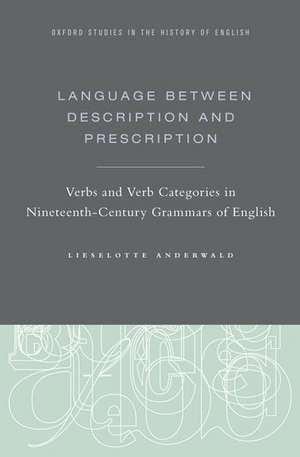
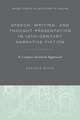
Language Between Description and Prescription: Verbs and Verb Categories in Nineteenth-Century Grammars of English: Oxford Studies in the History of English
Autor Lieselotte Anderwalden Limba Engleză Hardback – 4 aug 2016

Preț: 933.35 lei
Preț vechi: 1353.89 lei
-31%
Puncte Express: 1400
Carte tipărită la comandă
Livrare economică 10-16 decembrie
Livrare prin curier în România Termenul estimat este afișat lângă disponibilitate.
Transport gratuit pentru acest produs Plată online sau ramburs, în funcție de opțiunile comenzii.
Retur gratuit în 14 zile Comandă securizată și suport în română.
Specificații
ISBN-13: 9780190270674
ISBN-10: 0190270675
Pagini: 352
Dimensiuni: 160 x 236 x 33 mm
Greutate: 0.61 kg
Editura: Oxford University Press
Colecția OUP USA
Seria Oxford Studies in the History of English
Locul publicării:New York, United States
ISBN-10: 0190270675
Pagini: 352
Dimensiuni: 160 x 236 x 33 mm
Greutate: 0.61 kg
Editura: Oxford University Press
Colecția OUP USA
Seria Oxford Studies in the History of English
Locul publicării:New York, United States
V-ar putea interesa
-
 The Alice Behind WonderlandSimon Winchester-19%Preț: 85.24 lei105.75 lei
-
 Novels of the Eighteen-FortiesKathleen Tillotson-19%Preț: 282.63 lei349.83 lei
-
 Epic: Britain's Heroic Muse 1790-1910Herbert F. Tucker-10%Preț: 341.03 lei380.75 lei
-
 -31%Preț: 1328.68 lei1929.02 lei
-
 Yeats and ViolenceMichael Wood-13%Preț: 375.75 lei431.29 lei
-
 Words Alone: Yeats and his InheritancesR. F. Foster-15%Preț: 111.39 lei131.61 lei
-
 -30%Preț: 1027.80 lei1472.90 lei
-
 Scottish and Irish RomanticismMurray Pittock-22%Preț: 394.72 lei508.57 lei
-
 -16%Preț: 218.81 lei259.90 lei
-
 Dive Deeper: Journeys with Moby-DickGeorge Cotkin-16%Preț: 219.68 lei262.06 lei
-
 Popular Medievalism in Romantic-Era BritainC. SimmonsPreț: 401.88 lei
-
 Novel Judgements: Legal Theory as FictionWilliam P. MacNeilPreț: 311.83 lei
-
 Preț: 371.68 lei
-
 Graphing Jane AustenJ. CarrollPreț: 393.74 lei
-
 Preț: 90.31 lei
-
 York Notes Companions: Victorian LiteratureBeth PalmerPreț: 89.94 lei
-
 Reading ChekhovJanet MalcolmPreț: 92.23 lei
Recenzii
thoroughly researched and extremely well-written study of language change and grammatical description of Late Modern English verbal syntax.
Notă biografică
Lieselotte Anderwald is Full Professor of English Linguistics at Kiel University, Germany. She specializes in corpus-based variation studies, dialect grammar, and grammar writing in the 19th century.
Cuprins
- Table of Contents
- 1 Introduction
- 1.1 First remarks
- 1.2 Previous research
- 1.2.1 The nineteenth century - still a gap
- 1.2.2 Eighteenth-century grammar writing: Bio-bibliographic studies
- 1.2.3 Studies of prescriptions/proscriptions
- 1.2.4 Correlating grammarians' views with language change
- 1.2.5 After 1800
- 1.3 This book
- 1.3.1 Grammaticography and normativity
- 1.3.2 The grammars: The CNG
- 1.3.3 Corpora employed
- 1.3.4 Background assumptions
- 1.3.5 Terminology used
- 1.4 Structure of this book
- 2 Defining the verb: form, meaning and syntax
- 2.1 Introduction
- 2.2 Defining verbs
- 2.3 Subdividing verbs: from active - passive - neuter to transitive - intransitive
- 2.4 The form of verbs: regular vs. irregular
- 2.4.1 The historical evolution of terminology
- 2.4.2 Defining regular, defining weak
- 2.5 The tenses of English
- 2.5.1 Defining tense
- 2.5.2 The status of the will-future
- 2.5.3 Other future constructions
- 2.5.4 The status of the perfect
- 2.6 Summary
- 3 Variable past tense forms I: strong verbs old and new
- 3.1 Introduction
- 3.2 u/a verbs
- 3.2.1 History of u/a-verbs
- 3.2.2 Corpus data
- 3.2.3 The SING and SLING classes in eighteenth-century grammar writing
- 3.2.4 The SING class in the CNG
- 3.2.5 Shrink in the CNG
- 3.2.6 The SLING class in the CNG
- 3.2.7 Qualitative comments in the CNG
- 3.3 Strong vs. weak verbs
- 3.3.1 Regularization and irregularization
- 3.3.2 Corpus data
- 3.3.3 Thrive, dive, sneak and drag in eighteenth-century grammar writing
- 3.3.4 Thrive in the CNG
- 3.3.5 Dive in the CNG
- 3.4 Summary and discussion
- 4 Variable past tense forms II: irregular weak verbs
- 4.1 Introduction
- 4.2 Weak verbs with vowel change: The DREAM class
- 4.2.1 History and previous studies
- 4.2.2 Corpus data
- 4.2.3 The DREAM class in eighteenth-century grammar writing
- 4.2.4 Kneel in the CNG
- 4.2.5 Dream in the CNG
- 4.2.6 Lean in the CNG
- 4.2.7 Leap in the CNG
- 4.2.8 Plead in the CNG
- 4.2.9 Interim summary
- 4.3 Irregular weak verbs without vowel change: The BURN class
- 4.3.1 History and previous studies
- 4.3.2 Corpus data
- 4.3.3 The BURN class in eighteenth-century grammar writing
- 4.3.4 Dwell in the CNG
- 4.3.5 Spill in the CNG
- 4.3.6 Burn in the CNG
- 4.4 Summary and discussion: Evidence of successful prescription?
- 5 The be-perfect: a grammatical blind spot
- 5.1 Introduction
- 5.2 History and previous studies
- 5.3 Corpus data
- 5.4. The be-perfect in eighteenth-century grammar writing
- 5.5 The be-perfect in the CNG
- 5.5.1 Overview
- 5.5.2 The be-perfect as a passive
- 5.5.3 The be-perfect as a stative construction
- 5.5.4 Evaluating the be-perfect
- 5.6 Summary and discussion
- 6 'A peculiar beauty of our language': The progressive
- 6.1 Introduction
- 6.2. History and previous studies
- 6.3 Corpus data
- 6.4 The progressive in eighteenth-century grammar writing
- 6.4.1 Defining the progressive in eighteenth-century grammar writing
- 6.4.2 Evaluating the progressive in eighteenth-century grammar writing
- 6.5 The progressive in the CNG
- 6.5.1 Defining the progressive
- 6.5.2 The progressive with stative verbs: I am loving, you are loving, they are loving
- 6.5.3 Evaluating the progressive
- 6.6 Summary and discussion
- 7 Two passive constructions
- 7.1 Introduction
- 7.2 'An absurd and monstrous innovation': The progressive passive
- 7.2.1 History and earlier studies
- 7.2.2 Corpus data
- 7.2.3 The passival in eighteenth-century grammar writing
- 7.2.4 The progressive passive in the CNG
- 7.2.5 Evaluating the progressive passive
- 7.2.6 The cultural values transported
- 7.2.7 Interim summary
- 7.3 'Unnecessary words and phrases': The get-passive
- 7.3.1 History and earlier studies
- 7.3.2 Corpus data
- 7.3.3 Get-constructions in eighteenth-century grammar writing
- 7.3.4 Get-constructions in the CNG
- 7.4.5 Prescriptive success?
- 7.4 Summary and discussion
- 8 Summary
- 8.1 Introduction
- 8.2. The prescriptivism of nineteenth-century grammar writing
- 8.3 The success of prescriptivism
- 8.4 Underlying premises of prescriptivism
- 8.5 Cultural key terms
- 8.6 The hyperactive production of English grammars in the nineteenth century