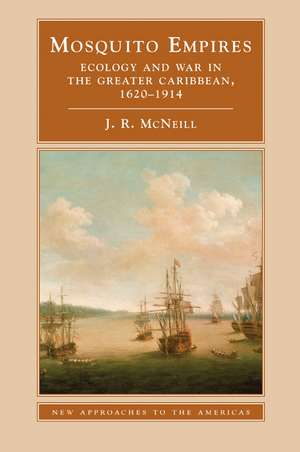
Mosquito Empires: Ecology and War in the Greater Caribbean, 1620–1914: New Approaches to the Americas
Autor J. R. McNeillen Limba Engleză Hardback – 10 ian 2010
Vezi toate premiile Carte premiată
Observăm în Mosquito Empires o abordare inovatoare a istoriei politice prin prisma ecologiei, lucrarea aducând în prim-plan un actor istoric neconvențional: țânțarul. Față de istoriografia tradițională a conflictelor din regiunea Marelui Caraibe, J. R. McNeill demonstrează cum transformările ecologice au creat habitate ideale pentru vectorii febrei galbene și ai malariei, transformând aceste boli în forțe partizane capabile să decidă soarta imperiilor. Apreciem rigoarea cu care autorul documentează modul în care imunitatea diferențiată a populațiilor locale față de cea a nou-veniților europeni a menținut hegemonia spaniolă în secolul al XVII-lea, pentru ca ulterior, în secolele XVIII și XIX, aceleași patogenii să decimeze forțele coloniale, facilitând succesul revoluțiilor din Haiti sau Columbia.
Structura volumului este organizată metodologic pentru a evidenția această evoluție: prima parte stabilește cadrul teoretic al „determinismului țânțarilor”, a doua explorează perioada imperială (exemplele Cartagena și Havana), iar a treia analizează rolul febrei în mișcările de independență. Această lucrare completează perspectiva oferită de Sea and Land de Philip D. Morgan, adăugând o analiză militară și politică specifică asupra impactului bolilor infecțioase, acolo unde Morgan se concentrează mai mult pe mixajul ecologic general. În contextul operei sale, volumul rafinează temele explorate în Rethinking Environmental History, aplicând conceptele de istorie globală a mediului pe un studiu de caz regional extrem de bine definit. Tonul este cel al unei analize academice lucide, evitând simplificările și oferind o perspectivă nuanțată asupra modului în care biologia a interacționat cu strategia militară timp de trei secole.
Din seria New Approaches to the Americas
-
 Preț: 141.04 lei
 -
 Preț: 208.59 lei
 -
 Preț: 206.18 lei
 -
 Preț: 163.17 lei
 -
 Preț: 196.56 lei
 -
 Preț: 163.38 lei
 -
 Preț: 209.37 lei
 -
 Preț: 231.14 lei
 -
 Preț: 177.73 lei
 -
 Preț: 207.48 lei
 -
 Preț: 206.58 lei
 -
 Preț: 244.24 lei
 -
 Preț: 247.03 lei
 - 5%
 Preț: 251.91 lei
 -
 Preț: 209.37 lei
 -
 Preț: 232.08 lei
 -
 Preț: 208.31 lei
 -
 Preț: 249.56 lei
Preț: 645.14 lei
Preț vechi: 724.87 lei
-11%
Carte tipărită la comandă
Livrare economică 29 iunie-13 iulie
Specificații
ISBN-10: 0521452864
Pagini: 390
Ilustrații: 12 maps
Dimensiuni: 152 x 229 x 25 mm
Greutate: 0.73 kg
Editura: Cambridge University Press
Colecția Cambridge University Press
Seria New Approaches to the Americas
Locul publicării:New York, United States
V-ar putea interesa
-
 This Orient IsleJerry Brotton-20%Preț: 74.36 lei92.69 lei
 -
 The Voynich ManuscriptRaymond ClemensPreț: 358.27 lei
 -
 Preț: 242.57 lei
 -
 Preț: 437.97 lei
 -
 Preț: 194.46 lei
 -
 War and Conflict in the Early Modern WorldBrian SandbergPreț: 245.04 lei
 -
 A Companion to Global Environmental HistoryJ R McNeillPreț: 376.71 lei
 -
 -15%Preț: 411.88 lei484.56 lei
 -
 -27%Preț: 68.09 lei93.01 lei
 -
 -18%Preț: 871.95 lei1063.36 lei
De ce să citești această carte
Recomandăm această carte istoricilor, cercetătorilor în științe politice și celor interesați de istoria medicinei. Cititorul va câștiga o înțelegere profundă a modului în care factorii de mediu, adesea ignorați în manualele clasice, pot dicta rezultatul unor războaie și prăbușirea unor imperii. Este o demonstrație magistrală a modului în care ecologia a modelat harta politică a Americilor.
Despre autor
J. R. McNeill este profesor universitar la Departamentul de Istorie al Universității Georgetown. Este un pionier recunoscut în domeniul istoriei mediului, fiind autorul unor lucrări de referință precum Something New Under the Sun și co-autor, alături de tatăl său William H. McNeill, al volumului The Human Web. Expertiza sa acoperă transformările ecologice la scară globală, fiind premiat de organizații prestigioase precum World History Association. Prin contribuțiile sale în serii precum The Cambridge World History, McNeill a redefinit modul în care interacțiunea dintre om și natură este integrată în narațiunea istorică modernă.
Descriere scurtă
Cuprins
Recenzii
'J. R. McNeill's new book does more than exhibit his usual gifts - breadth of range, mastery of material, depth of insight, freedom of thought, clarity of expression. It has changed the way I think about empires of the eighteenth and nineteenth centuries and will challenge many readers' assumptions about the limits of human agency in shaping great events.' Felipe Fernandez-Armesto, University of Notre Dame
'In this authoritative and engaging book, J. R. McNeill argues convincingly that disease played a pivotal role in many of the momentous events of Caribbean history. He shows how the region's disease ecology changed following the advent of European colonization and how this served and then subverted the interests of the Caribbean's oldest colonial powers. Mosquito Empires is indispensable to any student of Caribbean history or the history of disease.' Mark Harrison, Wellcome Unit for the History of Medicine, University of Oxford
'Who would have guessed that the mosquito played such a vital role, shaping the fate of empires and revolutions, in such a vitally important part of the world? This provocative book is an eye-opener, written with great verve and wit.' Philip Morgan, Johns Hopkins University
'Drawing on an enormous documentary source base, culled from many archives and texts in several languages, and ranging effortlessly across military history and medical science, J. R. McNeill's book is a major achievement. Henceforth, histories of empire, warfare, and international relations that neglect the environmental context of the events they recount will be seriously deficient.' Gabriel Paquette, Times Literary Supplement
'J. R. McNeil has written a book full of revelations that left me astounded and eager to assign it to my students. Mosquito Empires is beautifully paced, well-researched, convincing, and important. It also left me more than a little envious: I wish I had written this book.' Environment and History
'… this book offers a scholarly but well-written narrative and analysis of a crucial theme in Latin American and Caribbean history.' Jonathan D. Ablard, H-LatAm
Premii
- PROSE Winner, 2010