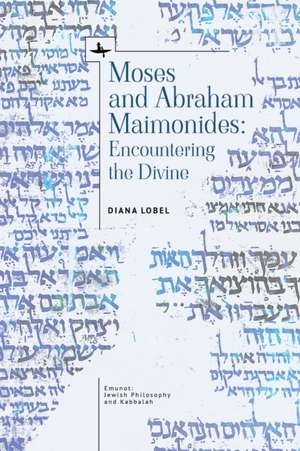
Moses and Abraham Maimonides: Encountering the Divine: Emunot: Jewish Philosophy and Kabbalah
Autor Diana Lobelen Limba Engleză Paperback – 21 iun 2022
Moses Maimonides—a proud heir to the Andalusian tradition of Aristotelian philosophy—crafted a bold and original philosophical interpretation of Torah and Judaism. His son Abraham Maimonides is a fascinating maverick whose Torah commentary mediates between the philosophical interpretations of his father, the contextual approach of Biblical exegetes such as Saadya, and the Sufi-flavored illuminative mysticism of his Egyptian Pietist circle. This pioneering study explores the intersecting approaches of Moses and Abraham Maimonides to the spark of divine illumination and revelation of the divine name Ehyeh asher Ehyeh, “I am that I am / I will be who I will be.”
Din seria Emunot: Jewish Philosophy and Kabbalah
- 20%
 Preț: 499.74 lei
 - 23%
 Preț: 859.28 lei
 - 23%
 Preț: 915.18 lei
 -
 Preț: 374.81 lei
 - 26%
 Preț: 548.43 lei
 - 26%
 Preț: 586.10 lei
 - 34%
 Preț: 499.09 lei
 - 26%
 Preț: 643.46 lei
 - 25%
 Preț: 509.39 lei
 - 24%
 Preț: 500.55 lei
 -
 Preț: 228.46 lei
 -
 Preț: 316.81 lei
 - 26%
 Preț: 591.41 lei
 - 23%
 Preț: 847.82 lei
 - 21%
 Preț: 235.36 lei
 - 25%
 Preț: 735.08 lei
 - 25%
 Preț: 509.26 lei
 - 26%
 Preț: 638.77 lei
 - 26%
 Preț: 589.30 lei
 - 25%
 Preț: 638.27 lei
 -
 Preț: 217.84 lei
 - 25%
 Preț: 500.01 lei
 - 9%
 Preț: 593.92 lei
Preț: 218.51 lei
Puncte Express: 328
Carte disponibilă
Livrare economică 10-24 noiembrie
Livrare express 27-31 octombrie pentru 27.14 lei
Livrare prin curier în România Termenul estimat este afișat lângă disponibilitate.
Transport gratuit de la 400.00 lei Plată online sau ramburs, în funcție de opțiunile comenzii.
Retur gratuit în 14 zile Comandă securizată și suport în română.
Specificații
ISBN-13: 9781644695371
ISBN-10: 1644695375
Pagini: 238
Ilustrații: Bibliography
Dimensiuni: 156 x 234 x 13 mm
Editura: Academic Studies Press
Colecția Academic Studies Press
Seria Emunot: Jewish Philosophy and Kabbalah
Locul publicării:Boston, MA, United States
ISBN-10: 1644695375
Pagini: 238
Ilustrații: Bibliography
Dimensiuni: 156 x 234 x 13 mm
Editura: Academic Studies Press
Colecția Academic Studies Press
Seria Emunot: Jewish Philosophy and Kabbalah
Locul publicării:Boston, MA, United States
Cuprins
Table of Contents
AcknowledgmentsIntroduction
Part One. Maimonides and Abraham Maimonides on Created Light, Created Word, and the Evant at Mount Sinai
1. Abraham Maimonides on Created Light in the Cleft of the Rock: Exodus 33:22
2. Maimonides on Created Light: An Esoteric Interpretation
3. Abraham and Moses Maimonides on Cloud and Glory: Exodus 16:9–10/Guide III:9
4. Abraham Maimonides on Created Light in the Preparation for the Sinai Event
5. Maimonides on the Theophany at Mount Sinai
6. Abraham Maimonides on the Created Word at Mount Sinai: Between Maimonides and R. Abraham he-Ḥasid
7. Abraham and Moses Maimonides on Created Light in the Vision of the Nobles
Part Two. Ehyeh asher Ehyeh and the Tetragrammaton: Between Eternity and Necessary Existence
8. Introduction: Ehyeh asher Ehyeh and the Tetragrammaton
9. Rabbinic Interpretations of Ehyeh asher Ehyeh
10. The Interpretation of Saadya Gaon
11. Saadya’s Long Commentary to Exodus 3:13–15
12. Abraham Maimonides on Saadya Gaon
13. The Interpretation of Maimonides
14. Abraham on Eternity and Relationship
Conclusion
Recenzii
“…Moses and Abraham Maimonides: Encountering the Divine, offers us a far more nuanced comparison of Abraham and Moses Maimonides than we have previously seen. Lobel presents a valuable portrait of the interplay between Maimonides’s philosophy and his inner religious life and spiritual practices. …Lobel’s book provides an excellent comparison between the thought of Moses and Abraham Maimonides. Her contributions to the scholarship, though subtle and nuanced, are certainly important. It is definitely a worthwhile read for anyone interested in Moses or Abraham Maimonides. …She identifies nuanced differences and puts to rest facile oversimplifications. It is the start of the study, though, not the end. There remain important questions that, as Pines wrote, ‘“need further investigation.’””
— David Fried, The Lehrhaus
“Reading Lobel’s book, one gets a vivid impression of scholarship as a joint venture and a communal affair. The reader will not find in her study breakthroughs and new directions that are going against the current of the main scholarly stream. Rather, the book presents thoughtful and stimulating discussions that elaborate, reinforce, and complement investigations made by other scholars in the field.”
— Ehud Krinis, Speculum: A Journal of Medieval Studies
— David Fried, The Lehrhaus
“Reading Lobel’s book, one gets a vivid impression of scholarship as a joint venture and a communal affair. The reader will not find in her study breakthroughs and new directions that are going against the current of the main scholarly stream. Rather, the book presents thoughtful and stimulating discussions that elaborate, reinforce, and complement investigations made by other scholars in the field.”
— Ehud Krinis, Speculum: A Journal of Medieval Studies