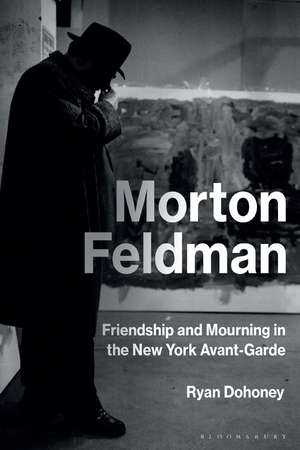
Morton Feldman: Friendship and Mourning in the New York Avant-Garde
Autor Prof Ryan Dohoneyen Limba Engleză Paperback – 24 mar 2022
Preț: 165.88 lei
Preț vechi: 213.22 lei
-22%
Puncte Express: 249
Carte disponibilă
Livrare economică 24 octombrie-07 noiembrie
Livrare express 13-17 octombrie pentru 73.91 lei
Livrare prin curier în România Termenul estimat este afișat lângă disponibilitate.
Transport gratuit de la 400.00 lei Plată online sau ramburs, în funcție de opțiunile comenzii.
Retur gratuit în 14 zile Comandă securizată și suport în română.
Specificații
ISBN-13: 9781501345456
ISBN-10: 1501345451
Pagini: 232
Ilustrații: 23 images
Dimensiuni: 152 x 224 x 18 mm
Greutate: 0.36 kg
Editura: Bloomsbury Publishing
Colecția Bloomsbury Academic
Locul publicării:New York, United States
ISBN-10: 1501345451
Pagini: 232
Ilustrații: 23 images
Dimensiuni: 152 x 224 x 18 mm
Greutate: 0.36 kg
Editura: Bloomsbury Publishing
Colecția Bloomsbury Academic
Locul publicării:New York, United States
V-ar putea interesa
-
 Getting a Handel on MessiahDavid W. BarberPreț: 82.24 lei
 -
 Audible Signs: Essays from a Musical GroundMichael Alec Rose-17%Preț: 191.36 lei230.31 lei
 -
 Giants LeapBob CampbellPreț: 258.01 lei
 -
 Ivo Papazov’s BalkanologyCarol Silverman-16%Preț: 127.72 lei152.72 lei
 -
 A Women’s History of the BeatlesProf Christine Feldman-Barrett-38%Preț: 709.61 lei1148.18 lei
 -
 Pearl Jam's Vs.Clint Brownlee-32%Preț: 50.97 lei75.51 lei
 -
 Donna Summer's Once Upon a TimeAlex Jeffery-32%Preț: 51.08 lei75.28 lei
 -
 Sam Cooke’s Live at the Harlem Square Club, 1963Colin Fleming-33%Preț: 50.48 lei75.22 lei
 -
 Carole King's TapestryLoren Glass-33%Preț: 50.01 lei74.73 lei
 -
 21st-Century Dylan: Late and TimelyDr. Laurence Estanove-33%Preț: 614.37 lei911.10 lei
 -
 -13%Preț: 354.23 lei405.78 lei
 -
 ämanacionnyj metod monitoringa geodinamicheskih qwlenijValerij Rudakow-8%Preț: 526.01 lei571.75 lei
 -
 Uprawlenie finansowymi aktiwami w uslowiqh neopredelennostiSergej Vawilow-8%Preț: 585.92 lei636.87 lei
 -
 Riski rossijskoj äkonomikiLeonid Andreewich Iwanchenko-8%Preț: 557.41 lei605.88 lei
 -
 Stress-protektornye peptidy s kortikotropinpodobnoj strukturojElena Nawolockaq-8%Preț: 398.18 lei432.80 lei
 -
 Prinqtie reshenij po kachestwennym kriteriqmViktor RozenPreț: 404.20 lei
 -
 Jelektromagnitnoe äkranirowanie, T.2Stanislaw Mihajlowich Apollonskij-8%Preț: 526.46 lei572.24 lei
 -
 Sarmatskie glinyJurij Olqnskij-8%Preț: 528.23 lei574.16 lei
 -
 -8%Preț: 527.14 lei572.98 lei
 -
 A Counterpoint of Characters: the Music of Michael ColgrassJeffrey BoeckmanPreț: 311.78 lei
 -
 SuiteEduard HanslickPreț: 299.70 lei
 -
 Bach Händel MendelssohnJulius SchumannPreț: 350.73 lei
 -
 Johannes Brahms und seine MusikRichard BarthPreț: 214.05 lei
 -
 Die Familie Mendelssohn 1827 - 1847Sebastian HenselPreț: 459.06 lei
Cuprins
List of Illustrations
Introduction
1. Spontaneity, Intimacy, and Friendship in the 1950s
2. "Élan vital . and how to fake it"
Intermission: The Necessary Other
3. The Elegiac Science
4. "We broke up because of style"
Conclusion: Friendship's Silence
Acknowledgments
Bibliography
Index
Introduction
1. Spontaneity, Intimacy, and Friendship in the 1950s
2. "Élan vital . and how to fake it"
Intermission: The Necessary Other
3. The Elegiac Science
4. "We broke up because of style"
Conclusion: Friendship's Silence
Acknowledgments
Bibliography
Index
Recenzii
The book bears powerful testament to his proposal that in writing about friendships mediated through painting, poetry and music one can derive new insights into that painting, poetry and music.
Dohoney's graceful and affecting meditation on the plexus of Feldman's relationships compellingly surveys Feldman's dedication-and his dedications-to his friends, his love for poetry, painting, and for their makers, and the mourning and melancholy that ultimately tied them together. Feldman's music becomes increasingly concerned, in Dohoney's vivid account, with what survives, what endures, and what can still be heard, even as it ebbs.
Ryan Dohoney's book distinctively illuminates and contextualizes Morton Feldman's modernist music. It is an account of Feldman's relationships, in particular, with the poet and art writer Frank O'Hara and the visual artist Philip Guston. Two large themes emerge, friendship and death. This is a new kind of musicology, with much detailed historical research that also finds emotional elements central to understanding the music, an affective account of what Feldman would call his life in art. It puts together the personal and what we have "out there," the music.
Ryan Dohoney's fantastic book on Morton Feldman points to a Copernican turn within studies of the social life of the arts: trapped for decades in the domain of theme and anecdote, friendship here emerges instead as the infrastructure or medium it in fact is. Friendship thus does not "contextualize" Feldman's music from the outside, but rather enables and structures it from within, like the charged gaps between his notes.
Dohoney's graceful and affecting meditation on the plexus of Feldman's relationships compellingly surveys Feldman's dedication-and his dedications-to his friends, his love for poetry, painting, and for their makers, and the mourning and melancholy that ultimately tied them together. Feldman's music becomes increasingly concerned, in Dohoney's vivid account, with what survives, what endures, and what can still be heard, even as it ebbs.
Ryan Dohoney's book distinctively illuminates and contextualizes Morton Feldman's modernist music. It is an account of Feldman's relationships, in particular, with the poet and art writer Frank O'Hara and the visual artist Philip Guston. Two large themes emerge, friendship and death. This is a new kind of musicology, with much detailed historical research that also finds emotional elements central to understanding the music, an affective account of what Feldman would call his life in art. It puts together the personal and what we have "out there," the music.
Ryan Dohoney's fantastic book on Morton Feldman points to a Copernican turn within studies of the social life of the arts: trapped for decades in the domain of theme and anecdote, friendship here emerges instead as the infrastructure or medium it in fact is. Friendship thus does not "contextualize" Feldman's music from the outside, but rather enables and structures it from within, like the charged gaps between his notes.