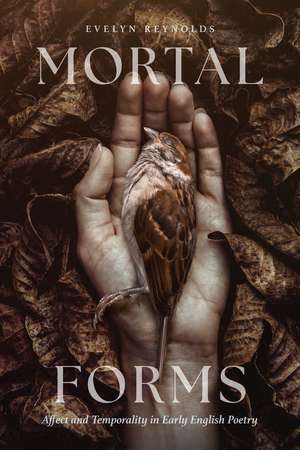
Mortal Forms: Affect and Temporality in Early English Poetry: Interventions: New Studies in Medieval Culture
Autor Evelyn Reynoldsen Limba Engleză Hardback – 17 feb 2026
In Mortal Forms, Evelyn Reynolds introduces the concept of the “absorption-denial dynamic” to explore how medieval English poetic forms simultaneously invite and resist imaginative and affective engagement. She thus offers a model for understanding how language engages audiences with that which is beyond language. This new methodology helps us understand how poetic forms communicate the unspeakable—especially of loss and grief, pain and disgust, joy and eternity—without circumscribing it. Connecting medieval English poetics to modern aesthetic theory and broader questions about the limits of representation, Reynolds considers Old and Middle English poems alongside one another and reads texts achronologically, thus revising standard histories of English poetics that insist on dramatic change from Old to Middle English. Overall, Reynolds deftly deploys her innovative theoretical framework to attend to how medieval poems, from Beowulf to Piers Plowman, navigate the limits of the unspeakable—and thus to develop an understanding of poetics that can enrich our capacity to meet the losses of our own time.
Din seria Interventions: New Studies in Medieval Culture
- 18%
 Preț: 723.03 lei
 -
 Preț: 269.82 lei
 -
 Preț: 241.40 lei
 -
 Preț: 241.40 lei
 -
 Preț: 246.01 lei
 -
 Preț: 282.89 lei
 -
 Preț: 293.47 lei
 -
 Preț: 302.83 lei
 -
 Preț: 301.72 lei
 -
 Preț: 266.28 lei
 -
 Preț: 301.72 lei
 -
 Preț: 301.72 lei
 -
 Preț: 297.08 lei
 -
 Preț: 249.85 lei
 -
 Preț: 249.61 lei
 -
 Preț: 287.57 lei
 -
 Preț: 152.87 lei
 -
 Preț: 236.86 lei
 -
 Preț: 240.41 lei
 -
 Preț: 253.89 lei
 -
 Preț: 287.57 lei
 -
 Preț: 287.57 lei
 -
 Preț: 274.08 lei
 -
 Preț: 267.35 lei
 -
 Preț: 274.08 lei
 - 23%
 Preț: 562.39 lei
Preț: 613.87 lei
Preț vechi: 757.86 lei
-19% Precomandă
Puncte Express: 921
Preț estimativ în valută:
108.68€ • 126.55$ • 94.41£
108.68€ • 126.55$ • 94.41£
Carte nepublicată încă
Doresc să fiu notificat când acest titlu va fi disponibil:
Se trimite...
Preluare comenzi: 021 569.72.76
Specificații
ISBN-13: 9780814216064
ISBN-10: 0814216064
Pagini: 212
Dimensiuni: 152 x 229 mm
Editura: Ohio State University Press
Colecția Ohio State University Press
Seria Interventions: New Studies in Medieval Culture
ISBN-10: 0814216064
Pagini: 212
Dimensiuni: 152 x 229 mm
Editura: Ohio State University Press
Colecția Ohio State University Press
Seria Interventions: New Studies in Medieval Culture
Recenzii
“Reynolds brilliantly reimagines the relationship between form and temporality in medieval poetry. Challenging traditional storytelling paradigms, her concept of ‘dynamic stillness’ reveals narratives that transcend the constraints of end-oriented forms. Crucially, she challenges assumptions about affect, demonstrating that there are indeed different types of affective response, and different ways of stimulating them. Her incisive close readings and innovative approach to transience, embodiment, and feeling make Mortal Forms a groundbreaking contribution to early English poetry studies.” —Rebecca Davis, author of “Piers Plowman” and the Books of Nature
“By tracking how poems express the inexpressible through repetition, opposition, and rhythm from Old English to Middle English and beyond, Reynolds challenges strict temporal and linguistic divisions between literary periods. Mortal Forms carries important implications for postmedieval scholars working on poetics, New Formalism, and affect theory.” —Alex Mueller, author of Translating Troy: Provincial Politics in Alliterative Romance
“Reynolds’s close readings, which include seeing the representation of the crucifixion in Piers Plowman as present but ‘vanishing’ and showing how the earthly and heavenly gardens in Pearl are embedded one inside the other, offer fascinating new ways into the texts.” —Christopher Cannon, author of From Literacy to Literature: England, 1300–1400
“Mortal Forms brings a new perspective to medieval English eschatological poetry, showing how its peculiar aesthetic both invites readerly immersion in the contemplation of last things and precludes any genuine engagement with the ineffability of death and its real significance.” —R. D. Fulk, coauthor of A History of Old English Literature
Notă biografică
Evelyn Reynolds holds a PhD in medieval English literature and an MFA in poetry from Indiana University. She has published on medieval texts from Beowulf to Margery Kempe. Her research interests include Old and Middle English literature, poetry and poetics, ecocriticism, and religious studies.
Extras
How does poetry grip its readers? When someone reads a poem, how do its forms—including personification, metonymy, alliteration, or imagery—work? In this book, I argue that poetic forms actually push against our capacities for imagination and feeling, just as much as they invite or activate our abilities to picture and sympathize, by creating senses of distance, bewilderment, confusion, and exclusion. That counterintuitive claim may seem to contradict decades of analyses of how poetry works. But I want to argue that attending to poems’ resistances is just as important as attending to their invitations. A form’s power lies both in its ability to baffle as well as in its ability to evoke images and feelings that parallel the text. Furthermore, attending to this formal paradox allows us to consider how language activates imagination and affect to experience, even to inhabit, far larger issues, such as the interplays between time and eternity, presence and absence, sympathy and bewilderment.
In this book, I take up a set of premodern poems, namely, Old and Middle English texts on transience, that can help us explore such issues. I choose these texts because they often use some of the most intense poetic forms—and may stir some of the deepest affective reactions—of any texts in early English poetry. Loss, suffering, grief, death, decay, and whatever may follow in the hereafter push language to attempt to communicate the incommunicable—the depths of fear or, perhaps, hope; the magnitude of loss; and our expectations for eternity. By attending both to how these poems invite and how they disrupt readerly engagement, we can trace how, even in the experience of reading about transience, a lived permanence becomes possible through form. In essence, by both activating and interrupting picturing and feeling, forms create a sense of stillness that contradicts the very scenes of loss these poems depict. We can examine this formal interplay through a framework that I call the absorption-denial dynamic. The product of poetic forms establishing the absorption-denial dynamic is this sense of dynamic stillness, of suspension or attention. The absorption-denial dynamic and its resulting possibility for stillness can help us consider afresh how poetry responds to grief, loss, and death, how transience and eternity may coinhere in art, and how poetic forms can trace the boundaries of the ineffable.
One early English poem that grapples with decay is the thirteenth-century The Grave. It dwells upon death’s visceral aspects. Yet, if we attend to how forms harmonize in The Grave, we can track how they shape a stillness that contradicts their own representation of transience. The poem’s guiding metaphor of grave as house upholds this tension: the text seems to describe life as movement toward death, while the metaphor actually extends a sense of stable inevitability...The Grave’s first line states mortality as indisputable fact. In the poem’s metaphor, the grave exists as home for the human body before that body is born, “er ðu of moder come” [before you came from [your] mother]. This metaphor might elicit horror and hopelessness. Life is lost before we live it. Death is inevitable and final. As the poem describes the house’s roof—the grave’s dirt—closing down on the addressee’s body, it shuts them inside the problem of mortality: Ought one to reject the earthly house because it resembles the grave? Or ought one to spend life grieving for all that is lost?
In this book, I take up a set of premodern poems, namely, Old and Middle English texts on transience, that can help us explore such issues. I choose these texts because they often use some of the most intense poetic forms—and may stir some of the deepest affective reactions—of any texts in early English poetry. Loss, suffering, grief, death, decay, and whatever may follow in the hereafter push language to attempt to communicate the incommunicable—the depths of fear or, perhaps, hope; the magnitude of loss; and our expectations for eternity. By attending both to how these poems invite and how they disrupt readerly engagement, we can trace how, even in the experience of reading about transience, a lived permanence becomes possible through form. In essence, by both activating and interrupting picturing and feeling, forms create a sense of stillness that contradicts the very scenes of loss these poems depict. We can examine this formal interplay through a framework that I call the absorption-denial dynamic. The product of poetic forms establishing the absorption-denial dynamic is this sense of dynamic stillness, of suspension or attention. The absorption-denial dynamic and its resulting possibility for stillness can help us consider afresh how poetry responds to grief, loss, and death, how transience and eternity may coinhere in art, and how poetic forms can trace the boundaries of the ineffable.
One early English poem that grapples with decay is the thirteenth-century The Grave. It dwells upon death’s visceral aspects. Yet, if we attend to how forms harmonize in The Grave, we can track how they shape a stillness that contradicts their own representation of transience. The poem’s guiding metaphor of grave as house upholds this tension: the text seems to describe life as movement toward death, while the metaphor actually extends a sense of stable inevitability...The Grave’s first line states mortality as indisputable fact. In the poem’s metaphor, the grave exists as home for the human body before that body is born, “er ðu of moder come” [before you came from [your] mother]. This metaphor might elicit horror and hopelessness. Life is lost before we live it. Death is inevitable and final. As the poem describes the house’s roof—the grave’s dirt—closing down on the addressee’s body, it shuts them inside the problem of mortality: Ought one to reject the earthly house because it resembles the grave? Or ought one to spend life grieving for all that is lost?
Cuprins
Contents
Introduction
Chapter 1 The Vanishing World: Defining a Poetics of Transience
Chapter 2 The Vanishing Self: Dynamism, Stasis, and Denial
Chapter 3 The Vanishing Eternal: Representing Divine Mortality
Chapter 4 Beyond Transience: Immanent Eternity
Epilogue
Acknowledgments
Bibliography
Index
Introduction
Chapter 1 The Vanishing World: Defining a Poetics of Transience
Chapter 2 The Vanishing Self: Dynamism, Stasis, and Denial
Chapter 3 The Vanishing Eternal: Representing Divine Mortality
Chapter 4 Beyond Transience: Immanent Eternity
Epilogue
Acknowledgments
Bibliography
Index
Descriere
Freshly theorizes how medieval English poetic forms communicate the unspeakable (grief, pain, eternity), revealing previously unrecognized commonalities among Old and Middle English poems.