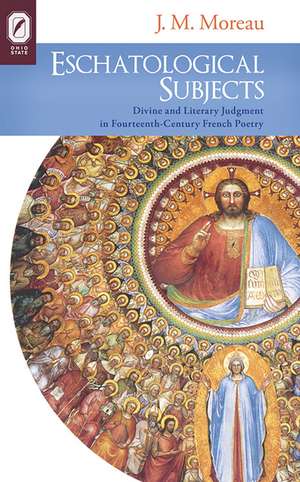
Eschatological Subjects: Divine and Literary Judgment in Fourteenth-Century French Poetry: Interventions: New Studies in Medieval Culture
Autor J. M. Moreauen Limba Engleză Paperback – iun 2016
Eschatological Subjects: Divine and Literary Judgment in Fourteenth-Century French Poetry takes an innovative approach to medieval eschatology by examining how poets cast themselves in the scene of judgment as defendants summoned to answer to the Almighty for the sins of their writing. Since medieval Europeans lived in perpetual anxiety of divine judgment, constantly surrounded by reminders in art and literature, author J. M. Moreau shows that this is a natural extension of medieval life. But Eschatological Subjects goes even further to demonstrate the largely unrecognized duality of this judge figure: not just God, the judge is also the imperious and imperfect human reader. The simultaneous divine and human judgments in (and of) French poetry reveal much about the ethical stakes of writing vernacular poetry in the later Middle Ages and, most importantly, about the relationships between authors and audiences. Focusing on Guillaume de Deguileville, Guillaume de Machaut, and Jean Froissart (each of whom composed scenes in which they appear on trial before God), Moreau contributes important new insights on the complex “trial process” of later medieval literature, in which poetic authority and fame depended on the poet’s ability to defend himself before a fearful court of reader opinion.
Din seria Interventions: New Studies in Medieval Culture
- 18%
 Preț: 722.98 lei
 -
 Preț: 269.82 lei
 -
 Preț: 241.40 lei
 -
 Preț: 246.01 lei
 -
 Preț: 282.89 lei
 -
 Preț: 293.47 lei
 -
 Preț: 302.83 lei
 -
 Preț: 301.72 lei
 -
 Preț: 266.28 lei
 -
 Preț: 301.72 lei
 -
 Preț: 301.72 lei
 -
 Preț: 297.08 lei
 -
 Preț: 249.61 lei
 -
 Preț: 287.57 lei
 -
 Preț: 152.87 lei
 -
 Preț: 236.86 lei
 -
 Preț: 240.41 lei
 -
 Preț: 253.89 lei
 -
 Preț: 287.57 lei
 -
 Preț: 287.57 lei
 -
 Preț: 274.08 lei
 -
 Preț: 274.08 lei
 - 23%
 Preț: 565.23 lei
 -
 Preț: 267.35 lei
 - nou
 Preț: 618.23 lei
 - nou
 Preț: 567.86 lei
Preț: 241.40 lei
Puncte Express: 362
Preț estimativ în valută:
42.68€ • 49.96$ • 37.27£
42.68€ • 49.96$ • 37.27£
Carte tipărită la comandă
Livrare economică 06-20 martie
Preluare comenzi: 021 569.72.76
Specificații
ISBN-13: 9780814253007
ISBN-10: 0814253008
Pagini: 248
Dimensiuni: 152 x 229 x 18 mm
Greutate: 0.31 kg
Ediția:1
Editura: Ohio State University Press
Colecția Ohio State University Press
Seria Interventions: New Studies in Medieval Culture
ISBN-10: 0814253008
Pagini: 248
Dimensiuni: 152 x 229 x 18 mm
Greutate: 0.31 kg
Ediția:1
Editura: Ohio State University Press
Colecția Ohio State University Press
Seria Interventions: New Studies in Medieval Culture
V-ar putea interesa
-
 A Late Fifteenth-Century Dominical Sermon CycleStephen Morrison-33%Preț: 809.21 lei1211.84 lei
 -
 Sophoclea: Studies on the Text of SophoclesHugh Lloyd-Jones-37%Preț: 530.72 lei844.17 lei
 -
 -34%Preț: 600.90 lei908.67 lei
 -
 -13%Preț: 223.18 lei256.14 lei
 -
 Venantius Fortunatus: A Latin Poet in Merovingian GaulJudith W. George-34%Preț: 628.80 lei959.02 lei
 -
 Lancelot and the Grail: A Study of the Prose `Lancelot'Elspeth Kennedy-19%Preț: 349.13 lei432.94 lei
 -
 -35%Preț: 405.18 lei620.80 lei
 -
 Preț: 195.74 lei
 -
 A Guide to Old EnglishBruce MitchellPreț: 301.64 lei
 -
 Homer the PreclassicGregory Nagy-23%Preț: 492.45 lei639.55 lei
 -
 Claudian and the Roman Epic TraditionCatherine Ware-14%Preț: 682.78 lei793.94 lei
 -
 Preț: 349.49 lei
 -
 Sir Gawain and the Green KnightJoseph Glaser-13%Preț: 88.53 lei101.43 lei
 -
 -12%Preț: 76.30 lei86.67 lei
 -
 Ovid: Amores III, a Selection: 2, 4, 5, 14Jennifer Ingleheart-19%Preț: 146.80 lei181.71 lei
Recenzii
“Eschatological Subjects proposes a fresh and innovative take on the fourteenth-century nature of authorship and manuscript production. This is a mature and articulate work of scholarship.” —Zrinka Stahuljak, University of California, Los Angeles
“Eschatological Subjects provides a fresh, persuasive, and informed assessment of judgment poetry that moves well beyond the limits of recent studies of this genre. Moreau reveals that judgment poems were not simply playful pieces intended as light entertainment for court culture; instead, these texts reveal the deep ethical concerns experienced by authors who recognized that judgment of their writing by readers was both inescapable and morally significant. It is a refreshing and thoughtful take on issues that have dominated francophone medieval studies.” —Deborah McGrady, University of Virginia
Notă biografică
J. M. Moreau was a Mellon Postdoctoral Fellow of French Studies and Comparative Literature at Brown University. He is now an independent scholar.
Cuprins
IntroductIon Literature as Eschatological Scene I. La sce`ne judiciaire: Big and Little Judges II. The Eschatological Proce`s III. Scope of the Book and Chapter Outline Chapter 1 Representation in Heaven: the Thirteenth- and Fourteenth-Century Rhetor Divinus I. Quid sum miser tunc dicturus? II. From Legal Subject to Eschatological Subject III. Human Rights and the Devil’s Rights: The Virgin’s Divine Advocacy IV. Divine Rhetoric in Action: The PuysChapter 2 A Particular Judgment: The Case of Deguileville’s Pe`lerinage de l’a^me I. Introduction II. Des ouvrages que¨ il a fait: The First Two Pe`lerinages III. Preliminary Judgments IV. Satan v. Guillermus de Deguilevilla Chapter 3 Post-Apocalyptic Judgment: Machaut’s Jugement dou roy de Navarre I. Introduction II. The Judgment of the Living and the Dead III. Bonneurte´’s Case and Guillaume’s Livres IV. Judgment in the Court of Charles de Navarre Chapter 4 The Judgment of Jupiter: Froissart’s Joli buisson de Jonece I. Introduction II. Froissart’s Judgment of Paris, or a Portrait of the Artist as a Young Machaut III. God’s Capital, Venus’s Gifts, and the Judgment of the Patron IV. Recollection and Redemption in Froissart’s “Lay de Nostre Dame” ConclusionIn Lieu of a Last Judgment: Beyond the Fourteenth Century
Descriere
Examining how poets cast themselves in the scene of judgment as defendants summoned to answer to the Almighty for the sins of their writing.