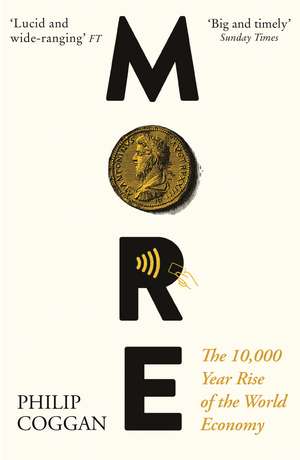
More: The 10,000-Year Rise of the World Economy: Economist Books
Autor Philip Cogganen Limba Engleză Paperback – 7 ian 2021
Adresăm această lucrare antreprenorilor, consultanților și studenților MBA care doresc să înțeleagă mecanismele invizibile ce guvernează prosperitatea globală. În More, Philip Coggan reușește o performanță rară: transformă datele economice aride într-o narațiune fascinantă despre conexiunile umane. Observăm cum autorul pornește de la un obiect banal — un tub de pastă de dinți — pentru a expune rețeaua complexă de comerț care se întinde pe milenii. Găsim în această carte o perspectivă revelatoare asupra continuității; contrar percepției comune, instrumente financiare sofisticate nu sunt invenții recente, ci au rădăcini adânci în istoria schimburilor transfrontaliere. Dacă The World That Trade Created v-a oferit cadrul teoretic al globalizării prin viniete istorice, această carte oferă instrumentele practice pentru a înțelege cum inovația și interconectarea produc bogăție reală. Suntem de părere că expertiza lui Coggan, șlefuită în deceniile petrecute la Financial Times și The Economist, se reflectă în claritatea cu care explică saltul economic din secolul al XVIII-lea. Față de lucrările sale anterioare, precum The Money Machine, unde se concentra pe mecanismele tehnice ale sistemului financiar, sau Paper Promises, dedicată istoriei datoriei, More reprezintă o sinteză ambițioasă, o „istorie totală” a modului în care am construit lumea modernă. Stilul este autoritar, dar accesibil, oferind o analiză critică a modului în care deschiderea piețelor a modelat civilizația, de la primele rute comerciale din Turcia preistorică până la provocările logistice ale erei post-pandemice.






Preț: 78.64 lei
Preț vechi: 94.56 lei
-17%
Carte disponibilă
Livrare economică 16-30 noiembrie
Livrare express 30 octombrie-05 noiembrie pentru 41.83 lei
Specificații
ISBN-10: 1781258090
Pagini: 496
Ilustrații: 8 pages colour plate section
Dimensiuni: 128 x 196 x 36 mm
Greutate: 0.34 kg
Ediția:Main
Editura: Profile
Colecția Economist Books
Seria Economist Books
Locul publicării:London, United Kingdom
V-ar putea interesa
-
 The New Geography of InnovationMehran GulPreț: 123.61 lei
 -
 Empire of ThingsFrank Trentmann-21%Preț: 116.85 lei147.03 lei
 -
 The Ascent of MoneyNiall Ferguson-27%Preț: 90.22 lei123.22 lei
 -
 -16%Preț: 198.17 lei236.02 lei
 -
 Atlas of Finance: Mapping the Global Story of MoneyDariusz WojcikPreț: 270.10 lei
 -
 Fifty Things that Made the Modern EconomyTim Harford-26%Preț: 69.42 lei93.77 lei
 -
 -26%Preț: 69.29 lei93.70 lei
 -
 Preț: 141.49 lei
 -
 The Human WebJ R McNeillPreț: 206.46 lei
 -
 Power and PlentyKevin H. O'RourkePreț: 381.82 lei
 -
 Money Changes EverythingWilliam N GoetzmannPreț: 163.28 lei
 -
 Preț: 309.50 lei
 -
 A Splendid ExchangeWilliam J BernsteinPreț: 129.65 lei
 -
 -26%Preț: 99.39 lei135.09 lei
 -
 Violent Saviours: The West, the Rest, and Capitalism Without ConsentWilliam Easterly-25%Preț: 101.94 lei136.36 lei
 -
 Money: A Story of HumanityDavid McWilliams-17%Preț: 67.61 lei81.06 lei
 -
 -23%Preț: 73.98 lei96.47 lei
 -
 The Penguin History of EconomicsRoger E. Backhouse-28%Preț: 77.86 lei108.44 lei
 -
 Peak HumanJohan NorbergPreț: 100.47 lei
De ce să citești această carte
Această carte este esențială pentru liderii care vor să înțeleagă originea și viitorul globalizării. Cititorul câștigă o viziune de ansamblu asupra celor 10.000 de ani de evoluție economică, învățând să identifice tiparele care duc la prosperitate. Este un ghid de referință care demonstrează că bogăția nu este un accident, ci rezultatul unei rețele globale de colaborare și inovație constantă.
Despre autor
Philip Coggan este un reputat jurnalist financiar, cunoscut pentru analizele sale incisive în cadrul publicației The Economist, unde semnează rubrica Bartleby (anterior Buttonwood). Cu o carieră de peste douăzeci de ani la Financial Times, Coggan a fost recompensat cu premiul „Senior Financial Journalist of the Year” în 2009. Expertiza sa în piețe de capital și istorie economică este dublată de o capacitate remarcabilă de a comunica concepte complexe publicului larg. Deși în prezent activează ca jurnalist independent în Asia, opera sa rămâne ancorată în rigoarea jurnalismului economic britanic de elită.
Notă biografică
Descriere scurtă
Recenzii
Coggan is one of the best financial journalists of his generation ... This is a grown-up book that is not suitable for adolescent Twitter warriors of the left or right
Big and timely ... Coggan's account of the rise of the world economy is accessible and mercifully free of jargon
Cogent and concise ... Philip Coggan achieves the impossible by weaving a superb story of the 10,000-year rise of the world economy in around 380 pages ... a must read
Descriere
A sweeping history that tracks the development of trade and industry across the world, from Ancient Rome to today.From the development of international trade fairs in the twelfth century to the innovations made in China, India, and the Arab world, it turns out that historical economies were much more sophisticated that we might imagine, tied together by webs of credit and financial instruments much like our modern economy.Here, Philip Coggan takes us from the ancient mountains of North Wales through Grand Central station and the great civilizations of Mesopotamia to the factories of Malaysia, showing how changes in agriculture, finance, technology, work, and demographics have driven the progress of human civilization. It's the story of how trade became broader and deeper over thousands of years; how governments have influenced economies, for good or ill; and how societies have repeatedly tried to tame, and harness, finance. More shows how, at every step of our long journey, it was the connection between people that resulted in more trade, more specialization, more freedom, and ultimately, more prosperity.