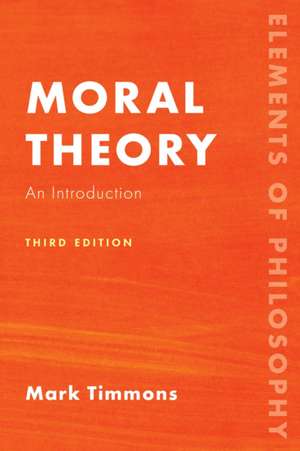
Moral Theory: An Introduction: Elements of Philosophy
Autor Mark Timmonsen Limba Engleză Paperback – 17 ian 2022
Preț: 288.14 lei
Preț vechi: 373.20 lei
-23%
Puncte Express: 432
Carte tipărită la comandă
Livrare economică 09-23 noiembrie
Livrare express 02-08 octombrie pentru 124.67 lei
Livrare prin curier în România Termenul estimat este afișat lângă disponibilitate.
Transport gratuit de la 400.00 lei Plată online sau ramburs, în funcție de opțiunile comenzii.
Retur gratuit în 14 zile Comandă securizată și suport în română.
Specificații
ISBN-13: 9781538152324
ISBN-10: 1538152320
Pagini: 388
Ilustrații: 18 b/w illustration
Dimensiuni: 150 x 226 x 22 mm
Greutate: 0.49 kg
Ediția:3
Editura: Bloomsbury Publishing
Colecția Rowman & Littlefield
Seria Elements of Philosophy
Locul publicării:New York, United States
ISBN-10: 1538152320
Pagini: 388
Ilustrații: 18 b/w illustration
Dimensiuni: 150 x 226 x 22 mm
Greutate: 0.49 kg
Ediția:3
Editura: Bloomsbury Publishing
Colecția Rowman & Littlefield
Seria Elements of Philosophy
Locul publicării:New York, United States
Descriere
Moral Theory: An Introduction explores some of the historically most important and currently debated moral theories about the nature of the right and the good, including divine command theory, relativism, natural law theory, consequentialism, egoism, Kant's ethics, ethics of prima facie duties, contractualism, virtue ethics and care ethics. Providing an introduction to moral theory that explains and critically examines the theories of such classical philosophers as Aristotle, Aquinas, Bentham, Kant, Mill, and Ross, this book acquaints students with the work of contemporary moral philosophers. Each chapter has been revised and updated. The third edition includes a new chapter on moral contractualism and an extensively revised chapter on virtue ethics and care ethics. Additionally, the book discusses recent work by moral psychologists making an impact on moral theory.
Cuprins
Preface
Acknowledgments
1. What is Moral Theory?
2. Divine Command Theory
3. Moral Relativism
4. Natural Law Theory
5. Consequentialism 1: Classical Utilitarianism
6. Consequentialism 2: Contemporary Developments
7. Ethical Egoism
8. Kant's Moral Theory
9. Ethics of Prima Facie Duty
10. Moral Contractualism
11. Virtue Ethics and Care Ethics
12. Moral Particularism
13. Conclusion
Appendix: Standards for Evaluating Moral Theories
Guide to Terminology
Acknowledgments
1. What is Moral Theory?
2. Divine Command Theory
3. Moral Relativism
4. Natural Law Theory
5. Consequentialism 1: Classical Utilitarianism
6. Consequentialism 2: Contemporary Developments
7. Ethical Egoism
8. Kant's Moral Theory
9. Ethics of Prima Facie Duty
10. Moral Contractualism
11. Virtue Ethics and Care Ethics
12. Moral Particularism
13. Conclusion
Appendix: Standards for Evaluating Moral Theories
Guide to Terminology
Recenzii
Like its predecessors, this third edition of Moral Theory offers a well-focused, clear account of moral theories. In a philosophical area marked by the tendency to speak in terms of abstract concepts and isms, Timmons makes frequent, effective use of particular cases, stories, and examples to illustrate the moral theory under discussion.. Throughout, Timmons is careful to present a balanced view of the theory-he mentions both the attractive points and the potential negative points of the theory in question. A useful appendix provides standards for evaluating moral theories. Recommended. Lower- and upper-division undergraduates; general readers.
The organization in Moral Theory: An Introduction is simply excellent. The framework for the book connects the whole together and the scope is better than other comparable texts I've seen.
The best thing about Moral Theory might be that it clearly sets forth major aims of moral theory, derives some standards by which to assess moral theories from those aims, and then explicitly applies those standards to the moral theories explained."
The organization in Moral Theory: An Introduction is simply excellent. The framework for the book connects the whole together and the scope is better than other comparable texts I've seen.
The best thing about Moral Theory might be that it clearly sets forth major aims of moral theory, derives some standards by which to assess moral theories from those aims, and then explicitly applies those standards to the moral theories explained."