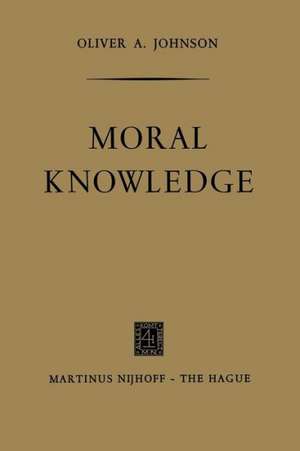
Moral Knowledge
Autor Oliver A Johnsonen Limba Engleză Paperback – 1966
Preț: 397.29 lei
Puncte Express: 596
Carte tipărită la comandă
Livrare economică 04-18 decembrie
Livrare prin curier în România Termenul estimat este afișat lângă disponibilitate.
Transport gratuit de la 400.00 lei Plată online sau ramburs, în funcție de opțiunile comenzii.
Retur gratuit în 14 zile Comandă securizată și suport în română.
Specificații
ISBN-13: 9789401185578
ISBN-10: 9401185573
Pagini: 172
Ilustrații: 172 p.
Dimensiuni: 155 x 235 x 11 mm
Greutate: 0.3 kg
Ediția:1966 edition
Editura: Springer
Locul publicării:Dordrecht, Netherlands
ISBN-10: 9401185573
Pagini: 172
Ilustrații: 172 p.
Dimensiuni: 155 x 235 x 11 mm
Greutate: 0.3 kg
Ediția:1966 edition
Editura: Springer
Locul publicării:Dordrecht, Netherlands
V-ar putea interesa
-
 In Praise of DesireNomy Arpaly-30%Preț: 591.47 lei842.13 lei
 -
 The Ajax Dilemma: Justice, Fairness, and RewardsPaul Woodruff-15%Preț: 147.26 lei174.00 lei
 -
 A Sentimentalist Theory of the MindMichael Slote-27%Preț: 520.38 lei717.38 lei
 -
 -12%Preț: 342.10 lei390.52 lei
 -
 Contractualism and the Foundations of MoralityNicholas Southwood-10%Preț: 368.43 lei411.30 lei
 -
 How We Fight: Ethics in WarHelen Frowe-28%Preț: 505.57 lei706.15 lei
 -
 Human Interests: or Ethics for PhysicalistsJoseph Mendola-31%Preț: 746.38 lei1079.76 lei
 -
 Oxford Studies in Normative Ethics, Volume 3Mark Timmons-13%Preț: 355.47 lei406.78 lei
 -
 The Human ConditionJohn Kekes-12%Preț: 336.25 lei380.24 lei
 -
 Oxford Studies in Agency and Responsibility, Volume 1David Shoemaker-11%Preț: 345.61 lei387.28 lei
 -
 From Individual to Collective Intentionality: New EssaysSara Rachel Chant-34%Preț: 647.17 lei977.00 lei
 -
 Environmental EthicsRobin AttfieldPreț: 226.05 lei
 -
 Ethics for OCR Religious StudiesMark CoffeyPreț: 396.64 lei
 -
 This Is EthicsJussi SuikkanenPreț: 318.95 lei
 -
 Perspectives on Human Dignity: A ConversationJeff Malpas-15%Preț: 667.08 lei784.79 lei
 -
 Rational PolemicsRichard Todd DevensPreț: 152.24 lei
 -
 Assholes: A TheoryAaron James-41%Preț: 68.21 lei114.64 lei
Public țintă
ResearchCuprins
I. The Problem of Moral Knowledge.- 1. Contemporary sources of moral skepticism.- 2. Hume and the deductive fallacy.- 3. The meaning of moral obligation.- 4. The criteria of knowledge.- 5. Plan of the book.- II. Duty and Goodness.- 1. Types of theory.- 2. The deontologists’ critique of utilitarianism.- 3. Intuitionistic utilitarianism as a theory of moral knowledge.- 4. The identification of goodness and duty.- 5. The “ought-to-be” argument.- 6. The deductive argument-a restatement.- 7. The appeal to self-evidence.- 8. Reductionistic utilitarianism.- 9. Moral goodness and duty.- 10. Duty and goodness and the “ought” and the “is”.- III. Duty and Rightness.- 1. The intuitionism of the deontologists.- 2. Prichard’s “unreasonable” theory.- 3. The self-evidence of our duties.- 4. The duty to keep promises.- 5. Intuition and generalization.- 6. Rightness and duty.- 7. From rightness to duty.- IV. A New Point of View.- 1. Oxford philosophy.- 2. The revolution in philosophy.- 3. Wittgenstein.- 4. Analysis and moral philosophy.- 5. Analysis and the problem of moral knowledge.- V. Duty and Ordinary Language.- 1. An interpretation of Toulmin’s conclusions.- 2. A reinterpretation of Toulmin’s conclusions.- 3. Good reasons and generally accepted reasons.- 4. Toulmin’s theory and the deductive fallacy.- 5. Does Toulmin escape the deductive fallacy?.- 6. Summary comments on Toulmin’s moral theory.- 7. Nowell-Smith and the problem of moral knowledge.- 8. Wittgenstein and the revolution in philosophy.- VI. A Return to Intuitionism.- 1. The deductive fallacy, skepticism, and intuitionism.- 2. A defense of intuitionism.- 3. Knowledge and a plurality of intuitions.- 4. Intuitive self-evidence and moral knowledge.- VII. Reason and Duty.- 1. Two notions ofself-evidence.- 2. Preliminary objections.- 3. Duty and good reasons.- 4. A moral axiom.- 5. A story.- 6. Elaboration and comments.- 7. The principle of personal impartiality.- 8. Egoism and morality.- 9. The deductive fallacy.- VIII. Toward a General Theory of Morality.- 1. Outline of a positive theory of obligation.- 2. Practical qualifications.- 3. Morality and utility.- 4. Goodness and the naturalistic fallacy.