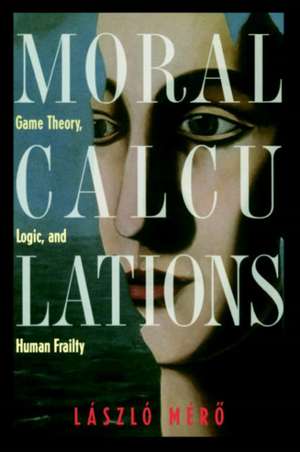
Moral Calculations: Game Theory, Logic, and Human Frailty
Traducere de A.C. Gösi-Greguss Autor Laszlo Meroen Limba Engleză Hardback – 30 iun 1998
Începem analiza acestui volum cu experimentul fascinant al licitației pentru un dolar, unde regulile impun ca și al doilea cel mai mare ofertant să plătească suma licitată, deși nu primește nimic. Notăm cu interes faptul că, în loc să ignore o astfel de capcană, participanții ajung adesea să plătească sume de peste trei ori mai mari decât valoarea nominală a bancnotei. Această premisă servește drept punct de plecare pentru Moral Calculations, o lucrare care investighează de ce raționalitatea matematică și comportamentul uman par adesea să funcționeze pe frecvențe diferite.
Descoperim aici o structură riguroasă, organizată în capitole care progresează de la mecanismele de bază ale jocurilor de moralitate către dileme logice complexe. Laszlo Mero nu se limitează la expunerea teoretică a conceptelor precum jocurile de sumă zero sau strategiile mixte, ci extinde aplicabilitatea teoriei jocurilor către etică și biologie, analizând, de exemplu, „Tit for Tat” în comportamentul peștilor sau originile altruismului. Considerăm că forța acestui text rezidă în capacitatea de a explica de ce „Eroul Brută” sau „Dilema Prizonierului” nu sunt doar modele abstracte, ci mecanisme care guvernează deciziile cotidiene.
În contextul literaturii de specialitate, această ediție publicată de Springer completează perspectiva oferită de Game Theory de Ken Binmore. În timp ce Ken Binmore se concentrează pe fundamentele raționale și forțele evoluționiste care elimină jocul irațional, Laszlo Mero explorează tocmai fragilitatea umană și modul în care gândirea morală influențează calculul strategic. Este o lectură care transformă matematica dintr-un instrument de calcul într-o oglindă a condiției umane, oferind o punte între psihologia experimentală și logica pură.
Preț: 324.66 lei
Carte disponibilă
Livrare economică 31 octombrie-14 noiembrie
Specificații
ISBN-10: 0387984194
Pagini: 288
Ilustrații: XI, 276 p.
Dimensiuni: 155 x 235 x 21 mm
Greutate: 0.59 kg
Ediția:1998
Editura: Springer
Colecția Copernicus
Locul publicării:New York, NY, United States
V-ar putea interesa
-
 -30%Preț: 460.98 lei654.93 lei
 -
 -30%Preț: 357.98 lei508.44 lei
 -
 Statistical Physics and EconomicsMichael Schulz-18%Preț: 976.86 lei1191.29 lei
 -
 Introduction to OptimizationPablo Pedregal-15%Preț: 518.63 lei610.14 lei
 -
 Superior Beings. If They Exist, How Would We Know?Steven BramsPreț: 209.04 lei
 -
 The Interval Market Model in Mathematical FinancePierre BernhardPreț: 413.32 lei
 -
 Theory of Conditional GamesWynn C. Stirling-20%Preț: 378.02 lei472.53 lei
 -
 Repeated GamesJean-Francois Mertens-11%Preț: 440.74 lei495.20 lei
 -
 Preț: 481.09 lei
 -
 Preț: 406.97 lei
 -
 Hazardous Forecasts and Crisis Scenario GeneratorArnaud Clément-Grandcourt-27%Preț: 500.04 lei687.22 lei
 -
 Financial MathematicsYuliya Mishura-9%Preț: 570.43 lei626.84 lei
 -
 Modeling, Dynamics, Optimization and Bioeconomics IAlberto Adrego Pinto-18%Preț: 1010.02 lei1231.73 lei
 -
 Gamification in Education and BusinessTorsten Reiners-18%Preț: 1794.76 lei2188.73 lei
 -
 -15%Preț: 563.26 lei662.66 lei
 -
 Set Functions, Games and Capacities in Decision MakingMichel Grabisch-18%Preț: 912.81 lei1113.17 lei
 -
 Regularity Theory for Mean-Field Game SystemsDiogo A. GomesPreț: 449.86 lei
 -
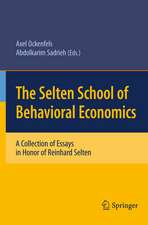 The Selten School of Behavioral EconomicsAxel Ockenfels-15%Preț: 642.06 lei755.37 lei
 -
 Übungsbuch zur angewandten WirtschaftsmathematikJürgen TietzePreț: 373.10 lei
 -
 Preț: 440.41 lei
 -
 Preț: 311.11 lei
 -
 Preț: 328.95 lei
 -
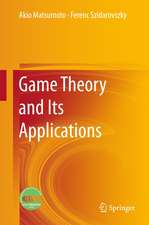 Game Theory and Its ApplicationsAkio Matsumoto-15%Preț: 727.49 lei855.88 lei
 -
 WAYS OF THINKING (B/S)Mero L-20%Preț: 298.17 lei372.72 lei
 -
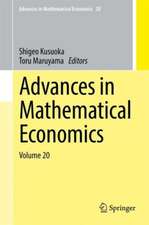 Advances in Mathematical Economics Volume 20Shigeo KusuokaPreț: 393.32 lei
 -
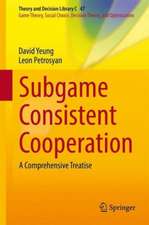 Subgame Consistent Cooperation: A Comprehensive TreatiseDavid W.K. Yeung-20%Preț: 655.19 lei818.99 lei
Public țintă
Popular/generalDe ce să citești această carte
Recomandăm această carte cititorilor interesați de intersecția dintre matematică și științele sociale. Veți câștiga o înțelegere profundă a modului în care teoria jocurilor explică nu doar economia, ci și altruismul sau conflictele politice. Este un volum esențial pentru cei care doresc să depășească modelele simpliste de raționalitate și să înțeleagă logica din spatele unor comportamente umane aparent absurde, totul într-un stil accesibil și erudit.
Despre autor
Laszlo Mero este un renumit psiholog și teoretician al jocurilor de origine maghiară, cunoscut pentru capacitatea sa de a sintetiza concepte matematice complexe în contexte de psihologie cognitivă. Profesor la Universitatea Eötvös Loránd din Budapesta, Mero a contribuit semnificativ la popularizarea științei, reușind să demonstreze cum structurile logice ale teoriei jocurilor, fundamentate de John von Neumann, se aplică în viața reală, de la decizii de afaceri până la dileme morale și etice.