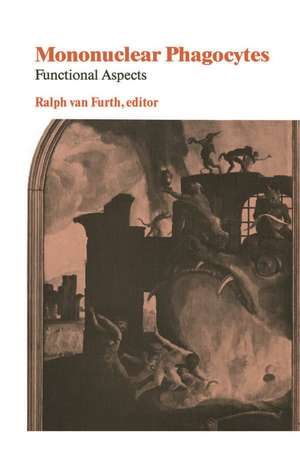
Mononuclear Phagocytes: Functional Aspects
Editat de R. van Furthen Limba Engleză Paperback – 23 aug 2014
During the last twenty-five years research on the biology of mononuclear phagocytes has increased tremendously. This motivated Professor R. van Furth to organize five international conferences on this subject in Leiden, the Netherlands. The edited proceedings of these meethings were published: in 1970 Mononuclear Phagocytes; in 1975 Mononuclear Phagocytes in Immunity, Infections and Pathology; in 1980 Mononuclear Phagocytes -- Functional Aspects; and in 1985 Mononuclear Phagocytes -- Characteristics, Physiology and Function. Reviews of these volumes, published in international journals, praised them as the most up-to-date state of the art publications. The publication of 1991 includes 88 chapters written by more than 200 authors.
Preț: 911.29 lei
Preț vechi: 959.25 lei
-5%
Puncte Express: 1367
Carte tipărită la comandă
Livrare economică 26 noiembrie-02 decembrie
Livrare prin curier în România Termenul estimat este afișat lângă disponibilitate.
Transport gratuit pentru acest produs Plată online sau ramburs, în funcție de opțiunile comenzii.
Retur gratuit în 14 zile Comandă securizată și suport în română.
Specificații
ISBN-13: 9789400987951
ISBN-10: 9400987951
Pagini: 2052
Ilustrații: LXXIII, 1961 p. 262 illus. In 4 volumes, not available separately.
Dimensiuni: 155 x 235 x 108 mm
Ediția:Softcover reprint of the original 1st ed. 1980
Editura: SPRINGER NETHERLANDS
Colecția Springer
Locul publicării:Dordrecht, Netherlands
ISBN-10: 9400987951
Pagini: 2052
Ilustrații: LXXIII, 1961 p. 262 illus. In 4 volumes, not available separately.
Dimensiuni: 155 x 235 x 108 mm
Ediția:Softcover reprint of the original 1st ed. 1980
Editura: SPRINGER NETHERLANDS
Colecția Springer
Locul publicării:Dordrecht, Netherlands
V-ar putea interesa
-
 -26%Preț: 874.88 lei1186.36 lei
 -
 The Compatibility GeneDaniel M Davis-50%Preț: 60.67 lei120.47 lei
 -
 -29%Preț: 286.44 lei402.13 lei
 -
 Transplant ImmunologyXian C Li-5%Preț: 659.41 lei694.12 lei
 -
 The Wiley-Blackwell Handbook of PsychoneuroimmunologyAlexander W Kusnecov-9%Preț: 1387.04 lei1524.23 lei
 -
 Vaccinophobia and Vaccine Controversies of the 21st CenturyArchana Chatterjee-21%Preț: 977.31 lei1241.17 lei
 -
 -5%Preț: 1136.65 lei1196.47 lei
 -
 Die Sepsis bei SplenektomieJakob R. Izbicki-5%Preț: 393.73 lei414.45 lei
 -
 Immunology of the Female Genital TractErnst Rainer Weissenbacher-5%Preț: 704.44 lei741.51 lei
 -
 Histamine IntoleranceReinhart Jarisch-5%Preț: 675.09 lei710.62 lei
 -
 -5%Preț: 720.82 lei758.76 lei
 -
 Evaluation and Management of Hospital InfectionsR van Furth-5%Preț: 1142.42 lei1202.55 lei
 -
 -5%Preț: 352.99 lei371.57 lei
 -
 Handbook of ImmunochemistryMiroslav FerenčíkPreț: 386.37 lei
 -
 -5%Preț: 364.50 lei383.68 lei
 -
 Immunological EngineeringD.W. Jirsch-5%Preț: 361.44 lei380.46 lei
 -
 -5%Preț: 719.72 lei757.61 lei
 -
 -5%Preț: 356.32 lei375.08 lei
 -
 New Trends and Developments in VaccinesA. Voller-5%Preț: 359.75 lei378.69 lei
 -
 Immunology for SurgeonsJ. E. Castro-5%Preț: 364.07 lei383.23 lei
Public țintă
ResearchCuprins
1 Cells of the mononuclear phagocyte system Nomenclature in terms of sites and conditions.- 2 Peroxidase and catalase in monocytes, macrophages, epithelioid cells and giant cells of the rat.- 3 Changes in peroxidase distribution within organelles of blood monocytes and peritoneal macrophages after surface adherence in vitro and in vivo.- 4 Development of exudate-resident macrophages, on the basis of the pattern of peroxidatic activity in vivo and in vitro.- 5 The vacuolar apparatus of alveolar macrophages and the turnover of surfactant.- 6 Properties of Kupffer cells.- 7 Origin and structure of the osteoclast.- 8 Veiled cells resembling Langerhans cells.- 9 Characteristics, origin and kinetics of human and murine mononuclear phagocytes.- 10 The origin and properties of peripheral lymph mononuclear phagocytes.- 11 Humoral control of monocyte production during inflammation.- 12 Long-term cultures of murine bone marrow mononuclear phagocytes.- 13 Effector cell functions in long-term culture of murine, prosimian, and human bone marrow.- 14 Formation of colonies by mononuclear phagocytes outside the bone marrow.- 15 Regulation of macrophage production by a colony-stimulating factor.- 16 Functions of macrophage cell lines.- 17 Gradients of chemotactic factors in various assay systems.- 18 The locomotor behaviour of human blood monocytes in chemotactic and chemokinetic environments and the role of substratum in monocyte locomotion.- 19 Alteration of macrophage and monocyte membrane potential by chemotactic factors.- 20 MIF/MAF-macrophage interactions: biochemical characterization of a putative glycolipid receptor for MIF and the existence and properties of two distinct MIFs.- 21 Lymphokine-induced modulation of macrophage functions.- 22 An inhibitor of macrophage accumulationproduced by neoplasms: its role in abrogating host resistance to cancer.- 23 Membrane flow during endocytosis.- 24 Membrane recycling (shuttle?) in endocytosis.- 25 The iodination and turnover of macrophage plasma membrane polypeptides.- 26 Macrophage ecto-enzymes: their identification, metabolism, and control.- 27 Membrane lipids and the control of endocytosis.- 28 Surface functions in dividing macrophages.- 29 Fc receptors on mouse macrophages.- 30 Structural characteristics of Fc receptors on macrophages.- 31 Quantitative studies on the interaction of macrophages with antibody and immune complexes.- 32 Hormone receptors and hormonal regulation of macrophage physiological functions.- 33 In vivo and in vitro evidence for a lysosomal enzyme uptake system in macrophages.- 34 Cellular recognition by phagocytes: role of lectin-like receptor(s).- 35 Phagocytosis.- 36 Modulation of macrophage plasma membrane receptors for IgG and complement.- 37 Genetic and functional studies of continuous macrophage-like cell lines.- 38 Contractile proteins and the mechanism of phagocytosis in macrophages.- 39 Factors modifying the fusion of phagosomes and lysosomes: art, fact, and artefact.- 40 Manipulations of phagosome-lysosome fusion in cultured macrophages: potentialities and limitations.- 41 Cyclic nucleotides and phagosome-lysosome fusion in mouse peritoneal macrophages.- 42 Determinants of phagosome-lysosome fusion in mouse macrophages.- 43 Oxygen intermediates and the microbicidal event.- 44 Release of superoxide anion by macrophages: effect of in vivo or in vitro priming.- 45 The release of hydrogen peroxide from mononuclear phagocytes and its role in extracellular cytolysis.- 46 Oxidative metabolism of mononuclear phagocytes.- 47 The oxygen metabolism of human blood monocytes andneutrophils.- 48 Effects of oxygen on metabolic patterns and endocytosis of macrophages.- 49 Lysozyme and plasminogen activator: constitutive and induced secretory products of mononuclear phagocytes.- 50 Modulation of macrophage plasminogen activator secretion.- 51 The synthesis of arachidonic acid oxygenation products by various mononuclear phagocyte populations.- 52 Generation of tissue thromboplastin by human monocytes.- 53 Secretion of lysosomal enzymes by macrophages.- 54 Synthesis and release of complement components by macrophages.- 55 The stimulation of mononuclear phagocytes by components of the classical and the alternative pathways of complement activation.- 56 Complement, coagulation and mononuclear phagocytes.- 57 Extracellular stimulation of intracellular killing.- 58 Respiratory pathways of macrophages — cellular localization and relation to cidal activity.- 59 Macrophage activation by interferon or interferon inducers.- 60 Macrophage activation by IgE.- 61 The effect of complement on the degradation of soluble immune aggregates by Kupffer cells and peritoneal macrophages in vitro.- 62 Macrophage activation in vitro by phagocytosis.- 63 Induction of macrophage microbicidal activity.- 64 Interactions of macrophages with intravacuolar bacteria and protozoa.- 65 Cytotoxic and microbicidal properties of macrophages.- 66 Significance of systemic macrophage activation in response to tumor growth.- 67 Regulation of macrophage non-specific tumoricidal capability.- 68 Distinctive characteristics of host tumor resistance in a rat fibrosarcoma model system.- 69 Intracellular killing, degradation, metabolic activity, and increase in ?-galactosidase activity as markers for activated macrophages.- 70 Cytotoxicity of human monocytes against sensitized erythrocytes.-71 Dendritic cells and macrophages — current knowledge of their distinctive properties and functions.- 72 Reticulum cells and macrophages in the immune response.- 73 Multiple interactions between listeria-immune T lymphocytes and macrophages: regulation by the major histocompatibility gene complex.- 74 Role of macrophages in the in vitro induction and regulation of antibody responses.- 75 Physical and functional macrophage-lymphocyte interactions in antigen recognition by T lymphocytes.- 76 Expression of Ir genes and Ia antigens by adherent accessory cells required for antigen- specific antibody-forming cell responses.- 77 Summation.