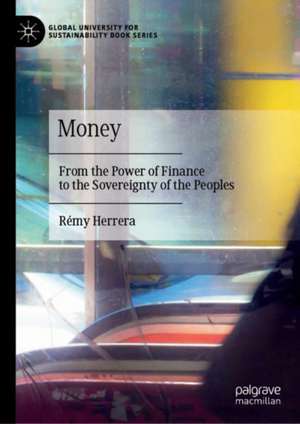
Money: Global University for Sustainability Book Series
Autor Rémy Herreraen Limba Engleză Hardback – 26 aug 2022

Preț: 814.50 lei
Preț vechi: 993.28 lei
-18%
Puncte Express: 1222
Carte tipărită la comandă
Livrare economică 03-17 decembrie
Livrare prin curier în România Termenul estimat este afișat lângă disponibilitate.
Transport gratuit pentru acest produs Plată online sau ramburs, în funcție de opțiunile comenzii.
Retur gratuit în 14 zile Comandă securizată și suport în română.
Specificații
ISBN-13: 9789811928475
ISBN-10: 9811928479
Pagini: 356
Ilustrații: XVIII, 337 p. 1 illus.
Dimensiuni: 153 x 216 x 24 mm
Greutate: 0.53 kg
Ediția:1st ed. 2022
Editura: Springer
Colecția Global University for Sustainability Book Series
Seria Global University for Sustainability Book Series
Locul publicării:Singapore, Singapore
ISBN-10: 9811928479
Pagini: 356
Ilustrații: XVIII, 337 p. 1 illus.
Dimensiuni: 153 x 216 x 24 mm
Greutate: 0.53 kg
Ediția:1st ed. 2022
Editura: Springer
Colecția Global University for Sustainability Book Series
Seria Global University for Sustainability Book Series
Locul publicării:Singapore, Singapore
Cuprins
Chapter 1. Rationale for the existence of money: conceptual, historical and institutional elements.- Chapter 2. The monetary hegemony of the United States: power of high finance, reign of the dollar and global chaos.- Chapter 3. Europe, between aporias and impasses: From the straitjacket of the euro to the logic of every man for himself.- Chapter 4. Africa under influence, but struggling: Persistent neo-colonialism, perpetual debt and neo-liberalized pan-Africanism.- Chapter 5. Oceania, often forgotten, but so revealing: Archaism of traditional societies of the periphery... or forms of monetary domination by the center?.- Chapter 6. Latin America and the Caribbean on the road to its second independence: Monetary lessons from a region in rebellion.- Chapter 7. Asia’s quest for a better future for itself (and for the world): From the “Asian crisis” to the control of the currency.- Chapter 8. The march towards currencies at the service of the peoples: Systemic crisis and currency warsor alternatives of sovereignty in a multipolar world?.- Conclusion.- Indicative bibliography.- Appendices.- Glossary.- Index.
Textul de pe ultima copertă
What is money, where does it come from, what is its purpose? Does it increase national and international inequalities? Rémy Herrera’s book analyzes how the changes in the capitalist world system have consolidated, over the last decades, the supremacy of the U.S. dollar, but also how this hegemony has recently been challenged, both by rising State resistance initiatives and by the emergence of crypto-currencies, which raises many questions. Reviewing the situation of each continent, this book invites us to debate the liberation from the dollar domination, as well as the future of the euro, that of the CFA and CFP francs, of the Cuban peso or of the Chinese yuan, among others, but also the means to take in hand our collective future by mastering money.
Rémy Herrera is a French economist, researcher at the CNRS (Centre national de la Recherche scientifique, National Center of Scientific Research). He has worked in financial auditing and in international institutions, including the OECD and the World Bank. He is the author of numerous books and scientific articles on economics, and teaches in several universities, especially at the Centre d’Économie de la Sorbonne. He regularly collaborates with the CETIM (Center Europe Third World), notably by supporting it in its advisory role with the United Nations.
Rémy Herrera is a French economist, researcher at the CNRS (Centre national de la Recherche scientifique, National Center of Scientific Research). He has worked in financial auditing and in international institutions, including the OECD and the World Bank. He is the author of numerous books and scientific articles on economics, and teaches in several universities, especially at the Centre d’Économie de la Sorbonne. He regularly collaborates with the CETIM (Center Europe Third World), notably by supporting it in its advisory role with the United Nations.
Caracteristici
Reassess the role of money in finance Advocates a democratization of finance Theorizes new directions in banking