
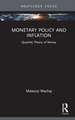
Monetary Policy and Inflation: Quantity Theory of Money: Routledge Focus on Economics and Finance
Autor Mateusz Machajen Limba Engleză Paperback – 27 iun 2025
It elucidates how and why – despite its important limitations – the theory can be applied throughout history, including the 2022 spikes in inflation. It also demonstrates how and why the quantity theory, with some internally good reasons, is not part of the modern monetary policy framework. The book argues that firstly, the issue of non-operationability of the money supply is a policy problem, but not a causality problem. Secondly, while some models can work without money, and while a simple deterministic relationship between money base and aggregates may not exist, the author shows that there is still room for quantity theory to be true. Thirdly, perhaps most importantly, as the book shows, the apparent lack of a relationship between the inflation index and money supply with single-digit inflation is a statistical artifact resulting from confounding factors. To conclude, although the quantity theory of money has not been employed in recent Central bank policy, it still holds up surprisingly well in explaining real world phenomena, including the current record inflation levels.
The practical significance of this book is to illustrate to researchers and scholars how classical macroeconomic thinking can explain key monetary factors that lead to inflation, but also at the same time show that it is fully compatible with modern macroeconomics and is not just a thing of the past.
| Toate formatele și edițiile | Preț | Express |
|---|---|---|
| Paperback (1) | 196.79 lei 3-5 săpt. | +3.95 lei 7-13 zile |
| Taylor & Francis – 27 iun 2025 | 196.79 lei 3-5 săpt. | +3.95 lei 7-13 zile |
| Hardback (1) | 397.89 lei 6-8 săpt. | |
| Taylor & Francis – 3 noi 2023 | 397.89 lei 6-8 săpt. |
Din seria Routledge Focus on Economics and Finance
- 8%
 Preț: 428.80 lei
 -
 Preț: 198.49 lei
 -
 Preț: 212.96 lei
 -
 Preț: 172.98 lei
 - 15%
 Preț: 399.43 lei
 -
 Preț: 216.97 lei
 -
 Preț: 216.09 lei
 - 15%
 Preț: 416.51 lei
 - 15%
 Preț: 409.97 lei
 -
 Preț: 197.46 lei
 -
 Preț: 172.78 lei
 -
 Preț: 222.19 lei
 - 15%
 Preț: 410.78 lei
 -
 Preț: 223.72 lei
 -
 Preț: 215.41 lei
 -
 Preț: 172.98 lei
 -
 Preț: 451.89 lei
 -
 Preț: 219.00 lei
 -
 Preț: 193.28 lei
 -
 Preț: 217.49 lei
 - 15%
 Preț: 397.89 lei
 -
 Preț: 216.59 lei
 - 15%
 Preț: 412.02 lei
 -
 Preț: 205.47 lei
 -
 Preț: 205.62 lei
 -
 Preț: 209.48 lei
 - 8%
 Preț: 420.73 lei
 -
 Preț: 424.80 lei
 - 8%
 Preț: 437.55 lei
 -
 Preț: 210.74 lei
 -
 Preț: 209.85 lei
Preț: 196.79 lei
Puncte Express: 295
Preț estimativ în valută:
34.79€ • 40.99$ • 30.34£
34.79€ • 40.99$ • 30.34£
Carte disponibilă
Livrare economică 20 martie-03 aprilie
Livrare express 06-12 martie pentru 13.94 lei
Specificații
ISBN-13: 9781032558509
ISBN-10: 1032558504
Pagini: 72
Ilustrații: 18
Dimensiuni: 138 x 216 x 4 mm
Greutate: 0.1 kg
Ediția:1
Editura: Taylor & Francis
Colecția Routledge
Seria Routledge Focus on Economics and Finance
Locul publicării:Oxford, United Kingdom
ISBN-10: 1032558504
Pagini: 72
Ilustrații: 18
Dimensiuni: 138 x 216 x 4 mm
Greutate: 0.1 kg
Ediția:1
Editura: Taylor & Francis
Colecția Routledge
Seria Routledge Focus on Economics and Finance
Locul publicării:Oxford, United Kingdom
Public țintă
PostgraduateNotă biografică
Mateusz Machaj is a Researcher at the University of New York in Prague and an Associate Professor at the Institute of Economic Sciences, University of Wroclaw, Poland.
Cuprins
1. 1. Instead of an introduction. BIS report: Welcome to 2023, inflation depends on money supply 2. Formalized quantity theory of money and Milton Friedman's monetary program 3. The most important studies in the quantity theory of money research in the last 40 years 4. Conventional monetary policy and the rationale for the absence of money supply in its rules 5. Active monetary policy after 2008 and the inadequacy of the money multiplier model 6. Active monetary policy during the 2020 pandemic 7. Conclusions
Descriere
This book builds upon a long-accepted tradition of quantity theory of money in explaining long run inflation levels. It elucidates how and why – despite its important limitations – the theory can be applied throughout history, including the 2022 spikes in inflation.