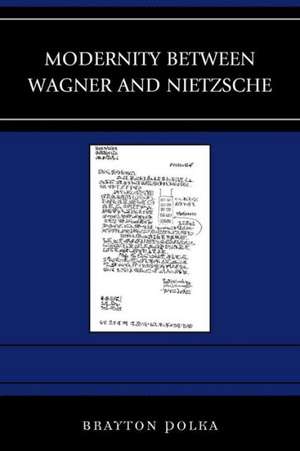
Modernity between Wagner and Nietzsche
Autor Brayton Polkaen Limba Engleză Hardback – 6 ian 2015
Preț: 659.61 lei
Preț vechi: 814.33 lei
-19%
Puncte Express: 989
Carte tipărită la comandă
Livrare economică 08-22 iunie
Specificații
ISBN-13: 9780739193150
ISBN-10: 0739193155
Pagini: 218
Dimensiuni: 157 x 235 x 18 mm
Greutate: 0.51 kg
Editura: Bloomsbury Publishing
ISBN-10: 0739193155
Pagini: 218
Dimensiuni: 157 x 235 x 18 mm
Greutate: 0.51 kg
Editura: Bloomsbury Publishing
V-ar putea interesa
-
 A History of OperaCarolyn AbbatePreț: 131.57 lei
 -
 A Dictionary of Opera CharactersJoyce Bourne-12%Preț: 90.69 lei102.65 lei
 -
 Richard WagnerBarry Millington-22%Preț: 147.71 lei189.67 lei
 -
 The Faber Pocket Guide to OperaRupert ChristiansenPreț: 88.73 lei
 -
 Preț: 298.01 lei
 -
 Preț: 76.26 lei
 -
 My Life with WagnerChristian Thielemann-27%Preț: 86.08 lei117.50 lei
 -
 Richard WagnerRaymond Furness-17%Preț: 85.53 lei103.22 lei
 -
 How to Enjoy OperaJohn Snelson-23%Preț: 78.13 lei101.92 lei
 -
 Opera: Today's Business Leaders on Tomorrow's WorldRobert WeinbergPreț: 69.10 lei
 -
 Ring ResoundingJohn CulshawPreț: 117.44 lei
Descriere
Modernity between Wagner and Nietzsche argues that the operas and writings of Wagner contradict the values that are fundamental to modernity. Analyzing Wagner's works in contrast to the philosophical thought of Nietzsche, Brayton Polka examines how Wagner breaks with Nietzsche and their common influencer, Schopenhauer.
Cuprins
Chapter 1: Introduction
Chapter 2: Wagner's Ring: Life Redeemed in Death - Love's Sacrifice of Life to Death
Chapter 3: Tristan und Isolde: Life Redeemed In Death - Love's Sacrifice of Life in Death
Chapter 4: Parsifal: Life Redeemed in Death - Love's Sacrifice of Life through Death
Chapter 5: Postlude Recapitulated as Prelude in Nietzsche: Ecce Homo!
Chapter 6: Conclusion: Modernity as Biblical Consonance
Chapter 2: Wagner's Ring: Life Redeemed in Death - Love's Sacrifice of Life to Death
Chapter 3: Tristan und Isolde: Life Redeemed In Death - Love's Sacrifice of Life in Death
Chapter 4: Parsifal: Life Redeemed in Death - Love's Sacrifice of Life through Death
Chapter 5: Postlude Recapitulated as Prelude in Nietzsche: Ecce Homo!
Chapter 6: Conclusion: Modernity as Biblical Consonance
Recenzii
Passionately and accessibly written, Brayton Polka's new book offers a bracing challenge to the prevailing view of Wagner and Nietzsche as the twin-progenitors of aesthetic modernism. Sharply critical of Wagner's 'falsification of the values that...constitute modernity,' Polka's study drives a sharp wedge between the musical 'master' and his one-time devotee. Eschewing a strictly immanent view of Wagner's revolutionary aesthetic, Polka's new study helpfully draws attention to modernism's deep philosophical and religious sources.