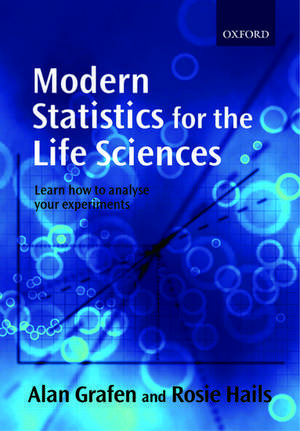
Modern Statistics for the Life Sciences
Autor Alan Grafen, Rosie Hailsen Limba Engleză Paperback – 21 mar 2002
Preț: 409.93 lei
Preț vechi: 518.15 lei
-21%
Puncte Express: 615
Carte disponibilă
Livrare economică 12-17 noiembrie
Livrare express 24-30 octombrie pentru 107.31 lei
Livrare prin curier în România Termenul estimat este afișat lângă disponibilitate.
Transport gratuit pentru acest produs Plată online sau ramburs, în funcție de opțiunile comenzii.
Retur gratuit în 14 zile Comandă securizată și suport în română.
Specificații
ISBN-13: 9780199252312
ISBN-10: 0199252319
Pagini: 368
Ilustrații: numerous figures
Dimensiuni: 171 x 246 x 20 mm
Greutate: 0.64 kg
Editura: Oxford University Press
Colecția OUP Oxford
Locul publicării:Oxford, United Kingdom
ISBN-10: 0199252319
Pagini: 368
Ilustrații: numerous figures
Dimensiuni: 171 x 246 x 20 mm
Greutate: 0.64 kg
Editura: Oxford University Press
Colecția OUP Oxford
Locul publicării:Oxford, United Kingdom
V-ar putea interesa
-
 -13%Preț: 248.90 lei286.74 lei
 -
 -20%Preț: 100.34 lei125.74 lei
 -
 -9%Preț: 660.12 lei725.41 lei
 -
 Fundamentals of Mathematical StatisticsSteffen Lauritzen-15%Preț: 681.51 lei801.78 lei
 -
 Deep Learning and Scientific Computing with R torchSigrid Keydana-18%Preț: 1131.43 lei1379.80 lei
 -
 Spatiotemporal AnalyticsJay Lee-18%Preț: 821.79 lei1002.19 lei
 -
 -20%Preț: 890.73 lei1113.41 lei
 -
 Handbook of Structural Equation Modeling, Second EditionRick H. Hoyle-9%Preț: 909.57 lei999.52 lei
 -
 Robust Methods for Data ReductionAlessio Farcomeni-18%Preț: 788.78 lei961.93 lei
 -
 Mathematical Statistics for Economics and BusinessRon C. Mittelhammer-15%Preț: 638.77 lei751.49 lei
 -
 Quantum and Stochastic Mathematical PhysicsAstrid Hilbert-18%Preț: 1162.66 lei1417.87 lei
 -
 -18%Preț: 1192.93 lei1454.79 lei
 -
 -18%Preț: 1278.91 lei1559.64 lei
 -
 Statistical Methods and Analyses for Medical DevicesScott A. Pardo-18%Preț: 1442.20 lei1758.78 lei
 -
 Closure Properties for Heavy-Tailed and Related DistributionsRemigijus LeipusPreț: 329.65 lei
 -
 -8%Preț: 405.09 lei440.31 lei
 -
 Modellierung von Lagerbeständen: Ein mathematischer AnsatzAnimesh Kumar SharmaPreț: 321.71 lei
 -
 Preț: 281.64 lei
 -
 Teoria de Jogo de Dados MúltiplosJimbo Henri ClaverPreț: 258.95 lei
 -
 Teoriq igry s neskol'kimi kostqmiDzhimbo Anri KlawerPreț: 128.84 lei
Recenzii
'The book is well laid out and concepts are very well explained by making effective use of diagrams and geometric representations. There are many analyses of example data sets to ilustrate the application the methods and the interpretation of the output'. Biometrics 59, 200-209, March 2003.
"it is a stepping-stone between one's first statistics course and what one really needs as a professional biologist. That said, it is the best stepping-stone on the market". Trends in Ecology and Evolution, 2003.
"Grafen and Hails have written a very nice book...many examples also serve to highlight design or analysis errors that are commonly made and encourage constructive critism: learning from mistakes is, I think, a very powerful approach." Animal Behaviour 2003
"it is a stepping-stone between one's first statistics course and what one really needs as a professional biologist. That said, it is the best stepping-stone on the market". Trends in Ecology and Evolution, 2003.
"Grafen and Hails have written a very nice book...many examples also serve to highlight design or analysis errors that are commonly made and encourage constructive critism: learning from mistakes is, I think, a very powerful approach." Animal Behaviour 2003
Notă biografică
Degrees in Experimental Psychology, Economics and Zoology have exposed Professor Alan Grafen to various different statistical traditions, and also to his main research interest in how adaptive complexity arises through natural selection. He has been interested in statistics since he was an undergraduate, learned mathematical theory of statistics as a graduate student, and encountered modern statistics in the package GLIM as a research student. The impetus to produce a systematic introduction for undergraduates to model formulae and the General Linear Model came from his appointment in 1989 to a lectureship in Quantitative Biology at Oxford University.Degrees in Zoology, Pest Management and Population Dynamics led Dr Rosie Hails toward the more quantitative areas of ecology. Most of her research career has developed the theme of the potential impacts of biological invasions, with reference to both natural invasions and genetically modified organisms. In the early 1990s, she was involved in the first experiments monitoring the behaviour and population dynamics of transgenic plants in natural habitats across the UK with Professor Mick Crawley. More recently, at the NERC Centre for Ecology and Hydrology in Oxford, her research themes have included the dynamics of wildlife diseases as well as plants. In moving to Oxford, Dr Hails became involved in teaching Professor Alan Grafen's undergraduate course, principally through a position at St Anne's College.
Cuprins
- Why use this book
- 1: An introduction to the analysis of variance
- 2: Regression
- 3: Models, parameters and GLMs
- 4: Using more than one explanatory variable
- 5: Designing experiments - keeping it simple
- 6: Combining continuous and categorical variables
- 7: Interactions - getting more complex
- 8: Checking the models A: Independence
- 9: Checking the models B: The other three assumptions
- 10: Model selection I: Principles of model choice and designed experiments
- 11: Model selection II: Data sets with several explanatory variables
- 12: Random effects
- 13: Categorical data
- 14: What lies beyond?
- Answers to exercises
- Revision section: The basics
- Appendix I: The meaning of p-values and confidence intervals
- Appendix II: Analytical results about variances of sample means
- Appendix III: Probability distributions
- Bibliography