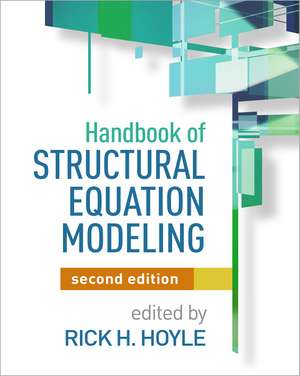
Handbook of Structural Equation Modeling, Second Edition
Editat de Rick H. Hoyleen Limba Engleză Hardback – 31 mar 2023
Observăm că aplicabilitatea practică a modelării prin ecuații structurale (SEM) a evoluat considerabil în ultimul deceniu, iar această a doua ediție a Handbook of Structural Equation Modeling sintetizează tocmai aceste progrese tehnice și metodologice. Credem că forța acestui volum rezidă în capacitatea de a ghida cercetătorul de la fundamentele teoretice — cum ar fi bazele cauzale prezentate de Judea Pearl — până la implementări de ultimă oră în machine learning și dinamica SEM. Structura este riguros etapizată: prima parte clarifică ipotezele, vizualizarea și estimarea, în timp ce secțiunile următoare explorează tipuri de modele pentru cauze neobservate și aplicații specializate.
Merită menționat că, spre deosebire de prima ediție, acest manual integrează direct soluții computaționale, oferind cod în Mplus și R (lavaan), ceea ce facilitează tranziția de la teorie la analiza propriilor date. Considerăm volumul o alternativă robustă la Structural Equation Modeling de Gregory R. Hancock pentru cursurile de statistică avansată în științele comportamentale, având avantajul unei acoperiri extinse a noilor dezvoltări, precum modelele bifactor sau amestecurile de modele (mixture models). În contextul operei editorului Rick H. Hoyle, această lucrare completează preocupările sale pentru metodologii riguroase, reflectate anterior în Statistical Strategies for Small Sample Research, oferind însă aici un cadru mult mai vast, de tip resursă unică pentru întreaga disciplină.
Preț: 866.72 lei
Preț vechi: 952.45 lei
-9%
Carte disponibilă
Livrare economică 16-30 mai
Livrare express 05-09 mai pentru 69.59 lei
Specificații
ISBN-10: 1462544649
Pagini: 785
Dimensiuni: 188 x 237 x 42 mm
Greutate: 1.44 kg
Ediția:2 ed
Editura: Guilford Publications
Colecția Guilford Press
De ce să citești această carte
Recomandăm acest manual cercetătorilor și studenților la doctorat care au nevoie de o referință tehnică actualizată pentru analiza datelor complexe. Cititorul câștigă acces la expertiza a zeci de metodologi de top și, esențial, la instrumentele practice (cod R/Mplus) necesare pentru a implementa modele sofisticate. Este resursa definitivă pentru a înțelege nu doar cum se rulează un model, ci și logica matematică și cauzală din spatele acestuia.
Despre autor
Rick H. Hoyle este profesor de cercetare în cadrul Departamentului de Psihologie și Neuroștiințe de la Universitatea Duke, având un doctorat obținut la University of North Carolina at Chapel Hill. Expertiza sa acoperă fundamentele stimei de sine și rolul personalității în comportamentele problemă, însă este recunoscut la nivel internațional pentru contribuțiile sale în metodologie. Activitatea sa se concentrează pe utilizarea strategică a modelării prin ecuații structurale pentru a descifra procese psihologice complexe, o viziune care fundamentează întreaga structură a acestui manual de referință.
Notă biografică
Descriere scurtă
New to This Edition
*Chapters on additional topics not mentioned above: SEM-based meta-analysis, dynamic SEM, machine-learning approaches, and more.
*Chapters include computer code associated with example analyses (in Mplus and/or the R package lavaan), along with written descriptions of results.
*60% new material reflects a decade's worth of developments in the mechanics and application of SEM.
*Many new contributors and fully rewritten chapters.
Cuprins
1. Structural Equation Modeling: An Overview, Rick H. Hoyle
2. A Brief History of Structural Equation Modeling, Ross L. Matsueda
3. The Causal Foundations of Structural Equation Modeling, Judea Pearl
4. Visualizations for Structural Equation Modeling, Jolynn Pek, Erin K. Davisson, & Rick H. Hoyle
5. Latent Variables in Structural Equation Modeling, Kenneth A. Bollen & Rick H. Hoyle
6. Simulation Methods in Structural Equation Modeling, Walter L. Leite, Deborah L. Bandalos, & Zuchao Shen
7. Assumptions in Structural Equation Modeling, Rex B. Kline
8. On the Estimation of Structural Equation Models with Latent Variables, Yunxiao Chen, Irini Moustaki, & Siliang Zhang
9. Power Analysis within a Structural Equation Modeling Framework, Yi Feng & Gregory R. Hancock
10. Model Fit in Structural Equation Modeling, Stephen G. West, Wei Wu, Daniel McNeish, & Andrea Savord
11. Model Selection in Structural Equation Modeling, Kristopher J. Preacher & Haley E. Yaremych
12. Fitting Structural Equation Models with Missing Data, Craig K. Enders
13. Structural Equation Modeling with the Mplus and lavaan Programs, Christian Geiser
II. Basic Models and Applications
14. Confirmatory Factor Analysis, Timothy A. Brown
15. Confirmatory Measurement Models for Dichotomous and Ordered Polytomous Indicators, Natalie A. Koziol
16. Item Parceling in SEM: A Researcher Degree-of-Freedom Ripe for Opportunistic Use, Sonya K. Sterba & Jason D. Rights
17. Using Factor Scores in Structural Equation Modeling, Ines Devlieger & Yves Rosseel
18. Bifactor Measurement Models, Steven P. Reise, Maxwell Mansolf, & Mark G. Haviland
19. Multitrait-Multimethod Models, Michael Eid, Tobias Koch, & Christian Geiser
20. Investigating Measurement Invariance Using Confirmatory Factor Analysis, Keith F. Widaman & Margarita Olivera-Aguilar
21. Flexible Structural Equation Modeling Approaches for Analyzing Means, Marilyn S. Thompson, Yixing Liu, & Samuel B. Green
22. Mediation/Indirect Effects in Structural Equation Modeling, Oscar Gonzalez, Matthew J. Valente, Jeewon Cheong, & David P. MacKinnon
23. Latent Interaction Effects, Augustin Kelava & Holger Brandt
24. Dynamic Moderation with Latent Interactions: General Cross-lagged Panel Models with Interaction Effects Over Time, Michael J. Zyphur & Ozlem Ozkok
25. Psychometric Scale Evaluation Using Structural Equation Modeling and Latent Variable Modeling, Tenko Raykov
26. Multilevel Structural Equation Modeling, Ronald H. Heck & Tingting Reid
III. Specialized and Advanced Models and Applications
27. Exploratory Structural Equation Modeling, Alexandre J. S. Morin
28. Structural Equation Modeling with Small Samples and Many Variables, Katerina M. Marcoulides, Ke-Hai Yuan, & Lifang Deng
29. Mixture Models, Douglas Steinley
30. Latent Curve Modeling of Longitudinal Growth Data, Kevin J. Grimm & John J. McArdle
31. Dynamic Structural Equation Modeling as a Combination of Time Series Modeling, Multilevel Modeling, and Structural Equation Modeling, Ellen L. Hamaker, Tihomir Asparouhov, & Bengt Muthén
32. Continuous-Time Dynamic Models: Connections to Structural Equation Models and Other Discrete-Time Models, Sy-Miin Chow, Diane Losardo, Jonathan Park, & Peter C. M. Molenaar
33. Latent Trait-State Models, David A. Cole & Qimin Liu
34. Longitudinal Models for Assessing Dynamics in Dyadic Data, Meng Chen, Hairong Song, & Emilio Ferrer
35. Structural Equation Modeling in Genetics, Susanne Bruins, Sanja Franić, Conor V. Dolan, Denny Borsboom, & Dorret I. Boomsma
36. Structural Equation Modeling (SEM)-Based Meta-Analysis, Mike W.-L. Cheung
37. Nonlinear Structural Equation Models: Advanced Methods and Applications, Jeffrey R. Harring & Jinwang Zou
38. Foundations and Extensions of Bayesian Structural Equation Modeling, Sarah Depaoli, David Kaplan, & Sonja D. Winter
39. Machine Learning Approaches to Structural Equation Modeling, Andreas M. Brandmaier & Ross C. Jacobucci
Recenzii
"The world of SEM--in terms of both applications and methodological advances--has expanded dramatically in recent years. Just learning SEM in the first place can be hard enough, let alone keeping up with all of the new developments. The second edition of this handbook is an invaluable resource for anyone seeking a comprehensive summary of current possibilities and best practices using SEM. The authors are all leading experts who have tackled an exhaustive list of topics, with an eye toward accessibility for new learners, but without shying away from the material’s inherent complexity."--Lesa Hoffman, PhD, Department of Psychological and Quantitative Foundations, College of Education, University of Iowa
"SEM provides unity to disparate analyses and facilitates model evaluation and modification in the everyday practice of uncountable researchers. This is an impressive, 'must-read' book for practitioners of SEM and those who want to apprehend the strength and usefulness of the SEM idea."--Albert Satorra, PhD, Emeritus Professor of Statistics, Universitat Pompeu Fabra, Barcelona, Spain
“This handbook is an outstanding desk reference on a wide variety of advanced and foundational topics. I recommend it either for personal use or for a class with students with strong quantitative backgrounds. The second edition has excellent coverage of exciting developments regarding analysis of longitudinal data. The chapter authors are a 'who's who' of the field.”--Jeffrey S. Simons, PhD, Department of Psychology, University of South Dakota
“I have always recommended this book for anyone interested in conducting or teaching SEM. The second edition continues to be my favorite comprehensive SEM reference book, with new chapters covering advanced topics.”--Dana Joseph, PhD, College of Business Administration, University of Central Florida-The breadth of topics covered in this reference text leaves little doubt that a firm grasp of data analysis with latent variables is essential to the advancement of scholarship in the social and behavioral sciences....An excellent resource for the many conceptual and analytical problems frequently encountered by researchers making use of SEM….Readers will find themselves returning to the Handbook again and again as a starting point for their work on virtually any topic currently within the broad reach of SEM. (on the first edition)--Structural Equation Modeling, 4/1/2013