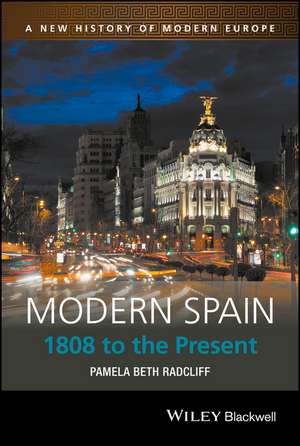
Modern Spain
Autor Pamela Beth Radcliffen Limba Engleză Hardback – 15 mai 2017
Găsim în această carte o abordare care prioritizează interdisciplinaritatea, integrând analiza istorică cu elemente de sociologie, economie politică și studii culturale. Modern Spain – 1808 to the Present nu se limitează la o simplă trecere în revistă a evenimentelor politice, ci explorează modul în care structurile sociale și evoluțiile economice pe termen lung au modelat statul spaniol contemporan. Putem afirma că lucrarea semnată de PB Radcliff reușește să plaseze Spania într-un context european și global extins, eliminând percepția izolării istorice a peninsulei. Merită menționat că structura volumului este una duală: narațiunea cronologică este susținută de capitole separate care aprofundează dezvoltările culturale și mișcările sociale. Această metodă oferă o claritate conceptuală necesară pentru înțelegerea unor teme complexe precum tranziția către democrație sau ascensiunea naționalismelor regionale. Tonul este unul academic precis, adaptat cerințelor curriculare moderne, punând accent pe interpretarea datelor recente în detrimentul descrierilor pur anecdotice. Completează perspectiva oferită de The History of Modern Spain de Professor Adrian Shubert, adăugând o analiză mai strâns corelată cu noile teorii despre modernitate și dinamica mișcărilor sociale, dincolo de istoria tematică a genului sau a mediului. De asemenea, spre deosebire de Spain since 1812 de Christopher Ross, care se concentrează pe extrase de texte și termeni lingvistici pentru studenții de limbi străine, volumul de față, publicat de Wiley, se adresează cu precădere studenților de istorie, oferind un cadru teoretic robust pentru analiza proceselor de democratizare și a conflictelor ideologice care au definit Spania modernă.
Preț: 443.13 lei
Preț vechi: 653.68 lei
-32%
Carte indisponibilă temporar
Specificații
ISBN-10: 1405186798
Pagini: 384
Dimensiuni: 152 x 231 x 23 mm
Greutate: 0.61 kg
Editura: Wiley
Locul publicării:Chichester, United Kingdom
V-ar putea interesa
-
 -20%Preț: 303.76 lei378.53 lei
 -
 -31%Preț: 787.86 lei1145.69 lei
 -
 The Voices of Nîmes: Women, Sex, and Marriage in Reformation LanguedocSuzannah LipscombPreț: 378.53 lei
 -
 Global Russian CulturesKevin M. F. Platt-23%Preț: 481.17 lei624.90 lei
 -
 From Mobilization to Civil WarPamela Beth RadcliffPreț: 345.92 lei
 -
 -27%Preț: 742.91 lei1017.68 lei
 -
 Preț: 422.10 lei
 -
 Pagan Religions Ancient BritishRonald HuttonPreț: 353.09 lei
 -
 Preț: 485.57 lei
 -
 Interpreting Christian HistoryEuan CameronPreț: 349.36 lei
 -
 Preț: 479.22 lei
 -
 Preț: 389.93 lei
 -
 -23%Preț: 450.50 lei585.07 lei
 -
 -23%Preț: 448.03 lei581.85 lei
 -
 RussiaPetra RethmannPreț: 234.00 lei
 -
 Not for King or CountryTyler WentzellPreț: 363.57 lei
 -
 Stalin's Gulag at WarWilson T BellPreț: 308.41 lei
 -
 Preț: 456.02 lei
 -
 British Policy Towards Poland, 1944-1956Andrea Mason-15%Preț: 517.24 lei608.51 lei
 -
 Convivencia and Medieval SpainMark T. Abate-18%Preț: 784.93 lei957.23 lei
 -
 Renaissance Responses to Technological ChangeSheila J. Nayar-15%Preț: 611.22 lei719.08 lei
 -
 -18%Preț: 712.31 lei868.66 lei
 -
 Teaching Migrant Children in West Germany and Europe, 1949-1992Brittany Lehman-15%Preț: 518.36 lei609.83 lei
 -
 Cypriot Nationalisms in ContextNikos Christofis-18%Preț: 814.67 lei993.51 lei
Public țintă
Undergraduate and graduate level students for courses in Spanish history and modern European historyDe ce să citești această carte
Această lucrare este esențială pentru studenții și cercetătorii interesați de istoria europeană modernă. Cititorul câștigă o înțelegere profundă a modului în care Spania a evoluat de la 1808 până azi, beneficiind de o sinteză actualizată a cercetărilor recente. Este un instrument academic riguros care explică tensiunile dintre tradiție și modernitate într-un format accesibil și bine structurat.
Despre autor
PB Radcliff este un istoric specializat în istoria modernă a Spaniei, recunoscut pentru rigoarea cercetărilor sale privind mobilizarea politică și societatea civilă. Contribuțiile sale în domeniu se concentrează pe tranziția Spaniei către modernitate, explorând adesea intersecția dintre politicile de stat și mișcările sociale de la bază. În volumul de față, publicat în seria A New History of Modern Europe, autorul aplică o metodologie comparativă, menită să integreze parcursul istoric spaniol în tendințele majore ale continentului european.
Descriere scurtă
Notă biografică
Cuprins
Preface xii
Acknowledgments xvi
Abbreviations and Glossary of Foreign Terms xviii
Political Chronology of Spanish History, 1808-2016 xxii
Part I: 1808-1868: The Era of the Liberal Revolution 1
1 Spain in the "Age of Revolutions" 3
Spain in Europe and the World, 1780s-1820 4
A Snapshot of the Economy: Gradual Growth 7
Uneven Regional Development: Center/Periphery Divide 10
The Mediterranean Regional Network 10
The North Atlantic Regional Network 11
Regional Networks of the Center 12
Demography: A Growth Pattern 14
Characteristics of the Population: Occupation and Social Structure 15
Culture and Community 18
Political Crisis, 1808-1814 20
Dynastic Crisis 20
War and Resistance 21
The Cortes of Cádiz and the Constitution of 1812 22
A Spanish "Constitutional Culture" 23
The End of the Revolutionary Era 25
Conclusion 26
2 Political Transformation: From the Old Regime to the Liberal State, 1814-1868 28
Introduction: The Liberal Revolution in Comparative Context 28
The Major Players 31
Moderate and Progressive Parties 31
The Military and Pronunciamientos 32
The Crown 32
Popular/Local Mobilization 33
Counter?]revolution: Carlists 33
The Catholic Church 34
Chronology: From the Restoration of Absolutism to the Construction and Crisis of the Liberal State, 1814-1868 35
1814-1833: The Restoration and Demise of the Absolutist State 35
Restoration of Absolutism, 1814-1820 35
The Liberal "Trienio," 1820-23 36
Return to Absolutism, 1823-34 38
1833-1845: The Construction of the Liberal State 39
The Carlist War 39
Moderate and Progressive Constitutions and Platforms 40
The Parameters of a Liberal Political, Juridical and Administrative Order, 1833-45 42
1845-1868: The Liberal State: From Consolidation to Crisis 44
Conclusion: Achievements and Limits of the Liberal Political Transformation 45
Part II: 1868-1923: The Emergence of Mass Politics 49
3 Politics on the Margins of the Liberal State: From 1848 to the "Sexenio" (1868-1874) 51
Introduction: Mid?]Nineteenth?]century Popular Politics in Comparative Perspective 51
The Major Players 54
Carlists 54
Cuban Separatists 55
Democrats and Republicans 56
The Labor Movement and the First International 58
The First Democracy: The Sexenio, 1868-1874 60
The September 1868 Revolution 60
The Democratic Monarchy (June 1869-February 1873) 61
The Republic (February 12, 1873-January 4, 1874) 63
Conclusion 65
4 A New Era of Liberal Politics: The Second Restoration, 1875-1898 67
The Restoration in Comparative Context: State,
Nation, Empire and Democracy 68
The Multiple Faces of the Restoration Regime 71
Constructing a New Constitutional Regime: Antonio Cánovas del Castillo and the turno pacífico 71
The Dark Side of the Turno: Electoral Fraud and Caciquismo 74
Evaluating the Constraints and Opportunities of Restoration Politics 75
Constraints on Political Liberties Imposed by the State 75
Political Constraints and Opportunities: The View "From Below" 77
The "Disaster" of 1898: The Start of a New Era? 80
5 Restoration Politics: From Fin de Siècle to Postwar Crisis, 1898-1923 83
Introduction: Early Twentieth?]Century Spanish Politics in Comparative Context 83
1898-1914: Efforts to Reform the Regime "From Above" 85
The Conservative Party and Antonio Maura 86
The Liberal Party and José Canalejas 87
1914-23: From Elite Reform to Mass Mobilization: Alternative Political Projects 90
The First World War in Spain 90
From the Turno to Fragmentation of the Liberal and Conservative Parties, 1913-23 91
Movements on the Right 92
Catholic Mobilization 92
Basque Nationalism (PNV/CNV) 93
Mauristas/Spanish Nationalism 94
Movements on the Left 95
Socialists (PSOE/UGT) 95
Anarcho?]syndicalists (CNT) 96
Movements of the Center 97
Republicanism 97
Catalanism/LLiga 98
Turning Points in the Crisis of the Restoration, 1917-23 99
The Democratic Assembly Movement, 1917 100
The La Canadiense Strike, 1919 101
A Last Effort at Reform "From Above," 1920-23? 102
Conclusion 103
Part III: The Long View: Social, Economic and Cultural Change, 1830-1930 105
6 Economic and Demographic Evolution: 1830-1930 107
Spain in the World Economy, 1830-1930 108
General Economic and Population Trends: Gradual Growth and Structural Evolution 110
The Agricultural Sector 113
The Industrial Sector 115
Uneven Regional Development: Center/Periphery Divide 118
Conclusion: Missed Opportunities or Inherent Constraints? 120
7 Culture and Society, 1830-1930 122
Introduction: Social and Cultural Evolution in Comparative Perspective 122
The Social Order: Evolution and Diversity 124
A Hybrid Elite 125
The Urban Middle Classes 126
The Popular Classes or "el pueblo" 127
Rural Society 128
Sociability and Identity: A Diverse and Evolving Cultural Landscape 129
A New Urban Culture: Encoding Social Hierarchy in the Public Sphere 130
On the Margins of Middle Class Culture: The Avant?]Garde and the Modern Woman 133
Urban Popular Sociability and Mass Culture 134
The Catholic Church, Religion and Rural Society 136
Local, Regional and National Cultures and Identities 139
Conclusion 142
Part IV: Dictatorship and Democracy, 1923-Present 143
8 The First Dictatorship: The Primo de Rivera Regime, 1923-1930 145
Introduction: The Primo Regime in Comparative Perspective 145
From Coup to "Temporary" Dictatorship, 1923-1925 148
Elements of a New Kind of Dictatorship: The Civil Directory, 1925-1929 149
Labor Relations 150
Nationalization Campaigns 151
Authoritarian Development 153
End of the Dictatorship, 1929-1930 154
Political Transition to a Republic, 1930-1931 155
Conclusion 156
9 The Second Republic: 1931-1936 158
The Second Republic in Comparative Perspective 159
Periodization: The Shifting Majority Coalitions of the Second Republic 161
The First Biennium (1931-1933): Pursuing a Center/Left Majority Coalition 164
What Went Wrong with the First Biennium? 167
Mobilizing against the Coalition 167
A Disintegrating Majority Coalition 169
The Second Biennium, 1933-1935: Pursuing a Center/Right Majority Coalition 173
What Went Wrong with the Second Biennium? 175
Mobilizing against the Coalition 176
An Unconsolidated Majority Coalition 178
The Popular Front, February-July 1936 180
What Went Wrong with the Popular Front? 181
Conclusion 182
10 The Civil War: 1936-1939 184
The Civil War in Comparative Perspective 185
From Military Coup to Civil War: The Summer of 1936 187
The Rebel Forces in the Summer of 1936 188
Ideology and Violence in Rebel Territory 190
The Loyalist Forces during the Summer of 1936 191
Revolution in Republican Territory 191
Violence in Republican Territory 194
Organizing for the Long War: The Republicans 195
Foreign Aid 196
Reconstructing a Republican State 198
Organizing for the Long War: The Nationalists 201
Constructing a "New State" 201
Foreign Aid 203
The Military Stages of the War 204
Conclusion 207
11 The Second Dictatorship: The Franco Regime, 1939-1976 209
The Franco Regime in Comparative Perspective 210
Periodization: The Stages of the Franco Dictatorship 212
Phase One, 1936-1945: Militarization, Fascist Influence and Extreme Repression 214
Phase II, 1945-1957: National Catholicism, Monarchist Restoration and International Integration 218
Phase III, 1957-1969: Authoritarian Development and Institutionalization 221
Phase IV, 1969-1975: Collapse of the Coalition and Death of the Dictator 227
Conclusion 229
12 Economic, Social and Cultural Transformation, 1930s-1970s 230
Economy, Society and Culture in Comparative Perspective 230
Economic and Demographic Trends 232
The "Years of Hunger": Deprivation, Disease and Death in the 1940s 232
From Economic Stagnation to Rapid Growth: 1950s-1970s 234
Structural shift from Agriculture to Industry and Service Sectors 235
Consumption and Population Trends 236
Uneven Benefits 237
Social and Cultural Trends 238
Society and Culture in the Years of Hunger 239
Rupture and Restitution for Winners and Losers 239
Family and Gender 240
The Church, Religion and Education 241
The Public Sphere: Associations and Sociability 242
Social and Cultural Evolution in the Growth Years: 1960s-1970s 244
Migration and Social Mobility 244
Diversification of the Public Sphere 245
The Decline of "Tradition": Youth, Gender and Religion 247
Conclusion 248
13 The Last Democratic Transition: 1976-1982 250
The Transition to Democracy in Comparative Perspective 251
Origins of the Transition: Favorable Factors vs. the 1930s 252
Economic Development 252
Geographic Location: Western Europe 252
Civil Society Mobilization 253
Francoist Elites: Reformers and the Bunker 254
The Institutional Transition: July 1976-December 1978 254
Elite Actors and the "Push from Below," 1976-77 255
The June 1977 Elections and Building Consensus Through "Pacts" 257
The Constitution of 1978 259
The Basque Exception 261
From Transition to Consolidation, 1978-1982 261
Autonomous Governments 262
Local Governments 262
Leadership Crisis and Attempted Coup, 1981 263
The 1982 Election 264
Conclusion 265
14 Democratic State and Social Transformation, 1982-2016 266
The Democratic Era in Comparative Perspective 266
Democratic government under PSOE leadership: 1982-1996 270
Institutionalization and European Integration 270
Neo?]Liberalism and Social Welfare 272
The End of the PSOE Era 273
From Consolidation to Crispación: PP and PSOE alternation from 1996 to 2011 274
Political Polarization 275
State/Regional Polarization 277
Democratic Society 277
2008-2016: Crisis and Uncertainty 278
Conclusion 280
Notes 282
Works Cited 314
Index 336