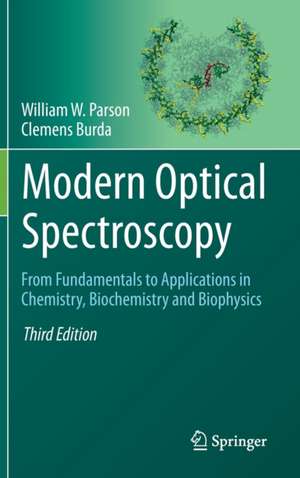
Modern Optical Spectroscopy
Autor William W. Parson, Clemens Burdaen Limba Engleză Hardback – mar 2023
Topics included are:
- electronic and vibrational absorption
- fluorescence
- symmetry operations and normal-mode calculations
- electron transfer from excited molecules energy transfer
- exciton interactions
- electronic and vibrational circular dichroism
- coherence and dephasing
- ultrafast pump-probe and photon-echo spectroscopy
- single-molecule and fluorescence-correlation spectroscopy
- Raman scattering
- multiphoton absorption
- quantum optics and non-linear optics
- entropy changes during photoexcitation
- electronic and vibrational Stark effects
- studies of fast processes in single molecules
- two-dimensional electronic and vibrational spectroscopy
Preț: 947.85 lei
Preț vechi: 1155.91 lei
-18%
Puncte Express: 1422
Carte tipărită la comandă
Livrare economică 28 noiembrie-12 decembrie
Livrare prin curier în România Termenul estimat este afișat lângă disponibilitate.
Transport gratuit pentru acest produs Plată online sau ramburs, în funcție de opțiunile comenzii.
Retur gratuit în 14 zile Comandă securizată și suport în română.
Specificații
ISBN-13: 9783031172212
ISBN-10: 3031172213
Pagini: 664
Ilustrații: XII, 650 p. 1 illus.
Dimensiuni: 160 x 241 x 41 mm
Greutate: 1.1 kg
Ediția:Third Edition 2023
Editura: Springer
Locul publicării:Cham, Switzerland
ISBN-10: 3031172213
Pagini: 664
Ilustrații: XII, 650 p. 1 illus.
Dimensiuni: 160 x 241 x 41 mm
Greutate: 1.1 kg
Ediția:Third Edition 2023
Editura: Springer
Locul publicării:Cham, Switzerland
Cuprins
Chapter 1: Introduction.- Chapter 2: Basic Concepts Of Quantum Mechanics.- Chapter 3: Light.- Chapter 4: Electronic Absorption.- Chapter 5: Fluorescence.- Chapter 6: Vibrational Absorption.- Chapter 7: Resonance Energy Transfer.- Chapter 8: Exciton Interactions.- Chapter 9: Circular Dichroism.- Chapter 10: Coherence And Dephasing.- Chapter 11: Pump-Probe Spectroscopy, Photon Echoes And Vibrational Wavepackets.- Chapter 12: Raman Scattering And Other Two-Photon Processes.
Notă biografică
William W. Parson ist emeritierter Professor für Biochemie und Honorarprofessor für Chemie an der University of Washington. Er erwarb seinen Bachelor-Abschluss an der Harvard University und promovierte in Biochemie an der Western Reserve University. Als Postdoktorand in Biophysik an der University of Pennsylvania begann er, mit gepulsten Lasern die frühen Elektronentransferreaktionen der Photosynthese zu erforschen. Dies führte zur Demonstration, dass die lichtgetriebene Reaktion bei photosynthetischen Bakterien eine Fotooxidation eines Bakteriochlorophyll-Komplexes ist, der dann Elektronen aus einer Reihe von Cytochromen entzieht. Parson setzte diese Studien an der University of Washington fort und nutzte dabei zunehmend schnellere Techniken der Laser- und optischen Spektroskopie. Mit dem Aufkommen der Elektronentransferschritte aus dieser Arbeit und der Aufklärung der Struktur bakterieller photosynthetischer Reaktionszentren durch Kristallographen begann er, spektroskopische Messungen mit rechnergestützten Ansätzen und quantenmechanischer Theorie zu kombinieren, um Faktoren zu erforschen, die die Geschwindigkeit, Spezifität und Temperatur des Elektronentransfers bestimmen. Er hat die Arbeit an der Theorie des Elektronentransfers seit seiner Emeritierung fortgesetzt. Professor Parson hat Freude daran, Studenten im Bachelor- und Masterstudium zu unterrichten, Postdoktoranden zu betreuen und mit internationalen Kollegen zusammenzuarbeiten. Das vorliegende Buch begann als eine Reihe von Vorlesungsnotizen für einen Kurs, den er für Graduierte in molekularer Biophysik unterrichtete. Das Buch aktuell zu halten und in neue Bereiche zu erweitern, sind weiterhin Quellen der Freude. Clemens Burda studierte an der Universität Basel in der Schweiz und setzte sein Graduiertenstudium in Photochemie und Laserspektroskopie unter der Anleitung von Prof. Jakob Wirz fort. Seine frühen Studien zur ultraschnellen chemischen Reaktivität führten zur spektroskopischen Identifizierung kurzlebiger Zwischenprodukte, einschließlich Singulett- und Triplett-Zustände von Nitrenen. Weitere Studien umfassten die Photochemie aromatischer Moleküle in Wasser, was zur Entdeckung mehrerer reaktiver Zwischenprodukte führte, als Excimer- und Farbstofflaser state-of-the-art waren, um Sub-Pikosekunden-Zeitaufklärung zu erreichen. Sein wachsendes Interesse an ultraschneller Spektroskopie führte ihn zu Postdoktorandenstudien in Femtosekundenspektroskopie bei Prof. Mostafa El-Sayed am Georgia Institute of Technology, wo er mit Festkörperlasern, OPAs und nichtlinearer Optik arbeitete, die heute in Spektroskopielabors weit verbreitet sind. Seit 2001 ist Clemens Burda Professor an der Case Western Reserve University, wo er den Lehrstuhl für Chemie innehat und das Zentrum für Chemiedynamik und das Nanomaterials Research Lab leitet. Seine Interessen umfassen Femtosekunden-zeitlich aufgelöste Spektroskopie undBildgebung von Molekülen, Halbleiter- und metallischen Nanomaterialien sowie die Entwicklung erneuerbarer Energien. Ein weiterer Schwerpunkt seiner Forschung ist die Entwicklung von Bildgebungsmodalitäten zur Identifizierung frühzeitiger Krankheiten, lichtgetriebener Therapien und ihrer thermischen Steuerung. Professor Burda ist ein begeisterter Pädagoge, der über 30 Graduierte betreut hat und es genießt, Spektroskopie an Studenten auf allen Ebenen zu unterrichten.
Textul de pe ultima copertă
The 3rd edition of this textbook offers clear explanations of optical spectroscopic phenomena and shows how spectroscopic techniques are used in modern chemistry, biochemistry and biophysics.
Topics included are:
The explanations are sufficiently thorough and detailed to be useful for researchers, graduate students and advanced undergraduates in chemistry, biochemistry and biophysics. They are based on time-dependent quantum mechanics, but are developed from first principles so that they can be understood by readers with little prior training in the field. Additional topics and highlights are presented in special boxes in the text. The book is richly illustrated with color figures throughout. Each chapter ends with a section of questions for self-examination.
Topics included are:
- electronic and vibrational absorption
- fluorescence
- symmetry operations and normal-mode calculations
- electron transfer from excited molecules
- energy transfer
- exciton interactions
- electronic and vibrational circular dichroism
- coherence and dephasing
- ultrafast pump-probe and photon-echo spectroscopy
- single-molecule and fluorescence-correlation spectroscopy
- Raman scattering
- multiphoton absorption
- quantum optics and non-linear optics
- entropy changes during photoexcitation
- electronic and vibrational Stark effects
- studies of fast processes in single molecules
- two-dimensional electronic and vibrational spectroscopy
The explanations are sufficiently thorough and detailed to be useful for researchers, graduate students and advanced undergraduates in chemistry, biochemistry and biophysics. They are based on time-dependent quantum mechanics, but are developed from first principles so that they can be understood by readers with little prior training in the field. Additional topics and highlights are presented in special boxes in the text. The book is richly illustrated with color figures throughout. Each chapter ends with a section of questions for self-examination.
Caracteristici
Fully updated and expanded new edition of the successful textbook Richly illustrated; color illustrations throughout Question section in each chapter