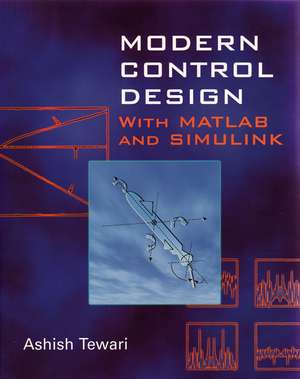
Modern Control Design
Autor Ashish Tewarien Limba Engleză Paperback – 26 mar 2002
> * Easily read and understood. * MATLAB/SIMULINK examples clear, concise, and directly integrated into the text. * Students learn to use MATLAB/SIMULINK as tools (not as black boxes). * Comprehensive coverage of topics, from classical control to optimal, robust, state-space control.
Preț: 549.21 lei
Preț vechi: 713.25 lei
-23%
Puncte Express: 824
Carte tipărită la comandă
Livrare economică 27 noiembrie-11 decembrie
Livrare prin curier în România Termenul estimat este afișat lângă disponibilitate.
Transport gratuit pentru acest produs Plată online sau ramburs, în funcție de opțiunile comenzii.
Retur gratuit în 14 zile Comandă securizată și suport în română.
Specificații
ISBN-13: 9780471496793
ISBN-10: 0471496790
Pagini: 520
Ilustrații: illustrations
Dimensiuni: 191 x 235 x 28 mm
Greutate: 0.93 kg
Ediția:0003
Editura: Wiley
Locul publicării:Chichester, United Kingdom
ISBN-10: 0471496790
Pagini: 520
Ilustrații: illustrations
Dimensiuni: 191 x 235 x 28 mm
Greutate: 0.93 kg
Ediția:0003
Editura: Wiley
Locul publicării:Chichester, United Kingdom
V-ar putea interesa
-
 Introduction to Optimum DesignJasbir Singh Arora-32%Preț: 721.59 lei1059.00 lei
 -
 Signals and Systems Using MATLAB®Aydin Akan-32%Preț: 669.76 lei981.55 lei
 -
 -23%Preț: 175.25 lei227.99 lei
 -
 Linear System Theory: The State Space ApproachLofti A. ZadehPreț: 207.90 lei
 -
 Optimal Control and EstimationRobert F. Stengel-20%Preț: 212.35 lei264.50 lei
 -
 Introduction to Nonlinear ControlChristopher M Kellett-14%Preț: 548.46 lei637.75 lei
 -
 Understanding Process Dynamics and ControlCostas Kravaris-9%Preț: 835.70 lei918.35 lei
 -
 Linear Multivariable Control SystemsShankar P Bhattacharyya-11%Preț: 667.91 lei750.46 lei
 -
 Kalman Filtering: Theory and Practice with MATLABMohinder S. Grewal-5%Preț: 662.84 lei697.72 lei
 -
 Aircraft Control and SimulationBrian L Stevens-23%Preț: 956.58 lei1242.31 lei
 -
 Digital Control System Analysis & Design, Global EditionCharles Phillips-15%Preț: 687.09 lei808.34 lei
 -
 MechatronicsW. Bolton-11%Preț: 666.56 lei748.94 lei
 -
 -11%Preț: 676.58 lei760.19 lei
 -
 -11%Preț: 674.61 lei758.00 lei
 -
 Linear Parameter-Varying ControlOlivier Sename-23%Preț: 718.87 lei933.60 lei
 -
 Automatic Control with Interactive ToolsJosé Luis Guzmán-15%Preț: 516.12 lei607.19 lei
 -
 Robust and Adaptive ControlEugene LavretskyPreț: 533.14 lei
 -
 Signals and Systems with MATLAB® and Simulink®Farzin AsadiPreț: 431.01 lei
 -
 Advanced Control Methods for Industrial ProcessesPablo A. López-Pérez-23%Preț: 698.89 lei907.65 lei
Public țintă
Undergraduate students in all types of Engineering (Electrical, Mechanical, Civil, Aerospace, Chemical) taking first course in Control Systems, or Feedback Control Systems, at 3rd/4th year level. Professional Engineers wanting an update on modern control methods.Notă biografică
Ashish Tewari is a Professor in the Department of Aerospace Engineering at the IIT-Kanpur. He specializes in flight mechanics and control, and his research areas include attitude dynamics and control, re-entry flight dynamics and control, non-linear optimal control and active control of flexible flight and structures.
Cuprins
Preface xiii
1. Introduction 1
1.1 What is Control? 1
1.2 Open-Loop and Closed-Loop Control Systems 2
1.3 Other Classifications of Control Systems 6
1.4 On the Road to Control System Analysis and Design 10
1.5 MATLAB, SIMULINK, and the Control System Toolbox 11
References 12
2. Linear Systems and Classical Control 13
2.1 How Valid is the Assumption of Linearity? 13
2.2 Singularity Functions 22
2.3 Frequency Response 26
2.4 Laplace Transform and the Transfer Function 36
2.5 Response to Singularity Functions 51
2.6 Response to Arbitrary Inputs 58
2.7 Performance 62
2.8 Stability 71
2.9 Root-Locus Method 73
2.10 Nyquist Stability Criterion 77
2.11 Robustness 81
2.12 Closed-Loop Compensation Techniques for Single-Input, Single-Output Systems 87
2.12.1 Proportional-integral-derivative compensation 88
2.12.2 Lag, lead, and lead-lag compensation 96
2.13 Multivariable Systems 105
Exercises 115
References 124
3. State-Space Representation 125
3.1 The State-Space: Why Do I Need lt? 125
3.2 Linear Transformation of State-Space Representations 140
3.3 System Characteristics from State-Space Representation 146
3.4 Special State-Space Representations: The Canonical Forms 152
3.5 Block Building in Linear, Time-Invariant State-Space 160
Exercises 168
References 170
4. Solving the State-Equations 171
4.1 Solution of the Linear Time Invariant State Equations 171
4.2 Calculation of the State-Transition Matrix 176
4.3 Understanding the Stability Criteria through the State-Transition Matrix 183
4.4 Numerical Solution of Linear Time-Invariant State-Equations 184
4.5 Numerical Solution of Linear Time-Varying State-Equations 196
4.6 Numerical Solution of Nonlinear State-Equations 204
4.7 Simulating Control System Response with SIMULINK 213
Exercises 216
References 218
5. Control System Design in State-Space 219
5.1 Design: Classical vs. Modern 219
5.2 Controllability 222
5.3 Pole-Placement Design Using Full-State Feedback 228
5.3.1 Pole-placement regulator design for single-input plants 230
5.3.2 Pole-placement regulator design for multi-input plants 245
5.3.3 Pole-placement regulator design for plants with noise 247
5.3.4 Pole-placement design of tracking systems 251
5.4 Observers, Observability, and Compensators 256
5.4.1 Pole-placement design of full-order observers and compensators 258
5.4.2 Pole-placement design of reduced-order observers and compensators 269
5.4.3 Noise and robustness issues 276
Exercises 277
References 282
6. Linear Optimal Control 283
6.1 The Optimal Control Problem 283
6.1.l The general optimal control formulation for regulators 284
6.1.2 Optimal regulator gain matrix and the riccati equation 286
6.2 Infinite-Time Linear Optimal Regulator Design 288
6.3 Optimal Control of Tracking Systems 298
6.4 Output Weighted Linear Optimal Control 308
6.5 Terminal Time Weighting: Solving the Matrix Riccati Equation 312
Exercises 318
References 321
7. Kalman Filters 323
7.1 Stochastic Systems 323
7.2 Filtering of Random Signals 329
7.3 White Noise, and White Noise Filters 334
7.4 The Kalman Filter 339
7.5 Optimal (Linear, Quadratic, Gaussian) Compensators 351
7.6 Robust Multivariable LQG Control: Loop Transfer Recovery 356
Exercises 370
References 371
8. Digital Control Systems 373
8. l What are Digital Systems? 373
8.2 A/D Conversion and the z-Transform 375
8.3 Pulse Transfer Functions of Single-Input, Single-Output Systems 379
8.4 Frequency Response of Single-Input, Single-Output Digital Systems 384
8.5 Stability of Single-Input, Single-Output Digital Systems 386
8.6 Performance of Single-Input, Single-Output Digital Systems 390
8.7 Closed-Loop Compensation Techniques for Single-Input, Single-Output Digital Systems 393
8.8 State-Space Modeling of Multivariable Digital Systems 396
8.9 Solution of Linear Digital State-Equations 402
8.10 Design of Multivariable, Digital Control Systems Using Pole-Placement: Regulators, Observers, and Compensators 406
8.11 Linear Optimal Control of Digital Systems 415
8.12 Stochastic Digital Systems, Digital Kalman Filters, and Optimal Digital Compensators 424
Exercises 432
References 436
9. Advanced Topics in Modern Control 437
9.1 Introduction 437
9.2 H¿ Robust, Optimal Control 437
9.3 Structured Singular Value Synthesis for Robust Control 442
9.4 Time-Optimal Control with Pre-shaped Inputs 446
9.5 Output-Rate Weighted Linear Optimal Control 453
9.6 Nonlinear Optimal Control 455
Exercises 463
References 465
Appendix A: Introduction to MATLAB, SIMULINK and the Control System Toolbox 467
Appendix B: Review of Matrices and Linear Algebra 481
Appendix C: Mass, Stiffness, and Control Influence Matrices of the Flexible Spacecraft 487
Answers to Selected, Exercises 489
Index 495
1. Introduction 1
1.1 What is Control? 1
1.2 Open-Loop and Closed-Loop Control Systems 2
1.3 Other Classifications of Control Systems 6
1.4 On the Road to Control System Analysis and Design 10
1.5 MATLAB, SIMULINK, and the Control System Toolbox 11
References 12
2. Linear Systems and Classical Control 13
2.1 How Valid is the Assumption of Linearity? 13
2.2 Singularity Functions 22
2.3 Frequency Response 26
2.4 Laplace Transform and the Transfer Function 36
2.5 Response to Singularity Functions 51
2.6 Response to Arbitrary Inputs 58
2.7 Performance 62
2.8 Stability 71
2.9 Root-Locus Method 73
2.10 Nyquist Stability Criterion 77
2.11 Robustness 81
2.12 Closed-Loop Compensation Techniques for Single-Input, Single-Output Systems 87
2.12.1 Proportional-integral-derivative compensation 88
2.12.2 Lag, lead, and lead-lag compensation 96
2.13 Multivariable Systems 105
Exercises 115
References 124
3. State-Space Representation 125
3.1 The State-Space: Why Do I Need lt? 125
3.2 Linear Transformation of State-Space Representations 140
3.3 System Characteristics from State-Space Representation 146
3.4 Special State-Space Representations: The Canonical Forms 152
3.5 Block Building in Linear, Time-Invariant State-Space 160
Exercises 168
References 170
4. Solving the State-Equations 171
4.1 Solution of the Linear Time Invariant State Equations 171
4.2 Calculation of the State-Transition Matrix 176
4.3 Understanding the Stability Criteria through the State-Transition Matrix 183
4.4 Numerical Solution of Linear Time-Invariant State-Equations 184
4.5 Numerical Solution of Linear Time-Varying State-Equations 196
4.6 Numerical Solution of Nonlinear State-Equations 204
4.7 Simulating Control System Response with SIMULINK 213
Exercises 216
References 218
5. Control System Design in State-Space 219
5.1 Design: Classical vs. Modern 219
5.2 Controllability 222
5.3 Pole-Placement Design Using Full-State Feedback 228
5.3.1 Pole-placement regulator design for single-input plants 230
5.3.2 Pole-placement regulator design for multi-input plants 245
5.3.3 Pole-placement regulator design for plants with noise 247
5.3.4 Pole-placement design of tracking systems 251
5.4 Observers, Observability, and Compensators 256
5.4.1 Pole-placement design of full-order observers and compensators 258
5.4.2 Pole-placement design of reduced-order observers and compensators 269
5.4.3 Noise and robustness issues 276
Exercises 277
References 282
6. Linear Optimal Control 283
6.1 The Optimal Control Problem 283
6.1.l The general optimal control formulation for regulators 284
6.1.2 Optimal regulator gain matrix and the riccati equation 286
6.2 Infinite-Time Linear Optimal Regulator Design 288
6.3 Optimal Control of Tracking Systems 298
6.4 Output Weighted Linear Optimal Control 308
6.5 Terminal Time Weighting: Solving the Matrix Riccati Equation 312
Exercises 318
References 321
7. Kalman Filters 323
7.1 Stochastic Systems 323
7.2 Filtering of Random Signals 329
7.3 White Noise, and White Noise Filters 334
7.4 The Kalman Filter 339
7.5 Optimal (Linear, Quadratic, Gaussian) Compensators 351
7.6 Robust Multivariable LQG Control: Loop Transfer Recovery 356
Exercises 370
References 371
8. Digital Control Systems 373
8. l What are Digital Systems? 373
8.2 A/D Conversion and the z-Transform 375
8.3 Pulse Transfer Functions of Single-Input, Single-Output Systems 379
8.4 Frequency Response of Single-Input, Single-Output Digital Systems 384
8.5 Stability of Single-Input, Single-Output Digital Systems 386
8.6 Performance of Single-Input, Single-Output Digital Systems 390
8.7 Closed-Loop Compensation Techniques for Single-Input, Single-Output Digital Systems 393
8.8 State-Space Modeling of Multivariable Digital Systems 396
8.9 Solution of Linear Digital State-Equations 402
8.10 Design of Multivariable, Digital Control Systems Using Pole-Placement: Regulators, Observers, and Compensators 406
8.11 Linear Optimal Control of Digital Systems 415
8.12 Stochastic Digital Systems, Digital Kalman Filters, and Optimal Digital Compensators 424
Exercises 432
References 436
9. Advanced Topics in Modern Control 437
9.1 Introduction 437
9.2 H¿ Robust, Optimal Control 437
9.3 Structured Singular Value Synthesis for Robust Control 442
9.4 Time-Optimal Control with Pre-shaped Inputs 446
9.5 Output-Rate Weighted Linear Optimal Control 453
9.6 Nonlinear Optimal Control 455
Exercises 463
References 465
Appendix A: Introduction to MATLAB, SIMULINK and the Control System Toolbox 467
Appendix B: Review of Matrices and Linear Algebra 481
Appendix C: Mass, Stiffness, and Control Influence Matrices of the Flexible Spacecraft 487
Answers to Selected, Exercises 489
Index 495
Descriere
In this book, Tewari emphasizes the physical principles and engineering applications of modern control system design. Instead of detailing the mathematical theory, MATLAB examples are used throughout.