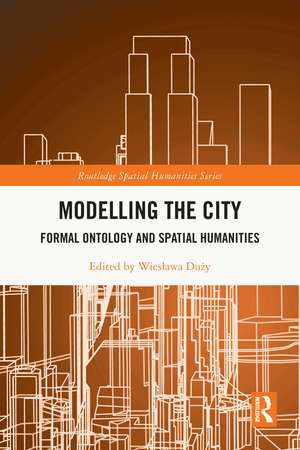
Modelling the City: Formal Ontology and Spatial Humanities: Routledge Spatial Humanities Series
Editat de Wiesława Dużyen Limba Engleză Paperback – 27 oct 2025
This book examines how urban space from the past is discovered, explained and presented. It discusses the multitude of historical sources mediating the past urban space, and the structural, technical, and epistemological issues raised around building a domain ontology, including continuity, and change within urban forms and functions.
Presentation of a formal domain ontology in spatial humanities makes this book unique and worth reading. It is strongly recommended to readers interested in the linked open data approach to research, data standards in Digital Humanities, urban planning, and old maps.


Preț: 398.68 lei
Puncte Express: 598
Carte tipărită la comandă
Livrare economică 30 noiembrie-14 decembrie
Livrare prin curier în România Termenul estimat este afișat lângă disponibilitate.
Transport gratuit de la 400.00 lei Plată online sau ramburs, în funcție de opțiunile comenzii.
Retur gratuit în 14 zile Comandă securizată și suport în română.
Specificații
ISBN-13: 9781032695877
ISBN-10: 1032695870
Pagini: 230
Ilustrații: 70
Dimensiuni: 156 x 234 x 13 mm
Greutate: 0.32 kg
Ediția:1
Editura: Taylor & Francis
Colecția Routledge
Seria Routledge Spatial Humanities Series
Locul publicării:Oxford, United Kingdom
ISBN-10: 1032695870
Pagini: 230
Ilustrații: 70
Dimensiuni: 156 x 234 x 13 mm
Greutate: 0.32 kg
Ediția:1
Editura: Taylor & Francis
Colecția Routledge
Seria Routledge Spatial Humanities Series
Locul publicării:Oxford, United Kingdom
Public țintă
Postgraduate and UndergraduateCuprins
I. Introduction How To Build A Solid House, Or About The Historical Ontology Of The Urban Space Project II. Media, sources, data model 1. Modelling As A Bridge Between Maps, Spatial Concepts, And The Territory; 2. An Ontology Of Geographical Places And Their Spatiotemporal, Social Evolution In The Context Of An Extension Of The CIDOC CRM For The Humanities And Social Sciences (SDHSS); 3. Naming the parts: identifying key features within the urban landscapes of Britain circa 1900 III. Investigating urban space 4. Narrating Szczecin. Creation of urban authenticity through touristic city trails; 5. How names transform space: The change of street names in Poznań and Gdynia in the nineteenth and twentieth centuries; 6. Uncertain information and spatial objects. Examples from works on the HOUSe project and the European Historic Towns Atlas series, Anna-Lena Schumacher IV. Mapping objects in urban space 7. Database of Topographic Objects 10k as the basis of the Historical Ontology of Urban Space ontology – construction, verification, validation; 8. Cartography and the city: Exploring urban ontologies through historic town-maps; 9. Changes in spatial development of Lviv from the second half of 18th century to the present day; Index
Notă biografică
Wiesława Duży is Assistant Professor at the Department of Historical Atlas at the Institute of History, Polish Academy of Sciences. She is also part of a project at the Faculty of History, “People, Places, and Events” of the University of Warsaw, Poland. Her research interests include social history of the eighteenth and nineteenth centuries, domain ontologies in the Humanities and spatial historical databases.
Descriere
This book focuses on European towns and cities, analysing the opportunities and limitations of modelling of urban space. It is strongly recommended to readers interested in the linked open data approach to research, data standards in Digital Humanities, urban planning, and old maps.