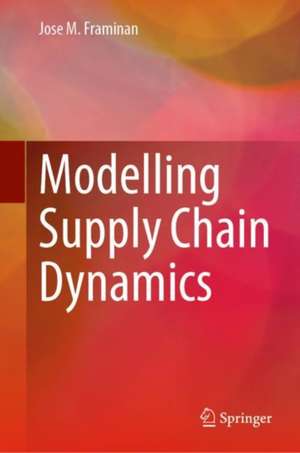
Modelling Supply Chain Dynamics
Autor Jose M. Framinanen Limba Engleză Hardback – 15 aug 2021
This book discusses supply chain management, focusing on developments within modelling the dynamic behaviour of the supply chain. Aimed at postgraduate students, researchers and practitioners, this book provides an in-depth knowledge of the dynamics of supply chains. Business trends such as the globalisation process and the increase of competition across many industrial sectors have forced companies to concentrate on their core competences and to outsource those activities in which they do not excel. As a consequence, companies no longer produce and distribute their goods in isolation, but being part of a supply chain or supply network, i.e. a set of interrelated companies who ultimately deliver the goods and services to the final customer. Despite the prevalence of supply chains as the primary form of production and distribution, their performance can be seriously hampered by the complex dynamics resulting from the collaboration and coordination (or lack thereof) among their members.
This book provides the reader with modelling tools to understand, analyse and improve the dynamic behaviour of supply chains. It assembles seminal works on supply chain models and recent developments on the topic in order to provide a comprehensive, unified vision of the field for researchers and practitioners who wish to grasp the challenges of supply chain management. Aside presenting the main elements, equations and performance indicators governing the dynamics of a supply chain, and the book addresses issues such as the effect of timely and accurately sharing the information across members, the influence of restrictions on the productive capacities of their members, or the impact of the variability of the lead times, among others. Furthermore, more complex supply chain structures such as non-serial supply networks or closed-loop supply chains are modelled and discussed. Relevant managerial insights regarding the causes of supply chain underperformance,as well as avenues to improve their efficiency can be extracted from the resulting models.
Preț: 755.57 lei
Preț vechi: 921.42 lei
-18%
Puncte Express: 1133
Carte tipărită la comandă
Livrare economică 03-17 decembrie
Livrare prin curier în România Termenul estimat este afișat lângă disponibilitate.
Transport gratuit pentru acest produs Plată online sau ramburs, în funcție de opțiunile comenzii.
Retur gratuit în 14 zile Comandă securizată și suport în română.
Specificații
ISBN-13: 9783030791889
ISBN-10: 3030791882
Pagini: 232
Ilustrații: XVI, 216 p. 39 illus., 35 illus. in color.
Dimensiuni: 160 x 241 x 19 mm
Greutate: 0.47 kg
Ediția:1st edition 2022
Editura: Springer
Locul publicării:Cham, Switzerland
ISBN-10: 3030791882
Pagini: 232
Ilustrații: XVI, 216 p. 39 illus., 35 illus. in color.
Dimensiuni: 160 x 241 x 19 mm
Greutate: 0.47 kg
Ediția:1st edition 2022
Editura: Springer
Locul publicării:Cham, Switzerland
Cuprins
Chapter 1. Introduction to Supply Chains.- Chapter 2. Supply Chain Management.- Chapter 3. Supply Chain Dynamics.- Chapter 4. Basic models for SC dynamics.- Chapter 5. The effect of the quality of information in SCD.- Chapter 6. Enriching SC models.- Chapter 7. Closed Loop Supply Chain.- Chapter 8. Modelling complex SC structures.- Chapter 9. Further issues in modelling SC dynamics.- Appendix.- Index.
Notă biografică
Jose M Framinan is an Industrial Engineer and is currently Professor and Head of the Industrial Engineering and Business Management Department in the University of Seville. His research interests refer to decision systems and models in industry and services, including a range of decisions related to the design and optimization of processes, production and supply chain planning and scheduling. In these areas, he has worked intensively on both public-and privately- funded research projects along an 18-year time span, producing over 50 refereed contributions. He has been scientific advisor for a number of international (mostly European and American) research institutions. In addition, he serves in the editorial board of several journals in the domain of Industrial Engineering and Operations Research. Professor Rainer Leisten holds a Master degree (former German Diploma degree) in Mathematics and a PhD in Industrial Management (Business Administration) from the University of Cologne. He also has professional experience as a controller in the financial industry. He received his Habilitation degree (German post-doc degree) from the University of Heidelberg and was Professor in Business Administration and Production Management at the University of Greifswald and at the University of Duisburg. Currently, he is Professor for Business Administration and Operations Management in the Faculty of Engineering of the University of Duisburg-Essen. He published numerous scientific articles in manufacturing scheduling as well as in coordination of complex planning systems and in logistics. His focus on Industrial Engineering led to numerous projects, both on the national and the international level and both with other researchers and companies. Professor Rubén Ruiz holds a PhD in statistics and Operations Research from the Universitat Politècnica de València where he is currently a professor. He has worked in the last 12 years in production planning andscheduling and has published more than 40 articles in international journals. He is co-editor of the "European Journal of Industrial Engineering" international journal and associate editor or member of the editorial board of many prestigious journals. Apart from his academic life, Professor Ruiz has completed more than 30 R+D projects with different companies of several industrial sectors related with production planning, scheduling and logistics. He is currently director of the Applied Optimization Systems Group at the Institute of Informatics where he is closely working with companies, students and colleagues.
Textul de pe ultima copertă
This book discusses supply chain management, focusing on developments within modelling the dynamic behaviour of the supply chain. Aimed at postgraduate students, researchers and practitioners, this book provides an in-depth knowledge of the dynamics of supply chains. Business trends such as the globalisation process and the increase of competition across many industrial sectors have forced companies to concentrate on their core competences and to outsource those activities in which they do not excel. As a consequence, companies no longer produce and distribute their goods in isolation, but being part of a supply chain or supply network, i.e. a set of interrelated companies who ultimately deliver the goods and services to the final customer. Despite the prevalence of supply chains as the primary form of production and distribution, their performance can be seriously hampered by the complex dynamics resulting from the collaboration and coordination (or lack thereof) among their members.
This book provides the reader with modelling tools to understand, analyse and improve the dynamic behaviour of supply chains. It assembles seminal works on supply chain models and recent developments on the topic in order to provide a comprehensive, unified vision of the field for researchers and practitioners who wish to grasp the challenges of supply chain management. Aside presenting the main elements, equations and performance indicators governing the dynamics of a supply chain, and the book addresses issues such as the effect of timely and accurately sharing the information across members, the influence of restrictions on the productive capacities of their members, or the impact of the variability of the lead times, among others. Furthermore, more complex supply chain structures such as non-serial supply networks or closed-loop supply chains are modelled and discussed. Relevant managerial insights regarding the causes of supply chain underperformance,as well as avenues to improve their efficiency can be extracted from the resulting models.
Caracteristici
Discusses the latest developments in dynamic supply chain modeling Brings together research from various fields of thought in a coherent way Provides an in-depth knowledge of supply chain management