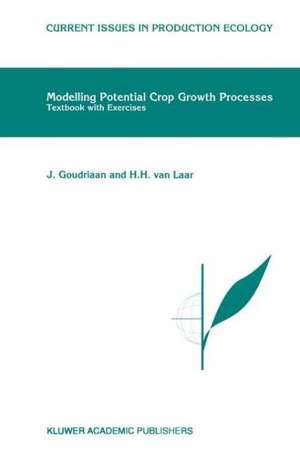
Modelling Potential Crop Growth Processes: Current Issues in Production Ecology, cartea 2
Autor H. H. Van Laar, J. Goudriaanen Limba Engleză Hardback – 31 oct 1994




Preț: 977.72 lei
Preț vechi: 1192.34 lei
-18%
Puncte Express: 1467
Carte tipărită la comandă
Livrare economică 24 noiembrie-08 decembrie
Livrare prin curier în România Termenul estimat este afișat lângă disponibilitate.
Transport gratuit pentru acest produs Plată online sau ramburs, în funcție de opțiunile comenzii.
Retur gratuit în 14 zile Comandă securizată și suport în română.
Specificații
ISBN-13: 9780792332190
ISBN-10: 0792332199
Pagini: 256
Ilustrații: XII, 239 p.
Dimensiuni: 160 x 241 x 19 mm
Greutate: 0.5 kg
Ediția:1994
Editura: SPRINGER NETHERLANDS
Colecția Current Issues in Production Ecology
Seria Current Issues in Production Ecology
Locul publicării:Dordrecht, Netherlands
ISBN-10: 0792332199
Pagini: 256
Ilustrații: XII, 239 p.
Dimensiuni: 160 x 241 x 19 mm
Greutate: 0.5 kg
Ediția:1994
Editura: SPRINGER NETHERLANDS
Colecția Current Issues in Production Ecology
Seria Current Issues in Production Ecology
Locul publicării:Dordrecht, Netherlands
V-ar putea interesa
-
 -18%Preț: 957.96 lei1168.24 lei
 -
 EthyleneWilliam T. Frankenberger Jr.-18%Preț: 983.40 lei1199.28 lei
 -
 Disease Management in CocoaRudgard-5%Preț: 1133.93 lei1193.62 lei
 -
 Animal Feed FormulationGene M. Pesti-18%Preț: 1171.87 lei1429.11 lei
 -
 -18%Preț: 1173.98 lei1431.69 lei
 -
 -18%Preț: 1270.66 lei1549.59 lei
 -
 -18%Preț: 1270.66 lei1549.59 lei
 -
 Green Manure/Cover Crop Systems of Smallholder FarmersMarjatta Eilittä-18%Preț: 990.13 lei1207.48 lei
 -
 -24%Preț: 1240.15 lei1631.77 lei
 -
 -15%Preț: 632.00 lei743.53 lei
 -
 Adventures in Yarn FarmingBarbara ParryPreț: 226.01 lei
Public țintă
ResearchCuprins
1 Introduction.- 1.1 Levels of understanding of crop growth.- 1.2 Growth factors and production situations.- 1.3 CO2 assimilation as a basis.- 1.4 Some general modelling considerations.- 1.5 Outline of the book.- 2 The main seasonal growth pattern.- 2.1 Introduction.- 2.2 The growth phases.- 2.3 Exponential-linear growth: one equation.- 2.4 A special case: rm, cm,p1 and s are constant.- 2.5 Application for variable weather conditions.- 2.6 Generalization on approaching the senescence phase.- 2.7 A term for losses due to maintenance respiration.- 2.8 Additional exercises.- 2.9 Solutions to the exercises.- 2.10 Symbols and acronyms used in Chapter 2.- 3 Climatic factors.- 3.1 Importance of the diurnal course.- 3.2 The daily progress of the incident global radiation.- 3.3 Temperature.- 3.4 Humidity.- 3.5 Wind speed.- 3.6 Annual temperature course.- 3.7 Additional exercises.- 3.8 Solutions to the exercises.- 3.9 Symbols and acronyms used in Chapter 3.- 4 Assimilate flow and respiration.- 4.1 Introduction.- 4.2 Growth and respiration.- 4.3 Short-circuiting the assimilate pool on the long-term.- 4.4 Growth respiration and chemical composition.- 4.5 Maintenance respiration.- 4.6 Additional exercises.- 4.7 Solutions to the exercises.- 4.8 Symbols and acronyms used in Chapter 4.- 5 Development and growth.- 5.1 Introduction.- 5.2 Development stages.- 5.3 Development rate and environmental factors.- 5.4 Distribution of dry matter and development stage.- 5.5 Leaf area growth.- 5.6 Solutions to the exercises.- 5.7 Symbols and acronyms used in Chapter 5.- 6 Radiation in crops.- 6.1 Introduction.- 6.2 A model crop with black horizontal leaves.- 6.3 Black leaves that are not horizontal.- 6.4 Horizontal leaves that are not black.- 6.5 Scattering leaves, non-horizontal.- 6.6 Scattering by leaves and soil.- 6.7 Distribution of absorption of light over the leaf canopy.- 6.8 Clustering.- 6.9 Additional exercise.- 6.10 Solutions to the exercises.- 6.11 Symbols and acronyms used in Chapter 6.- 7 Leaf energy balance and transpiration.- 7.1 Introduction.- 7.2 Energy balance of a non-transpiring leaf.- 7.3 Thermal (‘long-wave’) radiation: 3 – 20 ?m.- 7.4 Evaporation from a wet surface.- 7.5 Leaf transpiration.- 7.6 Units of conductance: m s?1 or ?mol m?2 s?1.- 7.7 Notation with the coupling factor Omega.- 7.8 Additional exercises.- 7.9 Solutions to the exercises.- 7.10 Symbols and acronyms used in Chapter 7.- 8 Analysis of leaf CO2 assimilation.- 8.1 Introduction.- 8.2 The photosynthesis-light response curve.- 8.3 The light and dark processes in CO2 assimilation.- 8.4 Limitation by low CO2.- 8.5 Maximal photosynthetic capacity (at both high light and high CO2).- 8.6 Limitation by low light.- 8.7 The C3 cycle, photorespiration and the CO2 compensation point.- 8.8 Temperature.- 8.9 Additional exercises.- 8.10 Solutions to the exercises.- 8.11 Symbols and acronyms used in Chapter 8.- References.- Appendix 1 Richards and Gompertz functions.- A1.1 Richards function.- A1.2 Gompertz function.- Appendix 2 Gaussian integration in simulation modelling.- A2.1 Introduction.- A2.2 Canopy photosynthesis.- A2.3 Solution to the exercise.- Appendix 3 SUCROS1 — A crop growth model for potential production.- A3.1 Introduction.- A3.2 Initial conditions.- A3.3 Crop development (Chapter 5).- A3.6 Carbohydrate production (Chapter 4).- A3.7 Maintenance (Chapter 4).- A3.8 Dry matter partitioning (Chapter 5).- A3.9 Growth of plant organs and translocation (Chapts 4 and 5).- A3.10 Leaf and ear development (Chapter 5).- A3.11 Dry matter production.- A3.12 Weather data(Chapter 3).- A3.13 Carbon balance check (Chapter 4).- A3.14 Run control.- A3.15 Structure and listing of the model.- A3.16 Definition of the abbreviations used in SUCROS1.- Appendix 4 SUCROS1 — adapted for soil reflection.- Appendix 5 The FORTRAN Simulation Translator (FST), a simulation language.- A5.1 Introduction.- A5.2 The structure of the model.- A5.3 FST example program simulating logistic growth.- A5.4 Comment lines and FST statements.- A5.5 Rules for FST keywords, variable names and values.- A5.6 Definition of input values of the model (PARAMETER, INCON, CONSTANT, FUNCTION).- A5.7 Hierarchy of operations in expressions, and the use of FST functions and FORTRAN functions.- A5.8 FST keywords for output (TITLE, PRINT, OUTPUT).- A5.9 FST run control keywords (TRANSLATION_GENERAL, TRANSLATION_FSE, TIMER, FINISH).- A5.10 Weather data in FST programs (WEATHER).- A5.11 Rerun facility, the END keyword.- A5.12 FORTRAN subroutines with FST, the STOP keyword.- Appendix 6 Derivation of the equations for exponential extinction of horizontal, non-black leaves (after Goudriaan (1977), pg 13–14).
Recenzii
`... the textbook is highly recommended for all who want to learn more about modelling plant growth and want to have a basis from where one can start and add modules within the specific area of interest.'
Scientia Horticulturae, 67 (1996)
Scientia Horticulturae, 67 (1996)