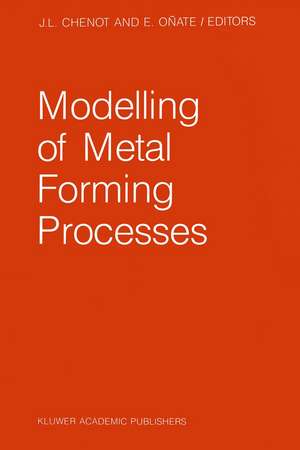
Modelling of Metal Forming Processes: Proceedings of the Euromech 233 Colloquium, Sophia Antipolis, France, August 29–31, 1988
Editat de J.L. Chenot, E. Oñateen Limba Engleză Paperback – 22 sep 2011
Preț: 376.90 lei
Puncte Express: 565
Carte tipărită la comandă
Livrare economică 19 noiembrie-03 decembrie
Livrare prin curier în România Termenul estimat este afișat lângă disponibilitate.
Transport gratuit de la 400.00 lei Plată online sau ramburs, în funcție de opțiunile comenzii.
Retur gratuit în 14 zile Comandă securizată și suport în română.
Specificații
ISBN-13: 9789401071314
ISBN-10: 9401071314
Pagini: 360
Ilustrații: IX, 345 p.
Dimensiuni: 160 x 240 x 19 mm
Greutate: 0.5 kg
Ediția:Softcover reprint of the original 1st ed. 1988
Editura: SPRINGER NETHERLANDS
Colecția Springer
Locul publicării:Dordrecht, Netherlands
ISBN-10: 9401071314
Pagini: 360
Ilustrații: IX, 345 p.
Dimensiuni: 160 x 240 x 19 mm
Greutate: 0.5 kg
Ediția:Softcover reprint of the original 1st ed. 1988
Editura: SPRINGER NETHERLANDS
Colecția Springer
Locul publicării:Dordrecht, Netherlands
V-ar putea interesa
-
 Ductile Design of Steel Structures, 2nd EditionMichel Bruneau-15%Preț: 579.38 lei681.62 lei
 -
 -31%Preț: 367.72 lei533.26 lei
 -
 -30%Preț: 637.11 lei905.26 lei
 -
 NMR Imaging of MaterialsBernhard Blumich-33%Preț: 675.62 lei1011.80 lei
 -
 Nanometer-Scale Defect Detection Using Polarized LightPierre-Richard Dahoo-9%Preț: 988.47 lei1086.22 lei
 -
 Springer Handbook of Metrology and TestingHorst Czichos-18%Preț: 1924.34 lei2346.76 lei
 -
 Spiral Grain and Wave Phenomena in Wood FormationJohn M. Harris-15%Preț: 614.24 lei722.63 lei
 -
 Liquid ExplosivesJiping Liu-18%Preț: 926.66 lei1130.08 lei
Public țintă
ResearchCuprins
1: MATERIAL BEHAVIOUR.- The description of yield surfaces for cold prestressed metals with the hypothesis of the isotropy centers translation.- Constitutive description and numerical approach in modelling for metal forming processes.- Simulation of impact tension deformation of metals by FEM.- Finite elements analysis of large plastic deformation in metals.- Modelling of structure formation and relation to mechanical properties of nodular cast iron.- 2: NUMERICAL TECHNIQUES.- H and P mesh refinement in the metal forming FEM analysis.- A mixed Eulerian- Lagrangian FEM for simulation of thermo-mechanical forming processes.- A method to reduce cost of mesh deformation in Eulerian- Lagrangian formulation.- Error control, mesh updating schemes and automatic adaptive remeshing for finite element analysis of unsteady extrusion processes.- Modelling of frictional tool surfaces in finite element metalforming analyses.- Numerical modelling of friction for metal forming processes.- 3: SHEET METAL FORMING.- Modelling of deep drawing processes by model testing and dimensional analysis.- A finite difference model as a basis for developing new constitutive equations for the sheet forming process.- Influence of anisotropy in sheet metal forming.- Experience with explicit and implicit finite element programs for sheet forming analysis.- Influence of thickness and curvature on the formability of metal sheets.- Experimental analysis of an axisymmetric deep drawing.- Computer aided design of a progressive die.- Finite element analysis of sheet metal forming problems using a viscous voided shell formulation.- Time stepping schemes for the numerical analysis of superplastic forming of thin sheet.- Thin sheet forming numerical analysis with a membrane approach.- 4: FORGING AND DRAWING.- Comparison of simulation techniques and industrial data in forging applications.- Finite Element calculation of hot forging with continuous remeshing.- Finite element applications in forming billet and P/M preforms.- Three dimensional finite element calculation of the forging of a connecting rod.- numerical identification of forging parameters.- Identification of defect locations in metal forming using a personal computer oriented finite element method.- Modelling of metal forming processes.- Numerical analysis of cold drawing of tubes.- 5: HOT AND COLD ROLLING.- A 3D thermomechanical analysis of steady flows in hot forming processes. Application to hot flat rolling and hot shape rolling.- Thermal-mechanical modelling for hot rolling: experimental substantiation.- Simulation of hot rolling of steel by plasticine or waxes. Comparison between the flow of steel and the flow of plasticine by actual rolling and finite element models.- Simulation of profile and flatness in the cold rolling of steel strip.- Application of a mathematical model for the cold rolling process on six-high mills.- Analysis of plane strain cold rolling using a flow function and the weighted residuals method.- Metallographic verification of computer modelling of hot rolling.- Finite element analysis of two-roll hot piercing.- Modelling the mechanics of the longitudinal tube rolling process.