
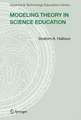
Modeling Theory in Science Education: Contemporary Trends and Issues in Science Education, cartea 24
Autor Ibrahim A. Hallounen Limba Engleză Hardback – 20 iul 2004
The author shows how a scientific theory that is the object of a given science course can be organized around a limited set of basic models. Special tools are introduced, including modeling schemata, for students to meaningfully construct models and required conceptions, and for teachers to efficiently plan instruction and assess and regulate student learning and teaching practice. A scientific model is conceived to represent a particular pattern in the structure or behavior of physical realities and to explore and reify the pattern in specific ways. The author further shows how to engage students in modeling activities through structured learning cycles.
Din seria Contemporary Trends and Issues in Science Education
- 18%
 Preț: 981.10 lei
 - 15%
 Preț: 613.80 lei
 - 15%
 Preț: 619.41 lei
 - 15%
 Preț: 661.23 lei
 - 15%
 Preț: 641.24 lei
 - 18%
 Preț: 980.46 lei
 - 15%
 Preț: 641.76 lei
 - 18%
 Preț: 979.20 lei
 - 18%
 Preț: 1290.59 lei
 - 18%
 Preț: 980.35 lei
 - 15%
 Preț: 624.62 lei
 - 15%
 Preț: 688.93 lei
 - 15%
 Preț: 619.29 lei
 - 15%
 Preț: 615.84 lei
 - 15%
 Preț: 627.43 lei
 - 15%
 Preț: 632.93 lei
 - 18%
 Preț: 1340.51 lei
 -
 Preț: 377.29 lei
 - 18%
 Preț: 1752.21 lei
 -
 Preț: 411.67 lei
 - 18%
 Preț: 919.18 lei
 - 15%
 Preț: 631.79 lei
 - 18%
 Preț: 1167.76 lei
 - 18%
 Preț: 1170.37 lei
 - 18%
 Preț: 748.01 lei
 - 18%
 Preț: 954.88 lei
 - 24%
 Preț: 871.96 lei
 - 9%
 Preț: 999.91 lei
 - 15%
 Preț: 666.33 lei
 - 31%
 Preț: 572.27 lei
 - 15%
 Preț: 679.26 lei
Preț: 664.69 lei
Preț vechi: 781.98 lei
-15%
Puncte Express: 997
Carte tipărită la comandă
Livrare economică 08-22 decembrie
Livrare prin curier în România Termenul estimat este afișat lângă disponibilitate.
Transport gratuit pentru acest produs Plată online sau ramburs, în funcție de opțiunile comenzii.
Retur gratuit în 14 zile Comandă securizată și suport în română.
Specificații
ISBN-13: 9781402021398
ISBN-10: 1402021399
Pagini: 268
Ilustrații: XIV, 252 p.
Dimensiuni: 160 x 241 x 20 mm
Greutate: 0.52 kg
Ediția:2004
Editura: Springer
Colecția Contemporary Trends and Issues in Science Education
Seria Contemporary Trends and Issues in Science Education
Locul publicării:Dordrecht, Netherlands
ISBN-10: 1402021399
Pagini: 268
Ilustrații: XIV, 252 p.
Dimensiuni: 160 x 241 x 20 mm
Greutate: 0.52 kg
Ediția:2004
Editura: Springer
Colecția Contemporary Trends and Issues in Science Education
Seria Contemporary Trends and Issues in Science Education
Locul publicării:Dordrecht, Netherlands
V-ar putea interesa
-
 First Grade ReadersParsonsPreț: 191.73 lei
 -
 The Pacific Campaign in World War II: From Pearl Harbor to GuadalcanalWilliam Bruce JohnsonPreț: 285.55 lei
 -
 10 Reading Comprehension Card GamesElaine RichardPreț: 73.58 lei
 -
 First Little Readers Parent Pack: Guided Reading Level aLiza CharlesworthPreț: 137.26 lei
 -
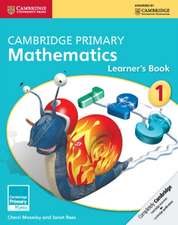 Cambridge Primary Mathematics Stage 1 Learner’s Book 1Cherri Moseley-21%Preț: 108.96 lei138.12 lei
 -
 Cambridge Primary Mathematics Stage 1 Games Book with CD-ROMCherri MoseleyPreț: 317.72 lei
 -
 Leading for LiteracyRuth SchoenbachPreț: 218.33 lei
 -
 Secondary Starters and PlenariesJohnnie Young-42%Preț: 85.27 lei147.17 lei
 -
 Toward a Visually-Oriented School Mathematics CurriculumFerdinand Rivera-15%Preț: 638.19 lei750.82 lei
 -
 -15%Preț: 645.13 lei758.97 lei
 -
 Modelling Learners and Learning in Science EducationKeith S. Taber-18%Preț: 820.09 lei1000.11 lei
 -
 Chemistry Education in the ICT AgeMinu Gupta Bhowon-18%Preț: 915.29 lei1116.22 lei
 -
 Biochemical EducationCharles F. BrycePreț: 368.12 lei
 -
 Das Niederlandische Faustspiel des Siebzehnten JahrhundertsJacob van RijndorpPreț: 400.69 lei
 -
 Thinking in PhysicsLaurence Viennot-15%Preț: 663.45 lei780.53 lei
Public țintă
ResearchCuprins
Fundamental Tenets of Modeling Theory.- Modeling Schemata.- Paradigmatic Evolution.- Modeling Program.- Learning Cycles.
Notă biografică
Ibrahim Halloun is recognized worldwide for his seminal contributions to education. He is particularly known for his work on students' intuitive ideas about the physical world and their novice views about knowing and learning science, and for turning scientific models and modeling into pedagogical tools and methodology for experiential, meaningful learning of physics and other STEM disciplines at the secondary school and university levels.Prof. Halloun has contributed to curriculum reform in many countries around the globe, and was behind several initiatives for systemic reform. He has been focused lately on systematizing the entire educational enterprise under systemic paradigms that meet the realities of the 21st century and that empower students to think outside the box and excel in various aspects of life. Systemic, praxis-immersive, convergence education (SPICE) is at the core of his attention, especially cross- and trans-disciplinarity that efficiently bridge traditional divides among disciplines from different fields like arts and science that are often misconceived as remotely related to each other.