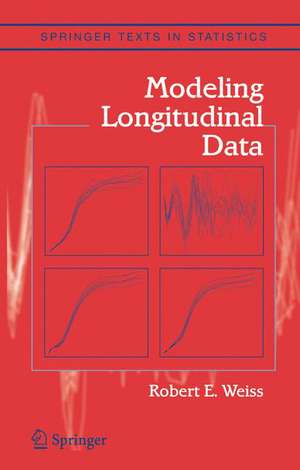
Modeling Longitudinal Data
Autor Robert E Weissen Limba Engleză Hardback – 28 iun 2005
Covariance models covered include random effects, autoregressive, autoregressive moving average, antedependence, factor analytic, and completely unstructured models among others. Longer expositions explore: an introduction to and critique of simple non-longitudinal analyses of longitudinal data, missing data concepts, diagnostics, and simultaneous modeling of two longitudinal variables. Applications and issues for random effects models cover estimation, shrinkage, clustered data, models for binary and count data and residuals and residual plots. Shorter sections include a general discussion of how computational algorithms work, handling transformed data, and basic design issues.
This book requires a solid regression course as background and is particularly intended for the final year of a Biostatistics or Statistics Masters degree curriculum. The mathematical prerequisite is generally low, mainly assuming familiarity with regression analysis in matrix form. Doctoral students in Biostatistics or Statistics, applied researchers and quantitative doctoral students in disciplines such as Medicine, Public Health, Public Policy, Psychology, Political Science, Biology, Sociology and Education will find this book invaluable. The book has many figures and tables illustrating longitudinal data and numerous homework problems. The associated web site contains many longitudinal data sets, examples of computer code, and labs to re-enforce thematerial.
From the reviews:
"...This book is extremely well presented and it has been written in a style that makes its reading really pleasant and enjoyable...I highly recommend Modeling Longitudinal Data as a good reference book for anyone interested in looking into the art and statistical science of modern longitudinal data analysis." Journal of Applied Statistics, December 2005
"The book is clearly written and well presented. The author's accumulated experience in presenting the material comes over. On balance, this is one of the books which anyone about to teach a practical course in longitudinal data analysis should consider adopting as the course text." Short Book Reviews of the ISI, June 2006
"...Modeling Longitudinal Data is a welcome addition to the vast literature on longitudinal data analysis. The book requires little in terms of prerequisites but offers a great deal." Zhigang Zhang for the Journal of the American Statistical Association, December 2006
"Overall, Robert Weiss's book can be used as an excellent textbook for a first master-level course in longitudinal data analysis in a statistics or biostatistics program, or as a self-study book for applied researchers interested in this area...The style is very clear, concepts are explained in an engaging way and amply illustrated, and the chapters on covariate selection and modeling the variance-covariance matrix are definite assets." Ralitza Gueorgueiva for Biostatistics, September 2006
Preț: 858.63 lei
Preț vechi: 903.82 lei
-5%
Puncte Express: 1288
Carte tipărită la comandă
Livrare economică 01-15 decembrie
Livrare prin curier în România Termenul estimat este afișat lângă disponibilitate.
Transport gratuit pentru acest produs Plată online sau ramburs, în funcție de opțiunile comenzii.
Retur gratuit în 14 zile Comandă securizată și suport în română.
Specificații
ISBN-13: 9780387402710
ISBN-10: 0387402713
Pagini: 432
Ilustrații: XXII, 432 p.
Dimensiuni: 155 x 235 x 26 mm
Greutate: 0.77 kg
Ediția:2005 edition
Editura: Springer
Locul publicării:New York, NY, United States
ISBN-10: 0387402713
Pagini: 432
Ilustrații: XXII, 432 p.
Dimensiuni: 155 x 235 x 26 mm
Greutate: 0.77 kg
Ediția:2005 edition
Editura: Springer
Locul publicării:New York, NY, United States
V-ar putea interesa
-
 The Oxford Handbook of Applied Bayesian AnalysisAnthony O' Hagan-19%Preț: 469.16 lei579.21 lei
 -
 Efficient and Adaptive Estimation for Semiparametric ModelsPeter J. Bickel-20%Preț: 775.81 lei969.76 lei
 -
 -27%Preț: 904.91 lei1239.59 lei
 -
 Nonparametric Hypothesis TestingStefano Bonnini-19%Preț: 498.79 lei615.78 lei
 -
 Meta-AnalysisCheung-8%Preț: 502.03 lei545.69 lei
 -
 Asymptotic Theory of Statistics and ProbabilityAnirban Dasgupta-15%Preț: 611.34 lei719.22 lei
 -
 Applied Regression AnalysisJohn O. Rawlings-15%Preț: 587.18 lei690.80 lei
 -
 Superconcentration and Related TopicsSourav Chatterjee-15%Preț: 662.58 lei779.51 lei
 -
 Probability on Compact Lie GroupsDavid Applebaum-15%Preț: 520.38 lei612.21 lei
 -
 Fourier Analysis and Stochastic ProcessesPierre BrémaudPreț: 272.57 lei
 -
 Séminaire de Probabilités XLVICatherine Donati-MartinPreț: 405.14 lei
 -
 Fluctuations in Markov ProcessesTomasz Komorowski-15%Preț: 655.08 lei770.67 lei
 -
 -15%Preț: 680.99 lei801.16 lei
Public țintă
ResearchCuprins
to Longitudinal Data.- Plots.- Simple Analyses.- Critiques of Simple Analyses.- The Multivariate Normal Linear Model.- Tools and Concepts.- Specifying Covariates.- Modeling the Covariance Matrix.- Random Effects Models.- Residuals and Case Diagnostics.- Discrete Longitudinal Data.- Missing Data.- Analyzing Two Longitudinal Variables.- Further Reading.
Recenzii
From the reviews:
"...This book is extremely well presented and it has been written in a style that makes its reading really pleasant and enjoyable...I highly recommend Modeling Longitudinal Data as a good reference book for anyone interested in looking into the art and statistical science of modern longitudinal data analysis." Journal of Applied Statistics, December 2005
"The book is clearly written and well presented. The author's accumulated experience in presenting the material comes over. On balance, this is one of the books which anyone about to teach a practical course in longitudinal data analysis should consider adopting as the course text." Short Book Reviews of the ISI, June 2006
"...Modeling Longitudinal Data is a welcome addition to the vast literature on longitudinal data analysis. The book requires little in terms of prerequisites but offers a great deal." Zhigang Zhang for the Journal of the American Statistical Association, December 2006
"Overall, Robert Weiss's book can be used as an excellent textbook for a first master-level course in longitudinal data analysis in a statistics or biostatistics program, or as a self-study book for applied researchers interested in this area...The style is very clear, concepts are explained in an engaging way and amply illustrated, and the chapters on covariate selection and modeling the variance-covariance matrix are definite assets." Ralitza Gueorgueiva for Biostatistics, September 2006
"This book is a gem and should be on everyone’s bookshelf … . It covers longitudinal data models at an elementary level – a second year student can handle the material with appropriate study. It is a model of clarity and provides many useful insights for the reader. … The book also contains suggestions for further reading, and an appendix with descriptions of data sets. The data sets are available online from the author’swebsite. ... I recommend this book highly." (Peter Lachenbruch, ISCB Newsletter, Issue 42, 2006)
"I enjoyed the writing style, which appears to accompany a sincere motive to explain both effective and ineffective longitudinal data models and associated analyses. Also, the website provides convenient access to datasets and example code. I therefore recommend the text to the intended audience … ." (Tom L. Burr, Technometrics, Vol. 48 (3), 2006)
"The author teaches the art and statistical science of modern longitudinal data analysis … . This book is intended for master’s and doctoral students in statistics and biostatistics as well as for doctoral students of many other disciplines such as psychology, education, economics, sociology, business, epidemiology and engineering." (Ivan Krivý, Zentralblatt MATH, Vol. 1076, 2006)
"The current book provides a good account of practical and up-to-date methods and techniques of modern longitudinal data modeling and analyses. … Overall, this book is a well-written textbook. The material is presented clearly and the techniques are explained with numerous real data examples and graphs. Though the book is aimed at master’s and doctoral students, it may also be a useful source of information for applied researchers." (Liqun Wang, Statistical Papers, Vol. 50, 2009)
"...This book is extremely well presented and it has been written in a style that makes its reading really pleasant and enjoyable...I highly recommend Modeling Longitudinal Data as a good reference book for anyone interested in looking into the art and statistical science of modern longitudinal data analysis." Journal of Applied Statistics, December 2005
"The book is clearly written and well presented. The author's accumulated experience in presenting the material comes over. On balance, this is one of the books which anyone about to teach a practical course in longitudinal data analysis should consider adopting as the course text." Short Book Reviews of the ISI, June 2006
"...Modeling Longitudinal Data is a welcome addition to the vast literature on longitudinal data analysis. The book requires little in terms of prerequisites but offers a great deal." Zhigang Zhang for the Journal of the American Statistical Association, December 2006
"Overall, Robert Weiss's book can be used as an excellent textbook for a first master-level course in longitudinal data analysis in a statistics or biostatistics program, or as a self-study book for applied researchers interested in this area...The style is very clear, concepts are explained in an engaging way and amply illustrated, and the chapters on covariate selection and modeling the variance-covariance matrix are definite assets." Ralitza Gueorgueiva for Biostatistics, September 2006
"This book is a gem and should be on everyone’s bookshelf … . It covers longitudinal data models at an elementary level – a second year student can handle the material with appropriate study. It is a model of clarity and provides many useful insights for the reader. … The book also contains suggestions for further reading, and an appendix with descriptions of data sets. The data sets are available online from the author’swebsite. ... I recommend this book highly." (Peter Lachenbruch, ISCB Newsletter, Issue 42, 2006)
"I enjoyed the writing style, which appears to accompany a sincere motive to explain both effective and ineffective longitudinal data models and associated analyses. Also, the website provides convenient access to datasets and example code. I therefore recommend the text to the intended audience … ." (Tom L. Burr, Technometrics, Vol. 48 (3), 2006)
"The author teaches the art and statistical science of modern longitudinal data analysis … . This book is intended for master’s and doctoral students in statistics and biostatistics as well as for doctoral students of many other disciplines such as psychology, education, economics, sociology, business, epidemiology and engineering." (Ivan Krivý, Zentralblatt MATH, Vol. 1076, 2006)
"The current book provides a good account of practical and up-to-date methods and techniques of modern longitudinal data modeling and analyses. … Overall, this book is a well-written textbook. The material is presented clearly and the techniques are explained with numerous real data examples and graphs. Though the book is aimed at master’s and doctoral students, it may also be a useful source of information for applied researchers." (Liqun Wang, Statistical Papers, Vol. 50, 2009)
Textul de pe ultima copertă
Longitudinal data are ubiquitous across Medicine, Public Health, Public Policy, Psychology, Political Science, Biology, Sociology and Education, yet many longitudinal data sets remain improperly analyzed. This book teaches the art and statistical science of modern longitudinal data analysis. The author emphasizes specifying, understanding, and interpreting longitudinal data models. He inspects the longitudinal data graphically, analyzes the time trend and covariates, models the covariance matrix, and then draws conclusions.
Covariance models covered include random effects, autoregressive, autoregressive moving average, antedependence, factor analytic, and completely unstructured models among others. Longer expositions explore: an introduction to and critique of simple non-longitudinal analyses of longitudinal data, missing data concepts, diagnostics, and simultaneous modeling of two longitudinal variables. Applications and issues for random effects models cover estimation, shrinkage, clustered data, models for binary and count data and residuals and residual plots. Shorter sections include a general discussion of how computational algorithms work, handling transformed data, and basic design issues.
This book requires a solid regression course as background and is particularly intended for the final year of a Biostatistics or Statistics Masters degree curriculum. The mathematical prerequisite is generally low, mainly assuming familiarity with regression analysis in matrix form. Doctoral students in Biostatistics or Statistics, applied researchers and quantitative doctoral students in disciplines such as Medicine, Public Health, Public Policy, Psychology, Political Science, Biology, Sociology and Education will find this book invaluable. The book has many figures and tables illustrating longitudinal data and numerous homework problems. The associated web site contains many longitudinal data sets, examples of computer code, and labs to re-enforce the material.
Robert Weiss is Professor of Biostatistics in the UCLA School of Public Health with a Ph.D. in Statistics from the University of Minnesota. He is expert in longitudinal data analysis, diagnostics and graphics, and Bayesian methods, and specializes in modeling of hierarchical and complex data sets. He has published over 50 papers a majority of which involves longitudinal data. He regularly teaches classes in longitudinal data analysis, multivariate analysis, Bayesian inference, and statistical graphics.
Covariance models covered include random effects, autoregressive, autoregressive moving average, antedependence, factor analytic, and completely unstructured models among others. Longer expositions explore: an introduction to and critique of simple non-longitudinal analyses of longitudinal data, missing data concepts, diagnostics, and simultaneous modeling of two longitudinal variables. Applications and issues for random effects models cover estimation, shrinkage, clustered data, models for binary and count data and residuals and residual plots. Shorter sections include a general discussion of how computational algorithms work, handling transformed data, and basic design issues.
This book requires a solid regression course as background and is particularly intended for the final year of a Biostatistics or Statistics Masters degree curriculum. The mathematical prerequisite is generally low, mainly assuming familiarity with regression analysis in matrix form. Doctoral students in Biostatistics or Statistics, applied researchers and quantitative doctoral students in disciplines such as Medicine, Public Health, Public Policy, Psychology, Political Science, Biology, Sociology and Education will find this book invaluable. The book has many figures and tables illustrating longitudinal data and numerous homework problems. The associated web site contains many longitudinal data sets, examples of computer code, and labs to re-enforce the material.
Robert Weiss is Professor of Biostatistics in the UCLA School of Public Health with a Ph.D. in Statistics from the University of Minnesota. He is expert in longitudinal data analysis, diagnostics and graphics, and Bayesian methods, and specializes in modeling of hierarchical and complex data sets. He has published over 50 papers a majority of which involves longitudinal data. He regularly teaches classes in longitudinal data analysis, multivariate analysis, Bayesian inference, and statistical graphics.
Caracteristici
Covers both the regression modeling aspect and the covariance modeling issues Coverage includes initial data exploration, model specification and building and inference Includes supplementary material: sn.pub/extras