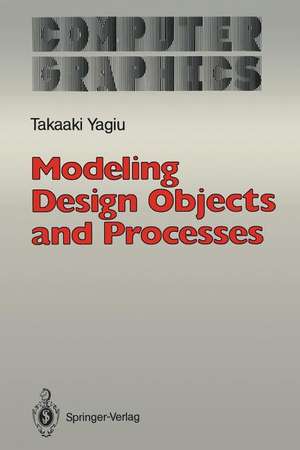
Modeling Design Objects and Processes: Computer Graphics: Systems and Applications
Autor Takaaki Yagiuen Limba Engleză Paperback – 28 ian 2012

Preț: 622.77 lei
Preț vechi: 778.45 lei
-20%
Puncte Express: 934
Carte tipărită la comandă
Livrare economică 17-31 octombrie
Livrare prin curier în România Termenul estimat este afișat lângă disponibilitate.
Transport gratuit pentru acest produs Plată online sau ramburs, în funcție de opțiunile comenzii.
Retur gratuit în 14 zile Comandă securizată și suport în română.
Specificații
ISBN-13: 9783642844225
ISBN-10: 3642844227
Pagini: 344
Ilustrații: X, 330 p.
Dimensiuni: 155 x 235 x 18 mm
Greutate: 0.48 kg
Ediția:Softcover reprint of the original 1st ed. 1991
Editura: Springer Berlin, Heidelberg
Colecția Springer
Seria Computer Graphics: Systems and Applications
Locul publicării:Berlin, Heidelberg, Germany
ISBN-10: 3642844227
Pagini: 344
Ilustrații: X, 330 p.
Dimensiuni: 155 x 235 x 18 mm
Greutate: 0.48 kg
Ediția:Softcover reprint of the original 1st ed. 1991
Editura: Springer Berlin, Heidelberg
Colecția Springer
Seria Computer Graphics: Systems and Applications
Locul publicării:Berlin, Heidelberg, Germany
V-ar putea interesa
-
 -20%Preț: 334.79 lei418.48 lei
 -
 -20%Preț: 213.77 lei267.22 lei
 -
 -20%Preț: 303.31 lei379.13 lei
 -
 -20%Preț: 259.36 lei324.21 lei
 -
 LiftoffDiana LarsenPreț: 179.76 lei
 -
 Pro Expression Blend 4Andrew Troelsen-20%Preț: 251.33 lei314.15 lei
 -
 Pro Spring 3Rob Harrop-20%Preț: 285.17 lei356.47 lei
 -
 Making Embedded SystemsElecia White-38%Preț: 200.48 lei324.68 lei
 -
 Ada for Software EngineersMordechai Ben-Ari-20%Preț: 557.53 lei696.91 lei
 -
 Java Methods for Financial EngineeringPhilip Barker-20%Preț: 603.37 lei754.22 lei
 -
 Successful Test ManagementIris Pinkster-20%Preț: 334.81 lei418.51 lei
 -
 Algorithms and Architectures for Parallel ProcessingAnu G. Bourgeois-20%Preț: 324.22 lei405.27 lei
 -
 Model Driven Engineering and Ontology DevelopmentDragan Ga¿evic-20%Preț: 660.12 lei825.15 lei
 -
 Assurances for Self-Adaptive SystemsJavier Cámara-20%Preț: 337.80 lei422.24 lei
 -
 -20%Preț: 410.80 lei513.50 lei
Public țintă
ResearchCuprins
0 Introduction.- 0.1 Primary Organization of a CAD System.- 0.2 Current State of Integration and Distribution.- 0.3 Roles of a Database.- 0.4 Toward Product Modeling.- 0.5 The Subject Matter.- 0.6 An Example.- 0.7 On the Formalness and Abstractness of Language.- 0.8 On the General Theory of Design.- 0.9 Program for Succeeding Chapters.- References.- 1 Requirements of CAD Databases.- 1.1 Structures and Semantics.- 1.2 Dynamic Aspect.- 1.3 Version Control.- References.- 2 Criticism of Past and Current Data Models.- 2.1 Graphics Packages in the 1960s.- 2.2 Ad hoc Developments of CAD Databases.- 2.3 The Network (CODASYL) Model and Its Extensions.- 2.4 Relational Model and Its Extensions.- References.- 3 First Order Theory and Its Interpretation.- 3.1 First Order Language.- 3.2 Formal Theory.- 3.3 Interpretation of First Order Theory.- 3.4 Undecidability and Incompleteness.- 3.5 Clausal Form and the Herbrand Model.- References.- 4 Criticism of Logical Approaches.- 4.1 Pertinencies of Logic to Computer Sciences and Applications.- 4.2 Theory or Interpretation?.- 4.3 Meanings of Logical Formulas.- 4.4 Single or Multiple Interpretations?.- 4.5 The Universe of Interpretation.- 4.6 What Kind of Logic?.- References.- 5 Philosophical Discussions.- 5.1 Philosophical Reinterpretations of Conceptual Frameworks.- 5.2 Criticism of Underlying Weltanschauungen.- 5.3 An Alternate Weltanschuung.- References.- 6 The Fundamental Structure of the Design Object Model.- 6.1 Physical Object, Theory and Interpretation.- 6.2 Qualifications on Theories and Interpretations.- 6.3 Illustrative Examples.- References.- 7 The Model Description Language (MDL).- 7.1 General.- 7.2 Theory Construction.- 7.3 Interpretation.- 7.4 Illustrative Examples.- References.- 8 Modeling the Design Process.- 8.1 The Concept of Minimal Extension.- 8.2 The Expansion of Model Description Language (MDL).- 8.3 Controlling the Model Development.- References.- 9 Implementation and Remaining Problems.- 9.1 General Organization.- 9.2 Logical Structure Description Language (LDL).- 9.3 Logical Structure Manipulation Language (LML).- 9.4 Logical Structure Manipulation Utility (LMU).- 9.5 Examples and Applications.- 9.6 Remaining Problems.- References.