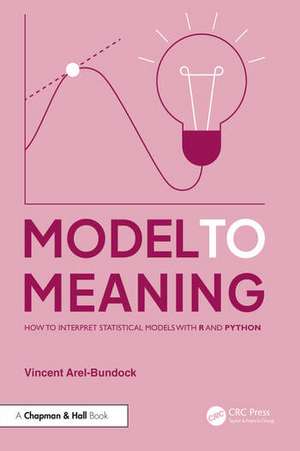
Model to Meaning: How to Interpret Statistical Models with R and Python
Autor Vincent Arel-Bundocken Limba Engleză Paperback – 28 sep 2025
Features:
- Presents a simple and powerful conceptual framework to interpret the results from a wide variety of statistical or machine learning models.
- Features in-depth case studies covering topics such as causal inference, experiments, interactions, categorical variables, multilevel regression, weighting, and machine learning.
- Includes extensive practical examples in both R and Python using the marginal effects software.
- Accompanied by comprehensive online documentation, tutorials, and bonus case studies.
Written for data scientists, researchers, and students, the book speaks to newcomers seeking practical skills, and to experienced analysts who are ready to adopt new tools and rethink entrenched habits. It offers useful ideas, concrete workflows, powerful software, and detailed case studies, presented using real-world data and code examples.
Preț: 503.15 lei
Preț vechi: 591.94 lei
-15%
Puncte Express: 755
Carte tipărită la comandă
Livrare economică 28 noiembrie-12 decembrie
Livrare express 27-31 octombrie pentru 52.29 lei
Livrare prin curier în România Termenul estimat este afișat lângă disponibilitate.
Transport gratuit pentru acest produs Plată online sau ramburs, în funcție de opțiunile comenzii.
Retur gratuit în 14 zile Comandă securizată și suport în română.
Specificații
ISBN-13: 9781032908724
ISBN-10: 1032908726
Pagini: 262
Ilustrații: 60
Dimensiuni: 156 x 234 x 15 mm
Greutate: 0.48 kg
Ediția:1
Editura: CRC Press
Colecția Chapman and Hall/CRC
ISBN-10: 1032908726
Pagini: 262
Ilustrații: 60
Dimensiuni: 156 x 234 x 15 mm
Greutate: 0.48 kg
Ediția:1
Editura: CRC Press
Colecția Chapman and Hall/CRC
Public țintă
AcademicCuprins
1 Who is this book for? 2 Models and meaning 3 Conceptual frameword 4 Hypothesis and equivalence tests 5 Predictions 6 Counterfactual comparisons 7 Slopes 8 Causal inference with G-computation 9 Experiments 10 Interactions and polynomials 11 Categorical and ordinal outcomes 12 Multilevel regression with poststratification 13 Machine learning 14 Uncertainty 15 Online content 16 Python
Notă biografică
Vincent Arel-Bundock is Professor at the Université de Montréal, where he teaches political economy and research methods. His research focuses on making the interpretation of statistical models more rigorous and accessible. Vincent is the creator of the widely-used marginaleffects software package, available for both R and Python.
Recenzii
"...Model to Meaning is an outstanding contribution to the applied statistics literature. Its emphasis on interpretability, its breadth of models, and its seamless integration with high-quality software make it an ideal reference for graduate courses in statistics, data science, political science, and related fields, as well as a valuable guide for applied researchers working with complex models in practice. The book succeeds not only in explaining how to interpret models, but in reshaping how analysts think about the relationship between models, estimands, and meaning."
-Brenda Betancourt in the Journal of the American Statistical Association, February 2026
-Brenda Betancourt in the Journal of the American Statistical Association, February 2026
Descriere
Proposes a consistent workflow that can be applied to (almost) any statistical or machine learning model. Readers will learn how to transform complex parameter estimates into quantities that are readily interpretable, intuitive, and understandable.