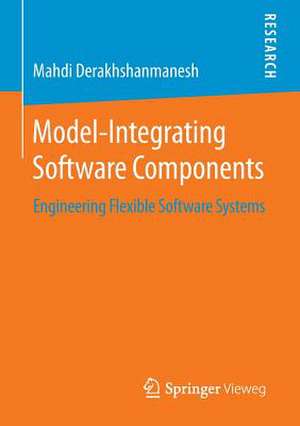
Model-Integrating Software Components
Autor Mahdi Derakhshanmaneshen Limba Engleză Paperback – 12 mai 2015
Preț: 335.13 lei
Preț vechi: 418.91 lei
-20%
Puncte Express: 503
Carte tipărită la comandă
Livrare economică 01-15 decembrie
Livrare prin curier în România Termenul estimat este afișat lângă disponibilitate.
Transport gratuit de la 400.00 lei Plată online sau ramburs, în funcție de opțiunile comenzii.
Retur gratuit în 14 zile Comandă securizată și suport în română.
Specificații
ISBN-13: 9783658096458
ISBN-10: 3658096454
Pagini: 356
Ilustrații: XXI, 333 p. 43 illus.
Dimensiuni: 148 x 210 x 20 mm
Greutate: 0.46 kg
Ediția:2015
Editura: SPRINGER VIEWEG
Locul publicării:Wiesbaden, Germany
ISBN-10: 3658096454
Pagini: 356
Ilustrații: XXI, 333 p. 43 illus.
Dimensiuni: 148 x 210 x 20 mm
Greutate: 0.46 kg
Ediția:2015
Editura: SPRINGER VIEWEG
Locul publicării:Wiesbaden, Germany
V-ar putea interesa
-
 Peopleware: Productive Projects and TeamsTom DeMarco-20%Preț: 253.15 lei316.44 lei
 -
 Software TestingAli Mili-20%Preț: 879.19 lei1098.99 lei
 -
 Software Project EstimationAlain Abran-20%Preț: 540.39 lei675.49 lei
 -
 Thinking with DataMax Shron-20%Preț: 177.88 lei222.34 lei
 -
 The Art of Application Performance Testing 2eIan Molyneaux-20%Preț: 217.63 lei272.04 lei
 -
 User Story MappingJeff Patton-20%Preț: 207.03 lei258.79 lei
 -
 Ada for Software EngineersMordechai Ben-Ari-20%Preț: 557.53 lei696.91 lei
 -
 Java Methods for Financial EngineeringPhilip Barker-20%Preț: 603.86 lei754.82 lei
 -
 Software Testing FoundationsAndreas Spillner-45%Preț: 206.30 lei377.10 lei
 -
 -20%Preț: 315.66 lei394.58 lei
 -
 Successful Test ManagementIris Pinkster-20%Preț: 355.40 lei444.26 lei
 -
 Algorithms and Architectures for Parallel ProcessingAnu G. Bourgeois-20%Preț: 324.22 lei405.27 lei
 -
 Model Driven Engineering and Ontology DevelopmentDragan Ga¿evic-20%Preț: 677.21 lei846.51 lei
 -
 Assurances for Self-Adaptive SystemsJavier Cámara-20%Preț: 337.80 lei422.24 lei
 -
 -20%Preț: 410.80 lei513.50 lei
Public țintă
ResearchCuprins
Part I: Introduction and Foundations: Introduction.- Foundations and Related Work.- Part II: Solution Concept: Initial Design Considerations.- Component Realization Concept.- Part III: Proof of Concept: Reference Implementation.- Feasibility Studies.- Part IV: Finale: Conclusions and Future Work.
Textul de pe ultima copertă
In his study, Mahdi Derakhshanmanesh builds on the state of the art in modeling by proposing to integrate models into running software on the component-level without translating them to code. Such so-called model-integrating software exploits all advantages of models: models implicitly support a good separation of concerns, they are self-documenting and thus improve understandability and maintainability, and in contrast to model-driven approaches there is no synchronization problem anymore between the models and the code generated from them. Using model-integrating components, software will be easier to build and easier to evolve by just modifying the respective model in an editor. Furthermore, software may also adapt itself at runtime by transforming its own model part.
Contents
Mahdi Derakhshanmanesh is a postdoctoral researcher and lecturer at the University of Koblenz-Landau, Institute for Software Technology.
Contents
- An extensive description of foundations and related work
- A realization concept for Model-Integrating Software Components (MoCos)
- A reference implementation (based on Java, OSGi and TGraphs) and its application
- Software engineering researchers and students in the fields of component-based software engineering, self-adaptive software, (dynamic) software product line engineering and modelling
- Component developers and users as well as creators of domain-specific (modeling) languages
Mahdi Derakhshanmanesh is a postdoctoral researcher and lecturer at the University of Koblenz-Landau, Institute for Software Technology.
Caracteristici
Publication in the field of technical sciences Includes supplementary material: sn.pub/extras