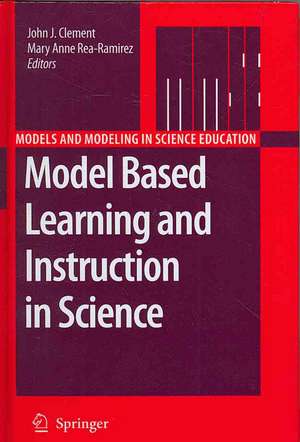
Model Based Learning and Instruction in Science
Editat de John Clement, Mary Anne Rea-Ramirezen Limba Engleză Hardback – 13 dec 2007
Preț: 634.43 lei
Preț vechi: 746.39 lei
-15%
Puncte Express: 952
Carte tipărită la comandă
Livrare economică 20 noiembrie-04 decembrie
Livrare prin curier în România Termenul estimat este afișat lângă disponibilitate.
Transport gratuit pentru acest produs Plată online sau ramburs, în funcție de opțiunile comenzii.
Retur gratuit în 14 zile Comandă securizată și suport în română.
Specificații
ISBN-13: 9781402064937
ISBN-10: 1402064934
Pagini: 279
Ilustrații: IX, 279 p.
Dimensiuni: 167 x 246 x 27 mm
Greutate: 0.56 kg
Ediția:2008
Editura: Springer
Locul publicării:Dordrecht, Netherlands
ISBN-10: 1402064934
Pagini: 279
Ilustrații: IX, 279 p.
Dimensiuni: 167 x 246 x 27 mm
Greutate: 0.56 kg
Ediția:2008
Editura: Springer
Locul publicării:Dordrecht, Netherlands
V-ar putea interesa
-
 Essays on PedagogyRobin AlexanderPreț: 389.18 lei
 -
 Creative Dialogue: Talk for Thinking in the ClassroomRobert FisherPreț: 342.15 lei
 -
 Teaching Skills For DummiesSue CowleyPreț: 154.73 lei
 -
 100 Ideas for Lesson PlanningAnthony Haynes-43%Preț: 79.90 lei140.84 lei
 -
 Balance in TeachingRudolf SteinerPreț: 99.50 lei
 -
 Professional Learning: Gaps and Transitions on the Way from Novice to ExpertHenny P. A. Boshuizen-15%Preț: 636.41 lei748.72 lei
 -
 The Book of ThunksIan GilbertPreț: 105.02 lei
 -
 Preț: 233.27 lei
Public țintă
ResearchCuprins
Basic Concepts and Background for Model Based Learning.- Student/Teacher Co-construction of Visualizable Models in Large Group Discussion.- An Instructional Model Derived from Model Construction and Criticism Theory.- to Model Based Teaching Strategies.- Determining Target Models and Effective Learning Pathways for Developing Understanding of Biological Topics.- Co-construction and Model Evolution in Chemistry.- Target Model Sequence and Critical Learning Pathway for an Electricity Curriculum Based on Model Evolution.- Case Study of Model Evolution in Electricity: Learning from Both Observations and Analogies.- Qualitative Research on Specific Strategies.- A Competition Strategy and Other Modes for Developing Mental Models in Large Group Discussion.- What If Scenarios For Testing Student Models in Chemistry.- Applying Modeling Theory to Curriculum Development: From Electric Circuits to Electromagnetic Fields.- Developing Complex Mental Models in Biology Through Model Evolution.- Role of Discrepant Questioning Leading to Model Element Modification.- Using Analogies in Science Teaching and Curriculum Design: Some Guidelines.- Model Based Reasoning Among Inner City Middle School Students.- Six Levels of Organization for Curriculum Design and Teaching.
Textul de pe ultima copertă
This book describes new, model based teaching methods for science instruction. It presents research that describes these new methods in a very diverse group of settings: middle school biology, high school physics, and college chemistry classrooms. Mental models in these areas such as understanding the structure of the lungs or cells, molecular structures and reaction mechanisms in chemistry, or causes of current flow in electricity are notoriously difficult for many students to learn. Yet these lie at the core of conceptual understanding in these areas. The studies focus on a variety of teaching strategies such as discrepant questioning, analogies, animations, model competition, and hands on activities. Five different levels of organization for teaching strategies are described, from those operating over months (design of the sequence of units in a curriculum) to those operating over minutes ( teaching tactics for guiding discussion minute by minute).
Caracteristici
Integrates social and cognitive perspectives for explaining science instruction Describes teaching methods that develop deep understanding and that are midway between pure discovery and lecture approaches Deepens our theory of instruction by developing diagramming systems for tracking model based learning in classrooms