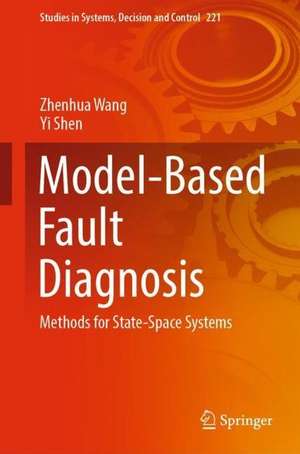
Model-Based Fault Diagnosis
Autor Zhenhua Wang, Yi Shenen Limba Engleză Hardback – 29 oct 2022
Preț: 982.05 lei
Preț vechi: 1197.62 lei
-18%
Puncte Express: 1473
Carte disponibilă
Livrare economică 09-23 noiembrie
Livrare prin curier în România Termenul estimat este afișat lângă disponibilitate.
Transport gratuit pentru acest produs Plată online sau ramburs, în funcție de opțiunile comenzii.
Retur gratuit în 14 zile Comandă securizată și suport în română.
Specificații
ISBN-13: 9789811967054
ISBN-10: 9811967059
Pagini: 216
Ilustrații: XV, 200 p. 70 illus., 60 illus. in color.
Dimensiuni: 160 x 241 x 17 mm
Greutate: 0.48 kg
Ediția:1st ed. 2023
Editura: Springer
Locul publicării:Singapore, Singapore
ISBN-10: 9811967059
Pagini: 216
Ilustrații: XV, 200 p. 70 illus., 60 illus. in color.
Dimensiuni: 160 x 241 x 17 mm
Greutate: 0.48 kg
Ediția:1st ed. 2023
Editura: Springer
Locul publicării:Singapore, Singapore
V-ar putea interesa
-
 Obstetric Imaging: Fetal Diagnosis and CareJoshua A. Copel-28%Preț: 1751.36 lei2417.89 leiRecomandat
-
 -28%Preț: 810.58 lei1121.58 leiRecomandat
-
 Clinical ChemistryWilliam J. Marshall-5%Preț: 357.78 lei376.60 leiRecomandat
-
 -23%Preț: 175.25 lei227.99 lei
-
 Linear System Theory: The State Space ApproachLofti A. ZadehPreț: 207.90 lei
-
 Optimal Control and EstimationRobert F. Stengel-20%Preț: 212.35 lei264.50 lei
-
 Optimal Estimation of Dynamic SystemsJohn L. Crassidis-8%Preț: 504.66 lei548.54 lei
-
 Kalman Filtering: Theory and Practice with MATLABMohinder S. Grewal-5%Preț: 662.84 lei697.72 lei
-
 CURRENT Medical Diagnosis & Treatment 2026Maxine A. Papadakis-24%Preț: 482.41 lei634.59 lei
-
 Fault Detection: Methods, Applications & TechnologyDaniel Martin-27%Preț: 727.49 lei990.22 lei
-
 H-SystemsElena De Santis-20%Preț: 912.34 lei1140.43 lei
-
 -24%Preț: 1290.90 lei1698.56 lei
-
 Robust and Adaptive ControlEugene LavretskyPreț: 533.14 lei
-
 State Estimation for Nonlinear Continuous-Discrete Stochastic SystemsGennady Yu. Kulikov-18%Preț: 786.67 lei959.35 lei
-
 Preț: 158.42 lei
-
 Automotive Air ConditioningQuansheng Zhang-9%Preț: 712.95 lei783.46 lei
-
 Model Reduction of Parametrized SystemsPeter Benner-18%Preț: 940.01 lei1146.36 lei
-
 -18%Preț: 1054.20 lei1285.61 lei
-
 -18%Preț: 819.72 lei999.67 lei
Cuprins
Introduction.- Modelling for Fault Diagnosis.- Observer-Based Residual Generation.- Robust Residual Generation Based on Unknown Input Observer.- Optimal Robust Residual Generation.- Residual Evaluation Based on Threshold Computation.- Fault Isolation Based on Structured Residual Generation.- Fault Isolation Based on Directional Residual Generation.- Observer-Based Fault Estimation.- Kalman Filter-Based Fault Diagnosis.- Parity Space Approaches.
Notă biografică
Dr. Bin Fan is an Associate Professor in the National Laboratory of Pattern Recognition, Institute of Automation, Chinese Academy of Sciences where he got his PhD degree in 2011 and acted as an Assistant Professor from 2011 to 2014. He has been a visiting professor at the Computer Vision Laboratory, Ecole Polytechnique Federale de Lausanne (EPFL), Switzerland, during 2014.5 to 2014.6 and 2015.3 to 2016.3. His research interests include computer vision and pattern recognition. Particularly, he is focusing on designing and matching of local features and their visual applications. He has published over 20 papers in prestigious international journals and conferences such as IEEE TPAMI, IEEE TIP, PR, CVPR, ICCV, ECCV, AAAI. He serves as an Associate Editor of Neurocomputing, Area Chair of WACV'16 and regular reviewer for top-ranking journals as well as on program committee member for major vision conferences. In CVPR'15, he was awarded the Outstanding Reviewer Awards and is currently amember of IEEE. He gave a tutorial about local invariant descriptors in the Vision and Learning Seminar (VALSE) 2014.
Dr. Zhenhua Wang is a research fellow in the Rapid-Rich Object Search (ROSE) Lab, School of EEE, Nanyang Technological University, Singapore since 2014.8. He received his BS degree in software engineering from Sichuan University in 2008, and the PhD degree in pattern analysis and machine intelligence from the National Laboratory of Pattern Recognition, Institute of Automation, Chinese Academy of Sciences. His research interests are in the fields of Computer Vision related topics, including feature detection, feature description, 3D reconstruction.
Prof. Fuchao Wu is a Professor in the National Laboratory of Pattern Recognition, Institute of Automation, Chinese Academy of Sciences. Previously, he acted as a Lecturer and then as an Associate Professor in Anqing Teacher's College from 1984 to 1994. From 1995 to 2000, he acted as a Professor in Anhui University. His research interests are now in computer vision, which includes multi-view geometry, 3D reconstruction, active vision, and image based modeling. He has published two books and over 100 papers in prestigious international journals and conferences such as IJCV, IEEE TPAMI, IEEE TIP, CVIU, PR, CVPR, ICCV, ECCV etc. He has received several honors and awards, including the Second Best Award of Natural Science of Anhui province in 2000.
Textul de pe ultima copertă
This book investigates in detail model-based fault diagnosis methods, including observer-based residual generation, residual evaluation based on threshold computation, observer-based fault isolation strategies, observer-based fault estimation, Kalman filter-based fault diagnosis methods, and parity space approach. Studies on model-based fault diagnosis have attracted engineers and scientists from various disciplines, such as electrical, aerospace, mechanical, and chemical engineering. Pursuing a holistic approach, the book establishes a fundamental framework for this topic, while emphasizing the importance of state-space approach. The methods introduced in the book are systemic and easy to follow. The book is intended for undergraduate and graduate students who are interested in fault diagnosis and state estimation, researchers investigating fault diagnosis and fault-tolerant control, and control system design engineers working on safety-critical systems.
Caracteristici
Gives a comprehensive and detailed introduction of the model-based fault diagnosis methods Studies the principles and implementations of model-based fault diagnosis methods in the state-space approach Integrates the residual generation and residual evaluation in the fault detection and isolation