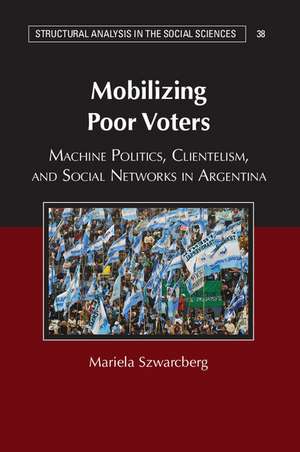
Mobilizing Poor Voters
Autor Mariela Szwarcbergen Limba Engleză Paperback – 15 iul 2015
Preț: 154.51 lei
Preț vechi: 198.92 lei
-22%
Puncte Express: 232
Carte indisponibilă temporar
Specificații
ISBN-13: 9781107534629
ISBN-10: 1107534623
Pagini: 185
Ilustrații: 7 b/w illus. 3 maps 13 tables
Dimensiuni: 147 x 226 x 20 mm
Greutate: 0.27 kg
Editura: Cambridge University Press
Locul publicării:New York, United States
ISBN-10: 1107534623
Pagini: 185
Ilustrații: 7 b/w illus. 3 maps 13 tables
Dimensiuni: 147 x 226 x 20 mm
Greutate: 0.27 kg
Editura: Cambridge University Press
Locul publicării:New York, United States
V-ar putea interesa
-
 -19%Preț: 76.39 lei93.97 lei
 -
 Work, Sex, and Power: The Forces that Shaped Our HistoryWillie ThompsonPreț: 167.85 lei
 -
 Preț: 96.45 lei
 -
 The Crosland Legacy: The Future of British Social DemocracyPatrick DiamondPreț: 175.40 lei
 -
 -28%Preț: 72.96 lei101.89 lei
 -
 Preț: 521.09 lei
 -
 -16%Preț: 133.69 lei159.75 lei
 -
 The Concept of Nature in MarxAlfred SchmidtPreț: 134.29 lei
 -
 Class War Conservatism: And Other EssaysRalph MilibandPreț: 97.27 lei
 -
 Philosophy for MilitantsAlain BadiouPreț: 102.40 lei
 -
 Building the CommuneGeo MaherPreț: 105.12 lei
 -
 The S WordJohn NicholsPreț: 124.64 lei
 -
 Preț: 150.17 lei
 -
 The ABCs of SocialismBhaskar SunkaraPreț: 77.08 lei
Cuprins
1. Politics on the ground: mobilizing poor voters in Argentina; 2. The microfoundations of political clientelism; 3. Building a party network: political, partisan and social networks in Argentina; 4. Moral hazard and asymmetric information in clientelistic networks; 5. The logic of perverse incentives; 6. Scaling up: the logic of perverse incentives at the subnational level; 7. Politics on the ground: a comparative perspective; 8. Conclusions: winners lose.
Recenzii
'This innovative book shows the value of careful multi-method research for our understanding of the micro-foundations of clientelism and its pervasive power in new democracies. Relying on impressive fieldwork as well as surveys, Mobilizing Poor Voters illuminates the different preferences of political brokers, which had been previously ignored by the literature, while also explaining the incentives that make brokers relying on clientelistic distribution more electorally successful. This second effect is crucial for understanding the predominance of clientelistic electoral strategies to mobilize poor voters. This well-crafted and insightful book will surely become a must-read for the study of clientelism and electoral mobilization in new democracies.' Maria Victoria Murillo, Columbia University
'Despite flourishing research on network analyses, most of the literature takes individuals (nodes) for granted and relationships (vertices) as unproblematic. In most network analyses, a node is a node is a node. This is definitely not the case in this wonderful book by Mariela Szwarcberg, which uses extensive ethnographic research to describe the making of clientelistic individuals and relationships. This is an original and rich theory of clientelistic mobilization through network building.' Ernesto Calvo, Associate Chair of Government and Politics, University of Maryland
'Despite flourishing research on network analyses, most of the literature takes individuals (nodes) for granted and relationships (vertices) as unproblematic. In most network analyses, a node is a node is a node. This is definitely not the case in this wonderful book by Mariela Szwarcberg, which uses extensive ethnographic research to describe the making of clientelistic individuals and relationships. This is an original and rich theory of clientelistic mobilization through network building.' Ernesto Calvo, Associate Chair of Government and Politics, University of Maryland
Descriere
Using network analysis and quantitative and qualitative data, this book explains why candidates use clientelistic strategies to mobilize poor voters.