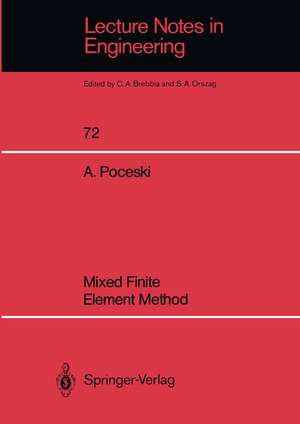
Mixed Finite Element Method: Lecture Notes in Engineering, cartea 72
Autor Apostol Poceskien Limba Engleză Paperback – 17 dec 1991
Din seria Lecture Notes in Engineering
- 15%
 Preț: 615.66 lei
 - 15%
 Preț: 618.50 lei
 - 15%
 Preț: 608.28 lei
 - 18%
 Preț: 1066.35 lei
 - 15%
 Preț: 613.00 lei
 - 15%
 Preț: 614.24 lei
 - 15%
 Preț: 613.31 lei
 - 15%
 Preț: 611.43 lei
 - 15%
 Preț: 613.18 lei
 - 18%
 Preț: 919.98 lei
 -
 Preț: 381.92 lei
 - 15%
 Preț: 628.56 lei
 - 15%
 Preț: 613.94 lei
 - 15%
 Preț: 610.33 lei
 - 15%
 Preț: 619.29 lei
 - 15%
 Preț: 610.63 lei
 - 15%
 Preț: 613.31 lei
 - 15%
 Preț: 608.78 lei
 - 15%
 Preț: 628.56 lei
 - 15%
 Preț: 611.89 lei
 - 15%
 Preț: 625.88 lei
 - 20%
 Preț: 620.38 lei
 - 15%
 Preț: 614.41 lei
 - 15%
 Preț: 608.78 lei
 - 15%
 Preț: 629.85 lei
 - 15%
 Preț: 627.31 lei
 - 15%
 Preț: 627.62 lei
 - 15%
 Preț: 618.64 lei
 - 15%
 Preț: 613.62 lei
 - 20%
 Preț: 615.76 lei
 - 15%
 Preț: 649.47 lei
 - 15%
 Preț: 614.90 lei
 - 15%
 Preț: 617.39 lei
 - 15%
 Preț: 613.80 lei
 - 15%
 Preț: 617.89 lei
 - 15%
 Preț: 622.29 lei
 - 15%
 Preț: 630.59 lei
 - 15%
 Preț: 640.03 lei
 -
 Preț: 395.98 lei
 -
 Preț: 391.34 lei
 - 15%
 Preț: 610.18 lei
 - 15%
 Preț: 625.75 lei
 - 18%
 Preț: 936.65 lei
 - 15%
 Preț: 617.89 lei
 - 15%
 Preț: 610.82 lei
 - 15%
 Preț: 615.66 lei
 - 15%
 Preț: 611.89 lei
 - 20%
 Preț: 634.14 lei
 - 15%
 Preț: 626.36 lei
 - 15%
 Preț: 610.01 lei
Preț: 621.03 lei
Preț vechi: 730.62 lei
-15%
Puncte Express: 932
Carte tipărită la comandă
Livrare economică 28 iulie-11 august
Livrare prin curier în România Termenul estimat este afișat lângă disponibilitate.
Transport gratuit pentru acest produs Plată online sau ramburs, în funcție de opțiunile comenzii.
Retur gratuit în 14 zile Comandă securizată și suport în română.
Specificații
ISBN-13: 9783540549161
ISBN-10: 3540549161
Pagini: 360
Ilustrații: VIII, 345 p.
Dimensiuni: 170 x 242 x 19 mm
Greutate: 0.57 kg
Ediția:Softcover reprint of the original 1st ed. 1992
Editura: Springer Berlin, Heidelberg
Colecția Springer
Seria Lecture Notes in Engineering
Locul publicării:Berlin, Heidelberg, Germany
ISBN-10: 3540549161
Pagini: 360
Ilustrații: VIII, 345 p.
Dimensiuni: 170 x 242 x 19 mm
Greutate: 0.57 kg
Ediția:Softcover reprint of the original 1st ed. 1992
Editura: Springer Berlin, Heidelberg
Colecția Springer
Seria Lecture Notes in Engineering
Locul publicării:Berlin, Heidelberg, Germany
V-ar putea interesa
-
 -23%Preț: 235.35 lei304.97 lei
 -
 -24%Preț: 248.73 lei326.17 lei
 -
 -37%Preț: 694.07 lei1108.96 lei
 -
 Engineering Mathematics Through ApplicationsKuldeep Singh-21%Preț: 426.87 lei543.66 lei
 -
 -8%Preț: 419.65 lei456.14 lei
 -
 Technical Math For DummiesBarry SchoenbornPreț: 137.53 lei
 -
 Modern Signal ProcessingDaniel N. RockmorePreț: 366.81 lei
 -
 Calculations for A Level PhysicsT L Lowe-25%Preț: 325.39 lei435.03 lei
 -
 Maths & English for ElectricalAndrew Spencer-18%Preț: 128.73 lei156.34 lei
 -
 -15%Preț: 618.50 lei727.65 lei
Public țintă
ResearchCuprins
1. Basic Principles.- 1.1. Introduction.- 1.2. The principle of virtual displacements.- 1.3. The unit force theorem.- 1.4. The unit displacement theorem.- 1.5. Energy variational principles.- 2. Fundamentals of the Finite Element Method.- 2.1. Historical development of the method.- 2.2. The concept of analysis by the finite element method.- 2.3. Energetic approaches of development of finite elements.- 2.4. Application of the unit displacement and unit force theorems.- 2.5. Energetic approach by boundary integration.- 2.6. The essence of the method.- 2.7. Isoparametric formulation.- 2.8. The direct method of development of finite elements.- 2.9. The progress of the mixed method.- 3. The Mixed Method in Analysis of Beam Systems.- 3.1. Introduction.- 3.2. Mixed beam element.- 3.3. Analysis of beam systems.- 3.4. Beam on elastic supports.- 3.5. Dynamics of beams.- 3.6. Stability of the beam systems.- 3.7. Coupled action of axial and transverse forces.- 4. Plate Bending Analysis.- 4.1. Rectangular element with independently assumed displacements and moments.- 4.2. Compatible element derived by boundary integration.- 4.3. Rectangular element derived by the direct method.- 4.4. Accuracy of the rectangular elements.- 4.5. Element for analysis of moderately thick plates.- 4.6. Isoparametric formulation.- 4.7. Quadrilateral element.- 4.8. Quadratic isoparametric element.- 4.9. Curved boundary element of complex displacement function.- 4.10. Accuracy of isoparametric elements.- 4.11. Practical application.- 4.12. Dynamics of plates.- 4.13. Stability of plates.- 5. Two-Dimensional Problems.- 5.1. Differential equations of the problems.- 5.2. Shortcomings of the previously developed elements.- 5.3. Rectangular mixed plane stress element.- 5.4. Quadrilateral element.- 5.5. Element ofcurved contours.- 5.6. Convergency and accuracy of the presented elements.- 6. Shells.- 6.1. Differential equations of shells.- 6.2. Mixed rectangular element.- 6.3. Analysis of dome shell.- 6.4. Analysis of cylindrical roof shell.- 6.5. Analysis of cylindrical pipe.- 6.6. Analysis of hyperbolic paraboloid shell.- 6.7. Comments and tasks for further research.- 7. Three-Dimensional Elements.- 7.1. Introduction.- 7.2. Three-dimensional elements.- 7.3. Mixed element of 36 d.o.f..- 7.4. Prismatic element of 36 d.o.f..- 7.5. Reduced three-dimensional element for plate bending analysis.- 7.6. Analysis of thick plates.- 7.7. Further development of three-dimensional elements.- 8. Further Development of the Finite Element Method.- 8.1. From one-dimensional to two-dimensional elements; accuracy.- 8.2. Displacement interpolation function.- 8.3. On the degrees of freedom.- 8.4. Some remarks on the application of the energy variational principles.- 8.5. The mathematical (direct) approach of development of finite elements.- 8.6. Application of the FEM for solution of different problems.- 8.7. Further development of the mixed method.- References.