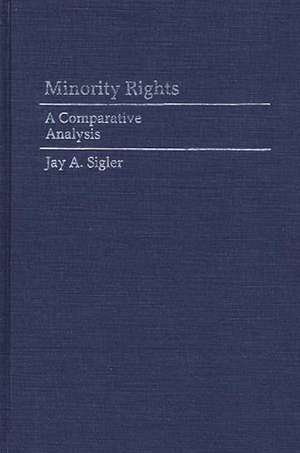
Minority Rights
Autor Jay A. Sigleren Limba Engleză Hardback – 2 dec 1983
Preț: 489.94 lei
Preț vechi: 804.04 lei
-39%
Puncte Express: 735
Carte tipărită la comandă
Livrare economică 24 decembrie 26 - 07 ianuarie 27
Livrare prin curier în România Termenul estimat este afișat lângă disponibilitate.
Transport gratuit pentru acest produs Plată online sau ramburs, în funcție de opțiunile comenzii.
Retur gratuit în 14 zile Comandă securizată și suport în română.
Specificații
ISBN-13: 9780313234002
ISBN-10: 0313234000
Pagini: 258
Dimensiuni: 161 x 240 x 19 mm
Greutate: 0.51 kg
Editura: Praeger
ISBN-10: 0313234000
Pagini: 258
Dimensiuni: 161 x 240 x 19 mm
Greutate: 0.51 kg
Editura: Praeger
V-ar putea interesa
-
 Necessity in International LawJens David Ohlin-31%Preț: 754.26 lei1093.72 lei
-
 Cosmopolitan WarCécile Fabre-20%Preț: 297.51 lei372.46 lei
-
 -30%Preț: 737.58 lei1049.52 lei
-
 The Law of Non-International Armed ConflictSandesh Sivakumaran-22%Preț: 620.30 lei797.65 lei
-
 -30%Preț: 750.89 lei1071.27 lei
-
 -31%Preț: 886.46 lei1290.85 lei
-
 Law and Morality at WarAdil Ahmad Haque-30%Preț: 713.09 lei1025.97 lei
-
 International Handbook on Race and Race RelationsJay A. Sigler-42%Preț: 343.32 lei594.83 lei
-
 Interactive Corporate ComplianceJay A. Sigler-25%Preț: 516.07 lei691.13 lei
-
 -29%Preț: 484.12 lei686.06 lei
-
 War, Aggression and Self-DefenceYoram Dinstein-23%Preț: 896.44 lei1164.20 lei
-
 Autonomous Weapons SystemsNehal BhutaPreț: 345.09 lei
-
 -21%Preț: 570.82 lei722.09 lei
-
 War, Aggression and Self-DefenceYoram DinsteinPreț: 511.95 lei
-
 International Tribunals and Human SecurityJames Meernik-21%Preț: 274.49 lei346.43 lei
-
 -15%Preț: 667.41 lei785.19 lei
-
 Managing Testimony and Administrating Victims: Colombia’s Transitional Scenario under the Justice and Peace ActJuan Pablo Aranguren RomeroPreț: 401.80 lei
Descriere
The unprecedented mass movement of populations since World War II has increased tensions among groups of people by breaking down the homogeneity of older countries and increasing the fragility of newly independent states encompassing several minorities within their borders. These changes, according to author Jay Sigler, dictate the necessity of clarifying human and minority rights. He highlights the main points of minority rights, traces their history, and demonstrates their distinctly modern features. Sigler considers the theoretical implications of minority versus individual and collective rights and examines the efforts in this area made by the United States, India, the United Kingdom, Belgium, and the Union of Soviet Socialist Republics. Finally, he proposes his own provisional theory of minority rights.