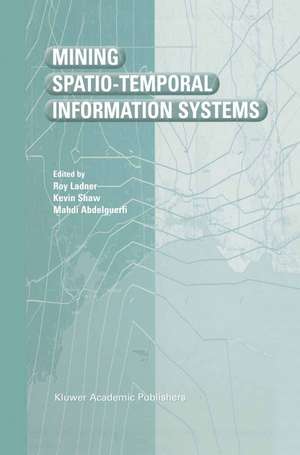
Mining Spatio-Temporal Information Systems: The Springer International Series in Engineering and Computer Science, cartea 699
Editat de Roy Ladner, Kevin Shaw, Mahdi Abdelguerfien Limba Engleză Paperback – 22 mar 2013
Mining Spatio-Temporal Information Systems is structured to meet the needs of practitioners and researchers in industry and graduate-level students in Computer Science.
Din seria The Springer International Series in Engineering and Computer Science
- 18%
 Preț: 1263.85 lei
 - 18%
 Preț: 921.36 lei
 - 20%
 Preț: 633.65 lei
 - 20%
 Preț: 665.64 lei
 - 20%
 Preț: 662.69 lei
 - 24%
 Preț: 876.97 lei
 - 20%
 Preț: 663.58 lei
 - 20%
 Preț: 950.07 lei
 - 20%
 Preț: 665.12 lei
 - 18%
 Preț: 903.90 lei
 - 20%
 Preț: 950.72 lei
 - 18%
 Preț: 985.84 lei
 - 15%
 Preț: 621.23 lei
 - 18%
 Preț: 979.41 lei
 - 18%
 Preț: 907.54 lei
 - 18%
 Preț: 1173.85 lei
 - 15%
 Preț: 663.24 lei
 - 18%
 Preț: 976.26 lei
 - 18%
 Preț: 904.83 lei
 - 18%
 Preț: 904.83 lei
 - 20%
 Preț: 1325.05 lei
 - 20%
 Preț: 1725.82 lei
 - 20%
 Preț: 1326.15 lei
 - 20%
 Preț: 989.14 lei
 -
 Preț: 381.30 lei
 - 20%
 Preț: 635.71 lei
 - 18%
 Preț: 1193.58 lei
 - 20%
 Preț: 622.65 lei
 - 20%
 Preț: 1319.14 lei
 - 18%
 Preț: 974.15 lei
 - 20%
 Preț: 670.15 lei
 - 15%
 Preț: 664.58 lei
 - 18%
 Preț: 1179.97 lei
 - 15%
 Preț: 670.25 lei
 - 15%
 Preț: 663.36 lei
 - 20%
 Preț: 620.83 lei
 - 18%
 Preț: 990.04 lei
 - 15%
 Preț: 660.75 lei
 - 18%
 Preț: 1266.48 lei
Preț: 615.32 lei
Preț vechi: 769.14 lei
-20%
Puncte Express: 923
Carte tipărită la comandă
Livrare economică 28 noiembrie-12 decembrie
Livrare prin curier în România Termenul estimat este afișat lângă disponibilitate.
Transport gratuit pentru acest produs Plată online sau ramburs, în funcție de opțiunile comenzii.
Retur gratuit în 14 zile Comandă securizată și suport în română.
Specificații
ISBN-13: 9781461354161
ISBN-10: 1461354161
Pagini: 184
Ilustrații: X, 170 p.
Dimensiuni: 155 x 235 x 10 mm
Greutate: 0.27 kg
Ediția:Softcover reprint of the original 1st ed. 2002
Editura: Springer Us
Colecția Springer
Seria The Springer International Series in Engineering and Computer Science
Locul publicării:New York, NY, United States
ISBN-10: 1461354161
Pagini: 184
Ilustrații: X, 170 p.
Dimensiuni: 155 x 235 x 10 mm
Greutate: 0.27 kg
Ediția:Softcover reprint of the original 1st ed. 2002
Editura: Springer Us
Colecția Springer
Seria The Springer International Series in Engineering and Computer Science
Locul publicării:New York, NY, United States
V-ar putea interesa
-
 Weapons of Math DestructionCathy O'Neil-31%Preț: 64.02 lei92.81 lei
 -
 An Introduction to Quantum ComputingPhillip Kaye-21%Preț: 473.00 lei601.00 lei
 -
 -22%Preț: 377.32 lei482.83 lei
 -
 Algorithmic PuzzlesAnany Levitin-30%Preț: 250.79 lei359.44 lei
 -
 Algorithms UnlockedThomas H. Cormen-26%Preț: 189.43 lei256.67 lei
 -
 -20%Preț: 671.08 lei838.85 lei
 -
 Stream Data ManagementNauman Chaudhry-20%Preț: 665.53 lei831.92 lei
 -
 Stream Data Processing: A Quality of Service PerspectiveSharma Chakravarthy-20%Preț: 997.31 lei1246.64 lei
 -
 Geospatial Services and Applications for the InternetJohn T. Sample-15%Preț: 664.35 lei781.58 lei
 -
 Multichip Module Technologies and Alternatives: The BasicsDaryl Ann Doane-20%Preț: 1310.52 lei1638.15 lei
 -
 Validation and Verification of Knowledge Based SystemsAnca Vermesan-20%Preț: 1331.31 lei1664.13 lei
 -
 Emerging Trends Database Knowledge BasedAbdelguerfi-20%Preț: 493.61 lei617.00 lei
 -
 Parallel Database TechniquesAbdelguerfi-20%Preț: 574.45 lei718.06 lei
 -
 Concentration of Measure for the Analysis of Randomized AlgorithmsDevdatt P. Dubhashi-20%Preț: 319.28 lei399.10 lei
 -
 -20%Preț: 860.62 lei1075.77 lei
 -
 3D Synthetic Environment ReconstructionMahdi Abdelguerfi-20%Preț: 942.95 lei1178.68 lei
 -
 -20%Preț: 311.44 lei389.30 lei
 -
 Advances in Data Base Theory: Volume 1Hervé Gallaire-20%Preț: 329.74 lei412.17 lei
 -
 Testing and Diagnosis of Analog Circuits and SystemsRuey-Wen Liu-20%Preț: 321.89 lei402.36 lei
 -
 Logic and Data BasesHervé Gallaire-20%Preț: 333.22 lei416.53 lei
 -
 Data Mining in FinanceBoris Kovalerchuk-20%Preț: 1229.72 lei1537.15 lei
 -
 A Modular Calculus for the Average Cost of Data StructuringMichel Schellekens-20%Preț: 622.92 lei778.65 lei
 -
 Applications of Evolutionary ComputationGiovanni Squillero-20%Preț: 333.31 lei416.64 lei
 -
 Digital Logic for ComputingJohn Seiffertt-20%Preț: 529.53 lei661.90 lei
 -
 Algorithmic Aspects of Cloud ComputingTimos Sellis-20%Preț: 316.83 lei396.04 lei
 -
 Algorithms and ComplexityDimitris Fotakis-20%Preț: 355.67 lei444.59 lei
 -
 ALGORITHMICS OF MATCHING UNDER PREFERENCManlove David-20%Preț: 1154.27 lei1442.83 lei
Public țintă
Professional/practitionerCuprins
1: Spatio-Temporal Data Mining and Knowledge Discovery: Issues Overview.- 1. Introduction.- 2. Background.- 3. Data.- 4. Data Issues.- 5. Conclusions.- 2: Indexing of Objects on the Move.- 1. Introduction.- 2. Problem Statement and Related Work.- 3. The TPR-Tree.- 4. The REXP-Tree.- 5. Summary of Performance Experiments.- 6. Conclusions.- 3: Efficient Storage of Large Volume Spatial and Temporal Point-Data in an Object-Oriented Database.- 1. Introduction.- 2. The GIDB System.- 3. The Problem Domain.- 4. An Object-Oriented Solution.- 5. Requirements.- 6. Towards a Solution.- 7. The Design.- 8. A Flexible Framework.- 9. Sample Applications.- 10. Evaluation.- 11. Future Developments.- 12. Conclusions.- 4: A Typology of Spatiotemporal Information Queries.- 1. Introduction.- 2. Spatiotemporal Information for the Dynamic World.- 3. A Typology of Spatiotemporal Queries.- 4. Conclusions.- 5: Visual Query of Time-Dependent 3D Weather in a Global Geospatial Environment.- 1. Introduction.- 2. 4D Data Model for the Visual Earth.- 3. Scalable, Hierarchical 3D Data Structure.- 4. Interactive, Accurate Visualization of Nonuniform Data.- 6: STQL — A Spatio-Temporal Query Language.- 1. Introduction.- 2. Related Work.- 3. The Data Model.- 4. Querying with Spatio-Temporal Operations.- 5. Visual Querying.- 6. Conclusions.- 7: Tripod: A Spatio-Historical Object Database System.- 1. Introduction.- 2. Case Study: UK National Land Use Database.- 3. The Tripod Object Model.- 4. Architecture.- 5. Related Work.- 6. Conclusions.- 8: Spatio-Temporal Subgroup Discovery.- 1. Introduction: Spatial Subgroup Mining.- 2. Application Example.- 3. Representation of Spatio-Temporal Data and of Spatial Subgroups.- 4. Spatio-Temporal Analyses.- 5. Database Integration.- 6. Conclusions and Future Work.