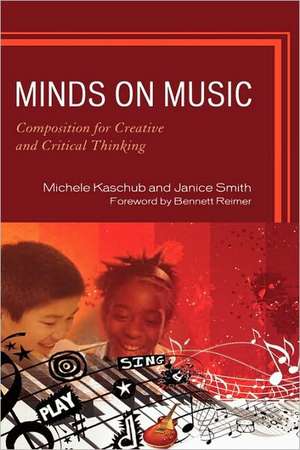
Minds on Music: Composition for Creative and Critical Thinking
Autor Michele Kaschub, Janice P. Smith Cuvânt înainte de Bennett Reimeren Limba Engleză Hardback – 15 iun 2009
Preț: 730.32 lei
Preț vechi: 1096.18 lei
-33%
Puncte Express: 1095
Carte tipărită la comandă
Livrare economică 23 noiembrie-07 decembrie
Livrare prin curier în România Termenul estimat este afișat lângă disponibilitate.
Transport gratuit pentru acest produs Plată online sau ramburs, în funcție de opțiunile comenzii.
Retur gratuit în 14 zile Comandă securizată și suport în română.
Specificații
ISBN-13: 9781607091936
ISBN-10: 1607091933
Pagini: 300
Dimensiuni: 162 x 240 x 24 mm
Greutate: 0.61 kg
Ediția:New.
Editura: Bloomsbury Publishing
Colecția R&L Education
Locul publicării:New York, United States
ISBN-10: 1607091933
Pagini: 300
Dimensiuni: 162 x 240 x 24 mm
Greutate: 0.61 kg
Ediția:New.
Editura: Bloomsbury Publishing
Colecția R&L Education
Locul publicării:New York, United States
V-ar putea interesa

Cuprins
Part 1 Foreword
Part 2 Rationale and Research
Chapter 3 Learning and Teaching Music Composition
Chapter 4 On Young Composers Composing: Characteristics, Creative Capacities, and Compositions
Chapter 5 Supporting Roles: Tools, Tasks, and Teachers
Part 6 Conceptualizing Compositional Pedagogy
Chapter 7 Preparing for Composing
Chapter 8 Assessment
Chapter 9 Designing and Working in a Composing Community
Part 10 Teaching and Learning Composition
Chapter 11 Composing in Early Childhood
Chapter 12 Composing in the Upper Elementary Grades
Chapter 13 The Transition to Middle School: Composing in Grades Five and Six
Chapter 14 Composing in Upper Middle School
Chapter 15 Composing in High School
Part 16 The Future of Composition Education
Chapter 17 The Composition Program
Part 2 Rationale and Research
Chapter 3 Learning and Teaching Music Composition
Chapter 4 On Young Composers Composing: Characteristics, Creative Capacities, and Compositions
Chapter 5 Supporting Roles: Tools, Tasks, and Teachers
Part 6 Conceptualizing Compositional Pedagogy
Chapter 7 Preparing for Composing
Chapter 8 Assessment
Chapter 9 Designing and Working in a Composing Community
Part 10 Teaching and Learning Composition
Chapter 11 Composing in Early Childhood
Chapter 12 Composing in the Upper Elementary Grades
Chapter 13 The Transition to Middle School: Composing in Grades Five and Six
Chapter 14 Composing in Upper Middle School
Chapter 15 Composing in High School
Part 16 The Future of Composition Education
Chapter 17 The Composition Program
Recenzii
Reflective, energising and informed, this book should be core reading for all wishing to know more about teaching and learning composition, along with entrants to the profession. Michele Kaschub and Janice Smith provide comprehensive and contemporary understanding of music composition rooted in genuinely educational contexts which reach in and beyond the classroom to the contemporary musical world in all its richness and diversity of practices. Combining the latest research with practical ideas and tasks,this multi-dimensional book sets out to inform, inspire and equip music educators of our time...
An excellent resource for drawing out the composer in every child as well as drawing out the child in all of us.
This book makes an important contribution to the literature about composition within school music programs. It thoughtfully examines the cognitive underpinnings of the composition process at every age level, and offers practical suggestions for designing projects that will be successful with students at a variety of levels. It is well researched, and likewise draws upon the extensive experiences of the authors. Beginning and seasoned teachers alike will find much to think about in this book.
In this book, Kaschub and Smith address an issue of great importance in the development of a 21st century music curriculum. They argue-most forcefully, thoroughly and thoughtfully-for the proposition that all children should be encouraged to compose music. Their work is truly pioneering, and their volume fills a need that has been present for quite some time. At every level of the PK-12 spectrum, Minds on Music provides valuable observations, insights into student psychology, introductory comments on notation, memory, musical form, instrumental timbre and the like. There are also a number of fascinating "scenarios"-a sampling of creative assignments, at each educational level-which should go a long way toward dispelling fears, on the part of both student and teacher, about entering this uncharted territory. One hopes that Minds on Music will be read by many music education professors and school music teachers!
This excellent book is important for music educators, composers and musicians dealing with composing in the class and in communities, but also for parents interested in the creativity of their children. Minds on Music focuses two basic ideas: "composition can be taught," and "children learn to compose by composing." The authors address important and diverse research fields and present models for teaching composition from early childhood to high school. I recommend this book to everyone who is focusing on composing with young people.
Established authors and music educators, Kaschub and Smith partnered with the National Association for Music Education to publish this book on the importance of children composing music. . . . Including valuable tables and charts, the book covers five age groups and highlights child development and musical progression. . . . This well-researched volume will benefit music educators, cross-curriculum advocates, and students of all ages. Recommended.
The teaching and learning of composing in schools is so much ingrained into the English National Curriculum that it takes a book such as this to jolt British readers out of an established mindset, and to consider alternative ways of doing things..this book serves two audiences: academic researchers investigating the construct of educational composing, and teachers who wish to introduce or develop their classroom practice in this area..it offers a welcome addition to the literature on classroom composing.
Minds on Music is a thorough, highly effective guide to facilitating composition activities and assessing student progress in preK-12 school music programs. This book would be most useful to novice teachers starting a program, composers who are new to teaching, and experienced composition teachers seeking fresh ideas. It is well organized, lending itself to quick reference use as well.
This penetrating and illuminating book is a perfect blend of theory and practice. The authors eloquently explain the vital role that composition must play in music education and they provide practical, accessible techniques for teaching it in our schools. An indispensible resource for music teachers and researchers at every stage of their careers, it belongs on all of our bookshelves.
I was hesitant to attempt composition in my band rehearsal, but Minds on Music encouraged me to try. While the product at the concert was amazing, the educational rewards in the classroom were far greater. And now my students are more invested in the program than ever before!
An excellent resource for drawing out the composer in every child as well as drawing out the child in all of us.
This book makes an important contribution to the literature about composition within school music programs. It thoughtfully examines the cognitive underpinnings of the composition process at every age level, and offers practical suggestions for designing projects that will be successful with students at a variety of levels. It is well researched, and likewise draws upon the extensive experiences of the authors. Beginning and seasoned teachers alike will find much to think about in this book.
In this book, Kaschub and Smith address an issue of great importance in the development of a 21st century music curriculum. They argue-most forcefully, thoroughly and thoughtfully-for the proposition that all children should be encouraged to compose music. Their work is truly pioneering, and their volume fills a need that has been present for quite some time. At every level of the PK-12 spectrum, Minds on Music provides valuable observations, insights into student psychology, introductory comments on notation, memory, musical form, instrumental timbre and the like. There are also a number of fascinating "scenarios"-a sampling of creative assignments, at each educational level-which should go a long way toward dispelling fears, on the part of both student and teacher, about entering this uncharted territory. One hopes that Minds on Music will be read by many music education professors and school music teachers!
This excellent book is important for music educators, composers and musicians dealing with composing in the class and in communities, but also for parents interested in the creativity of their children. Minds on Music focuses two basic ideas: "composition can be taught," and "children learn to compose by composing." The authors address important and diverse research fields and present models for teaching composition from early childhood to high school. I recommend this book to everyone who is focusing on composing with young people.
Established authors and music educators, Kaschub and Smith partnered with the National Association for Music Education to publish this book on the importance of children composing music. . . . Including valuable tables and charts, the book covers five age groups and highlights child development and musical progression. . . . This well-researched volume will benefit music educators, cross-curriculum advocates, and students of all ages. Recommended.
The teaching and learning of composing in schools is so much ingrained into the English National Curriculum that it takes a book such as this to jolt British readers out of an established mindset, and to consider alternative ways of doing things..this book serves two audiences: academic researchers investigating the construct of educational composing, and teachers who wish to introduce or develop their classroom practice in this area..it offers a welcome addition to the literature on classroom composing.
Minds on Music is a thorough, highly effective guide to facilitating composition activities and assessing student progress in preK-12 school music programs. This book would be most useful to novice teachers starting a program, composers who are new to teaching, and experienced composition teachers seeking fresh ideas. It is well organized, lending itself to quick reference use as well.
This penetrating and illuminating book is a perfect blend of theory and practice. The authors eloquently explain the vital role that composition must play in music education and they provide practical, accessible techniques for teaching it in our schools. An indispensible resource for music teachers and researchers at every stage of their careers, it belongs on all of our bookshelves.
I was hesitant to attempt composition in my band rehearsal, but Minds on Music encouraged me to try. While the product at the concert was amazing, the educational rewards in the classroom were far greater. And now my students are more invested in the program than ever before!