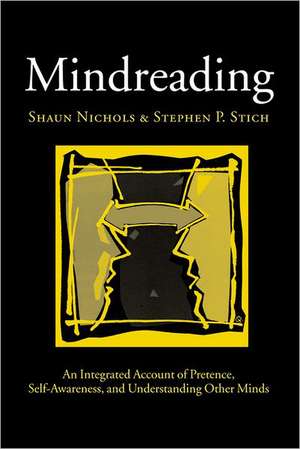
Mindreading: An Integrated Account of Pretence, Self-Awareness, and Understanding Other Minds: Oxford Cognitive Science Series
Autor Shaun Nichols, Stephen P. Stichen Limba Engleză Hardback – 4 sep 2003
The everyday capacity to understand the mind, fancifully dubbed 'mindreading', plays an enormous role in our lives. In the latter half of the 20th century mindreading became the object of sustained scientific and theoretical research, capturing the attention of a wide range of disciplines, including philosophy, developmental psychology, behavioral ecology, anthropology, and cognitive psychopathology. What has been missing is a detailed and integrated account of the mental components that underlie this remarkable capacity. Nichols and Stich develop and defend a new account of the psychological mechanisms underlying mindreading. They maintain that it is, as common sense would suggest, vital to distinguish between reading others' minds and reading one's own. In reading other minds, the imagination plays a central role. As a result, the authors begin with an explicit and systematic account of pretence and imagination which proposes that pretence representations are contained in a separate mental workspace, the 'Possible World Box', which is part of the basic architecture of the human mind. The mechanisms underlying pretence get recruited when people attempt to understand others and predict their behaviour. In some cases, we use our own mental mechanisms to simulate the mental processes of another, as suggested by the 'simulation theory' of mindreading. However, mindreading also implicates very different kinds of mechanisms that rely on rich bodies of information, as suggested by information-based accounts of mindreading. In addition, the authors argue, reading other minds involves important processes that don't fit into either category. None of these mechanisms, though, explain how we read our own minds, which, according to the authors, requires invoking an entirely independent set of mechanisms.What we find, then, is an intricate web of mental components to explain our fascinating and multifarious knack of understanding minds. This account provides a valuable framework for future work on mindreading and has broad implications for philosophical debates that have surrounded the issue for the last quarter century.




Preț: 945.96 lei
Preț vechi: 1408.37 lei
-33%
Puncte Express: 1419
Carte tipărită la comandă
Livrare economică 27 noiembrie-02 decembrie
Livrare prin curier în România Termenul estimat este afișat lângă disponibilitate.
Transport gratuit pentru acest produs Plată online sau ramburs, în funcție de opțiunile comenzii.
Retur gratuit în 14 zile Comandă securizată și suport în română.
Specificații
ISBN-13: 9780198236092
ISBN-10: 0198236093
Pagini: 248
Ilustrații: numerous figures and 1 halftone
Dimensiuni: 170 x 242 x 19 mm
Greutate: 0.5 kg
Editura: OUP OXFORD
Colecția OUP Oxford
Seria Oxford Cognitive Science Series
Locul publicării:Oxford, United Kingdom
ISBN-10: 0198236093
Pagini: 248
Ilustrații: numerous figures and 1 halftone
Dimensiuni: 170 x 242 x 19 mm
Greutate: 0.5 kg
Editura: OUP OXFORD
Colecția OUP Oxford
Seria Oxford Cognitive Science Series
Locul publicării:Oxford, United Kingdom
V-ar putea interesa
-
 Simple Heuristics That Make Us SmartGerd Gigerenzer-28%Preț: 396.55 lei549.97 lei
 -
 The Oxford Handbook of Philosophy of Cognitive ScienceEric Margolis-33%Preț: 1146.36 lei1699.11 lei
 -
 -22%Preț: 436.91 lei556.93 lei
 -
 Experimental PhilosophyJoshua Knobe-12%Preț: 302.89 lei344.58 lei
 -
 -34%Preț: 701.26 lei1055.82 lei
 -
 Agency and Self-Awareness: Issues in Philosophy and PsychologyJohannes Roessler-28%Preț: 429.08 lei596.20 lei
 -
 Consciousness and the WorldBrian O'Shaughnessy-27%Preț: 391.60 lei536.22 lei
 -
 Thinking about ConsciousnessDavid Papineau-28%Preț: 413.26 lei574.98 lei
 -
 -28%Preț: 347.41 lei483.18 lei
 -
 Bound: Essays on free will and responsibilityShaun Nichols-19%Preț: 530.09 lei654.43 lei
 -
 Origins of ObjectivityTyler Burge-9%Preț: 380.37 lei419.31 lei
 -
 The Opacity of Mind: An Integrative Theory of Self-KnowledgePeter Carruthers-13%Preț: 116.65 lei133.69 lei
 -
 The Complex MindMcfarland-15%Preț: 669.02 lei787.08 lei
 -
 Soft-WiredDr Michael Merzenich PhdPreț: 99.38 lei
 -
 Philosophy and Connectionist TheoryWilliam Ramsey-15%Preț: 475.49 lei559.41 lei
 -
 Mental RepresentationStichPreț: 407.80 lei
 -
 Consciousness: States, Mechanisms & DisordersAndrea Eugenio Cavanna-27%Preț: 1252.07 lei1704.22 lei
 -
 PRINCIPLES & APPLS OF SPATIAL HEARINGSuzuki Yoiti-18%Preț: 1056.94 lei1288.95 lei
 -
 COMPUTATIONAL MODELS OF COGNITIVE PROCESSESMayor Julien-15%Preț: 693.28 lei815.63 lei
Recenzii
This book is Nichols and Stichs long-awaited monograph on the theory of mind debate. The wait has been well worth it. Their discussion is integrative, innovative, extremely well informed, and crystal clear. Moreover, their own theories are for the most part carefully thought through and have been worked out in far greater detail than those of their competitors. This book sets a new benchmark for quality in discussions of human mind-reading abilities, and deserves to be highly influential in the field. . . . This is an excellent book, which anyone interested in naturalistic accounts of our abilities to pretend and to ascribe mental states to ourselves and to others needs to read.