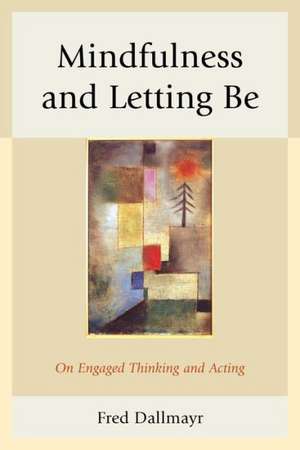
Mindfulness and Letting Be: On Engaged Thinking and Acting
Autor Fred Dallmayren Limba Engleză Hardback – 17 sep 2014
Preț: 592.78 lei
Preț vechi: 909.50 lei
-35%
Puncte Express: 889
Carte tipărită la comandă
Livrare economică 07-21 decembrie
Livrare prin curier în România Termenul estimat este afișat lângă disponibilitate.
Transport gratuit pentru acest produs Plată online sau ramburs, în funcție de opțiunile comenzii.
Retur gratuit în 14 zile Comandă securizată și suport în română.
Specificații
ISBN-13: 9780739199862
ISBN-10: 0739199862
Pagini: 154
Dimensiuni: 160 x 239 x 16 mm
Greutate: 0.36 kg
Editura: Bloomsbury Publishing
Colecția Lexington Books
Locul publicării:New York, United States
ISBN-10: 0739199862
Pagini: 154
Dimensiuni: 160 x 239 x 16 mm
Greutate: 0.36 kg
Editura: Bloomsbury Publishing
Colecția Lexington Books
Locul publicării:New York, United States
V-ar putea interesa
-
 Consciousness ExplainedDaniel C. Dennett-28%Preț: 78.82 lei108.76 lei
 -
 Pride, Shame, and Guilt: Emotions of Self-AssessmentGabriele Taylor-32%Preț: 745.43 lei1093.58 lei
 -
 Philosophy of Mind: A Beginner's GuideIan Ravenscroft-12%Preț: 350.73 lei398.07 lei
 -
 Mind, Morality, and Explanation: Selected CollaborationsFrank Jackson-18%Preț: 318.77 lei390.24 lei
 -
 Perceptual ExperienceTamar Szabó Gendler-28%Preț: 459.76 lei635.90 lei
 -
 An Introduction to the Philosophy of MindE. J. LowePreț: 407.15 lei
 -
 The Production of SpaceHenri LefebvrePreț: 302.48 lei
 -
 A Companion to the Philosophy of MindSamuel GuttenplanPreț: 389.61 lei
 -
 Mindsight – Image, Dream, MeaningColin McginnPreț: 238.68 lei
 -
 An Introduction to the Philosophy of MindKeith T MaslinPreț: 275.41 lei
 -
 Practices of SelfhoodZygmunt BaumanPreț: 178.71 lei
 -
 More Kinds of BeingE. J. LowePreț: 345.31 lei
 -
 A Brief History of HappinessNicholas P. WhitePreț: 250.17 lei
 -
 Philosophy of Mind and CognitiBraddon-MitchelPreț: 386.82 lei
 -
 Preț: 347.14 lei
 -
 Philosophy of MindEdward FeserPreț: 80.09 lei
Cuprins
Chapter 1. "The Future of Theory": Mindful Thinking
Chapter 2. Beyond "Action Theory": Mindful Praxis
Chapter 3. Nothingness, Non-Being, Emptiness: Thinking at the Edge of Thought
Chapter 4. But Only Speak the Word: Mindfulness and Language
Chapter 5. Naturing Nature: Mindfulness and Art
Chapter 6. The Future of the Past: Mindfulness and History
Chapter 7. Why Cross-cultural Studies Now?: Mindfulness and Cosmopolis
Appendix A. Are Humans Becoming Superfluous?: Robots and Gestell
Appendix B. For an Apophatic Humanism: Orthopraxis
Appendix C. Empire and Mindfulness: Theocracy as Temptation
Chapter 2. Beyond "Action Theory": Mindful Praxis
Chapter 3. Nothingness, Non-Being, Emptiness: Thinking at the Edge of Thought
Chapter 4. But Only Speak the Word: Mindfulness and Language
Chapter 5. Naturing Nature: Mindfulness and Art
Chapter 6. The Future of the Past: Mindfulness and History
Chapter 7. Why Cross-cultural Studies Now?: Mindfulness and Cosmopolis
Appendix A. Are Humans Becoming Superfluous?: Robots and Gestell
Appendix B. For an Apophatic Humanism: Orthopraxis
Appendix C. Empire and Mindfulness: Theocracy as Temptation
Recenzii
Distancing himself from current psychosocial uses of the term mindfulness, which he reads as too deeply connected to a Cartesian sense of self, Dallmayr carefully outlines a notion of mindfulness that aims to overcome the calculative thinking endemic to the Cartesianism of contemporary times. The book comprises seven chapters and three appendixes. All chapters focus on an aspect of mindfulness; they include 'Mindful Praxis,' 'Mindfulness and Cosmopolis,' and similar chapters on art, history, and language. The project draws on Western thinkers such as Martin Heidegger, Jacques Derrida, and Maurice Merleau-Ponty and explores Eastern contributions through Raimon Panikkar and classical Indian and Chinese thought. In each case, the book elaborates on the practice of letting be. Appendixes are freestanding essays exploring mindfulness and contemporary questions of the role of technology, the relationship between mindfulness theory and praxis, and the contemporary situation of empire building. Dallmayr's prose is readable and clear. Though Heidegger's influence is felt throughout the text, Dallmayr's explanations make it deeply relevant and compelling. Through the author's inspiring description of an active 'letting be,' readers will gain insight into a way out of the mindlessness of contemporary society. Summing Up: Recommended. Upper-division undergraduates through researchers/faculty.
Fred Dallmayr has written another a remarkable book. Learned and scholarly, it is also clear and unpretentious in its language. Sweeping in its cultural concerns and references, it is also focused upon the most basic and simple enigmas of life. Throughout, Dallmayr reminds us of the real challenges of a life that is engaged and full of thought.
Mindfulness and Letting Be contains fresh and inspiring words of wisdom from a well-known, distinguished master of Heidegger's thought. Fred Dallmayr's outlook is at the same time genuinely global, in the best sense of that word, and suffused with concern about humanity's future.
Mindfulness and Letting Be: on Engaged Thinking and Acting brings us further along the arc of Dallmayr's post-individualist political theory. Critical of contemporary pop culture understandings of mindfulness, Dallmayr instead rethinks the concept as an active "letting be." He provides a provocative and thoughtful cross-cultural argument for the resources, both theoretically and practically, mindfulness provides for a response to global dehumanization.
Fred Dallmayr has written another a remarkable book. Learned and scholarly, it is also clear and unpretentious in its language. Sweeping in its cultural concerns and references, it is also focused upon the most basic and simple enigmas of life. Throughout, Dallmayr reminds us of the real challenges of a life that is engaged and full of thought.
Mindfulness and Letting Be contains fresh and inspiring words of wisdom from a well-known, distinguished master of Heidegger's thought. Fred Dallmayr's outlook is at the same time genuinely global, in the best sense of that word, and suffused with concern about humanity's future.
Mindfulness and Letting Be: on Engaged Thinking and Acting brings us further along the arc of Dallmayr's post-individualist political theory. Critical of contemporary pop culture understandings of mindfulness, Dallmayr instead rethinks the concept as an active "letting be." He provides a provocative and thoughtful cross-cultural argument for the resources, both theoretically and practically, mindfulness provides for a response to global dehumanization.