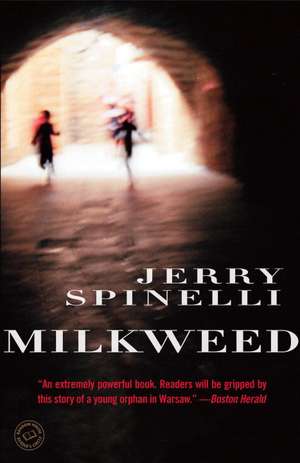
Milkweed: Random House Children's Books
Autor Jerry Spinellien Limba Engleză Paperback – 23 mar 2010
Ritmul narațiunii în Milkweed este dictat de urgența supraviețuirii stradale, pendulând între agilitatea furtului de hrană și momentele de liniște în care un copil încearcă să-și construiască o identitate. Jerry Spinelli ne introduce în Varșovia ocupată nu prin date istorice rigide, ci prin ochii unui băiat care nu își știe nici măcar numele adevărat. Notăm cu interes felul în care autorul folosește o perspectivă naivă — protagonistul admiră inițial cizmele lucioase ale naziștilor — pentru a sublinia absurditatea și cruzimea războiului pe măsură ce ghetoul se închide în jurul său.
Remarcăm o evoluție stilistică față de lucrările sale anterioare, precum Fourth Grade Rats (Rule the School #2) sau Third Grade Angels (Rule the School #1). Dacă în acele volume Jerry Spinelli explora ierarhiile și micile drame ale curții școlii, în Milkweed el păstrează finețea psihologică a adolescenței, dar o plasează într-un context de o gravitate extremă. Copiii care au iubit Once de Morris Gleitzman vor găsi aici aceeași voce fragilă, dar rezistentă a unui orfan evreu care caută sens într-o lume care vrea să îl șteargă.
Structura narativă este una a contrastelor: frumusețea unui fir de mătase de plantă (milkweed) în mijlocul cenușii ghetoului. Deși subiectul este devastator, tonul nu devine niciodată didactic, ci rămâne profund uman. Este o lectură despre momentul în care identitatea devine un pericol și despre cum, în vremuri de restriște, cel mai sigur loc este să fii „nimeni”.
Din seria Random House Children's Books
-
 Preț: 54.21 lei
 -
 Preț: 39.72 lei
 -
 Preț: 38.68 lei
 -
 Preț: 80.12 lei
 -
 Preț: 45.54 lei
 - 19%
 Preț: 40.91 lei
 -
 Preț: 49.55 lei
 -
 Preț: 44.22 lei
 -
 Preț: 48.93 lei
 -
 Preț: 82.77 lei
 -
 Preț: 45.72 lei
 -
 Preț: 27.76 lei
 - 17%
 Preț: 97.03 lei
 - 18%
 Preț: 40.75 lei
 - 18%
 Preț: 47.54 lei
 -
 Preț: 50.64 lei
 -
 Preț: 43.17 lei
 -
 Preț: 39.53 lei
 -
 Preț: 53.85 lei
 -
 Preț: 47.75 lei
 -
 Preț: 154.82 lei
 -
 Preț: 42.76 lei
 -
 Preț: 51.71 lei
 -
 Preț: 37.16 lei
 -
 Preț: 37.83 lei
 -
 Preț: 27.33 lei
 -
 Preț: 45.72 lei
 -
 Preț: 46.15 lei
 - 17%
 Preț: 65.91 lei
 -
 Preț: 39.72 lei
 -
 Preț: 77.80 lei
 -
 Preț: 44.63 lei
 -
 Preț: 51.06 lei
 -
 Preț: 37.83 lei
 -
 Preț: 39.72 lei
 -
 Preț: 51.71 lei
 -
 Preț: 44.63 lei
 -
 Preț: 27.56 lei
 -
 Preț: 47.18 lei
 -
 Preț: 73.53 lei
 - 19%
 Preț: 56.31 lei
 -
 Preț: 71.40 lei
 -
 Preț: 65.63 lei
 - 18%
 Preț: 46.59 lei
 -
 Preț: 67.98 lei
 -
 Preț: 83.83 lei
 -
 Preț: 45.54 lei
 -
 Preț: 42.96 lei
 - 29%
 Preț: 40.87 lei
Preț: 72.45 lei
Carte disponibilă
Livrare economică 16-30 noiembrie
Specificații
ISBN-10: 0375861475
Pagini: 242
Dimensiuni: 132 x 203 x 13 mm
Greutate: 0.18 kg
Editura: Random House
Colecția Random House Children's Books
Seria Random House Children's Books
V-ar putea interesa
-
 WringerJerry SpinelliPreț: 56.64 lei
 -
 Smiles to GoJerry SpinelliPreț: 66.43 lei
 -
 Maniac MageeJerry SpinelliPreț: 51.71 lei
 -
 The Other Half of LifeKim Ablon WhitneyPreț: 50.45 lei
 -
 Love, StargirlJerry SpinelliPreț: 69.18 lei
 -
 Land of HopeJoan Lowery NixonPreț: 36.99 lei
 -
 NightjohnGary Paulsen-21%Preț: 38.36 lei48.68 lei
 -
 SarnyGary PaulsenPreț: 42.72 lei
 -
 With Every Drop of BloodJames Lincoln CollierPreț: 43.72 lei
 -
 Soldier's HeartGary PaulsenPreț: 41.10 lei
 -
 Time Enough for DrumsAnn RinaldiPreț: 50.64 lei
 -
 The Power of OneBryce CourtenayPreț: 58.34 lei
 -
 StargirlJerry SpinelliPreț: 54.06 lei
 -
 Shackleton's StowawayVictoria McKernanPreț: 51.91 lei
 -
 Skippack SchoolMarguerite De AngeliPreț: 109.34 lei
 -
 Window of TimeKaren WeinbergPreț: 62.12 lei
 -
 Broken DrumEdith Morris HemingwayPreț: 72.77 lei
 -
 Brothers at WarMargaret Whitman BlairPreț: 54.30 lei
 -
 Cultivating HopeLinda K. HubalekPreț: 62.36 lei
De ce să citești această carte
Recomandăm această carte părinților care doresc să introducă tinerii cititori (12+) în istoria Holocaustului printr-o poveste centrată pe empatie și reziliență. Milkweed oferă o lecție valoroasă despre umanitate și curaj, ajutându-i pe adolescenți să înțeleagă complexitatea morală a istoriei prin ochii unui personaj de vârsta lor, facilitând discuții esențiale despre identitate și compasiune.
Despre autor
Jerry Spinelli (născut la 1 februarie 1941) este un scriitor american de renume, specializat în literatură pentru copii și adolescenți. Este laureat al prestigiosului premiu Newbery Medal, fiind recunoscut la nivel internațional pentru capacitatea sa de a surprinde vocea autentică a tinerilor aflați la granița dintre copilărie și maturitate. Printre cele mai cunoscute lucrări ale sale se numără „Maniac Magee” și „Stargirl”. În Milkweed, Spinelli își folosește talentul narativ pentru a aborda ficțiunea istorică, demonstrând aceeași sensibilitate față de personajele marginalizate pe care a manifestat-o și în lucrări precum Hokey Pokey sau Spinelli, J: Dead Wednesday.
Notă biografică
Extras
MEMORY
I am running.
That’s the first thing I remember. Running. I carry something, my arm curled around it, hugging it to my chest. Bread, of course. Someone is chasing me. “Stop! Thief!” I run. People. Shoulders. Shoes. “Stop! Thief!”
Sometimes it is a dream. Sometimes it is a memory in the middle of the day as I stir iced tea or wait for soup to heat. I never see who is chasing and calling me. I never stop long enough to eat the bread. When I awaken from dream or memory, my legs are tingling.
2
SUMMER
He was dragging me, running. He was much bigger. My feet skimmed over the ground. Sirens were screaming. His hair was red. We flew through streets and alleyways. There we thumping noises, like distant thunder. The people we bounced off didn’t seem to notice us. The sirens were screaming like babies. At last we plunged into a dark hole.
“You’re lucky,” he said. “Soon it won’t be ladies chasing you. It will be Jackboots.”
“Jackboots?” I said.
“You’ll see.”
I wondered who the Jackboots were. Were unfooted boots running along the streets?
“Okay,” he said, “hand it over.”
“Hand what over?” I said.
He reached into my shirt and pulled out the loaf of bread. He broke it in half. He shoved one half at me and began to eat the other.
“You’re lucky I didn’t kill you,” he said. “That lady you took this from, I was just getting ready to snatch it for myself.”
“I’m lucky,” I said.
He burped. “You’re quick. You took it before I even knew what happened. That lady was rich. Did you see the way she was dressed? She’ll just buy ten more.”
I ate my bread.
More thumping sounds in the distance. “What is that?” I asked him.
“Jackboot artillery,” he said.
“What’s artillery?”
“Big guns. Boom boom. They’re shelling the city.” He stared at me. “Who are you?”
I didn’t understand the question.
“I’m Uri,” he said. “What’s your name.
I gave him my name. “Stopthief.”
3
He took me to meet the others. We were in a stable. The horses were there. Usually they would be out on the streets, but they were home now because the Jackboots were boom-booming the city and it was too dangerous for horses. We sat in a stall near the legs of a sad-faced gray. The horse pooped. Two of the kids got up and went to the next stall, another horse. A moment later came the sound of water splashing on straw. The two came back. One of them said, “I’ll take the poop.”
“Where did you find him?” said a boy smoking a cigarette.
“Down by the river,” said Uri. “He snatched a loaf from a rich lady coming out of the Bread Box.”
Another boy said, “Why didn’t you snatch it from him?” This one was smoking a cigar as long as his face.
Uri looked at me. “I don’t know.”
“He’s a runt,” someone said. “Look at him.”
“Stand up,” said someone else.
I looked at Uri. Uri flicked his finger. I stood.
“Go there,” someone said. I felt a foot on my back, pushing me toward the horse.
“See,” said the cigar smoker, “he doesn’t even come halfway up to the horse’s dumper.”
A voice behind me squawked, “The horse could dump a new hat on him!”
Everyone, even Uri, howled with laughter. Explosions went off beyond the walls.
The boys who were not smoking were eating. In the corner of the stable was a pile as tall as me. There was bread in all shapes and sausages of all lengths and colors and fruits and candies. But only half of it was food. All sorts of other things glittered in the pile. I saw watches and combs and ladies’ lipsticks and eyeglasses. I saw the thin flat face of a fox peering out.
“What’s his name?” said someone.
Uri nodded at me. “Tell them your name.”
“Stopthief,” I said.
Someone crowed, “It speaks!”
Smoke burst from mouths as the boys laughed.
One boy did not laugh. He carried a cigarette behind each ear. “I think he’s cuckoo.”
Another boy got up and came over to me. He leaned down. He sniffed. He pinched his nose. “He smells.” He blew smoke into my face.
“Look,” someone called, even the smoke can’t stand him. It’s turning green!”
They laughed.
The smoke blower backed off. “So, Stopthief, are you a smelly cuckoo?”
I didn’t know what to say.
“He’s stupid,” said the unlaughing boy. “He’ll get us in trouble.”
“He’s quick,” said Uri. “And he’s little.”
“He’s a runt.”
“Runt is good,” said Uri.
“Are you a Jew?” said the boy in my face.
“I don’t know,” I said.
He kicked my foot. “How can you not know? You’re a Jew or you’re not a Jew.”
I shrugged.
“I told you, he’s stupid,” said the unlaugher.
“He’s young,” said Uri. “He’s just a little kid.”
“How old are you?” said the smoke blower.
“I don’t know,” I said.
The smoke blower threw up his hands. “Don’t you know anything?”
“He’s stupid.”
“He’s a stupid Jew.”
“A smelly stupid Jew.”
“A tiny smelly stupid Jew!”
More laughter. Each time they laughed, they threw food at each other and at the horse.
The smoke blower pressed my nose with the tip of his finger. “Can you do this?” He leaned back until he was facing the ceiling. He puffed on the cigarette until his cheeks, even his eyes, were bulging. His face looked like a balloon. It was grinning. I was sure he was going to destroy me with his faceful of smoke, but he didn’t. He turned to the horse, lifted its tail, and blew a stream of silvery smoke at the horse’s behind. The horse nickered.
Everyone howled. Even the unlaugher. Even me.
The pounding in the distance was like my heartbeat after running.
“He must be a Jew,” someone said.
“What’s a Jew?” I said.
“Answer the runt,” someone said. “Tell him what a Jew is.”
The unlaugher kicked ground straw at a boy who hadn’t spoken. The boy had only one arm. “That’s a Jew.” He pointed to himself. “This is a Jew.” He pointed to the others. “That’s a Jew. That’s a Jew. That’s a Jew.” He pointed to the horse. “That’s a Jew.” He fell to his knees and scrabbled in the straw near the horse flop. He found something. He held it out to me. It was a small brown insect. “This is a Jew. Look. Look!” He startled me. “A Jew is an animal. A Jew is a bug. A Jew is less than a bug.” He threw the insect into the flop. “A Jew is that.”
Others cheered and clapped.
“Yeah! Yeah!”
“I’m a horse turd!”
“I’m a goose turd!”
A boy pointed at me. “He’s a Jew all right. Look at him. He’s a Jew if I ever saw one.”
“Yeah, he’s in for it all right.”
I looked at the boy who spoke. He was munching on a sausage. “What am I in for?” I said.
He snorted. “Strawberry babka.”
“We’re all in for it,” said someone else. “We’re in for it good.”
From the Hardcover edition.
Descriere scurtă
He's a boy called Jew. Gypsy. Stopthief. Filthy son of Abraham.
He's a boy who lives in the streets of Warsaw. He's a boy who steals food for himself, and the other orphans. He's a boy who believes in bread, and mothers, and angels.
He's a boy who wants to be a Nazi, with tall, shiny jackboots of his own-until the day that suddenly makes him change his mind.
And when the trains come to empty the Jews from the ghetto of the damned, he's a boy who realizes it's safest of all to be nobody.
Newbery Medalist Jerry Spinelli takes us to one of the most devastating settings imaginable-Nazi-occupied Warsaw during World War II-and tells a tale of heartbreak, hope, and survival through the bright eyes of a young Holocaust orphan.