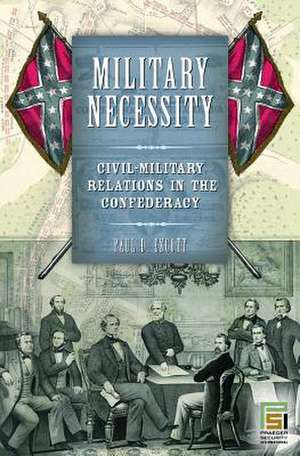
Military Necessity: Civil-Military Relations in the Confederacy: In War and in Peace: U.S. Civil-Military Relations
Autor Paul D. Escotten Limba Engleză Hardback – 30 ian 2006
Ultimately the crisis of the Confederacy threatened both the constitutionalism that southern politicians long had cherished and a core principle of the tradition of civil control over the military. Key figures in the army also took the lead in urging the use of slaves as soldiers and promoting the idea of emancipation. With many portraits of high-ranking generals and civil officials and telling anecdotes that reveal the nature of their relationships, this book reveals the depth of the Confederacy's social, political, and military crisis and highlights what this crisis revealed about the foundations of Confederate society.




Preț: 498.75 lei
Preț vechi: 679.81 lei
-27%
Puncte Express: 748
Carte tipărită la comandă
Livrare economică 21 noiembrie-05 decembrie
Livrare prin curier în România Termenul estimat este afișat lângă disponibilitate.
Transport gratuit pentru acest produs Plată online sau ramburs, în funcție de opțiunile comenzii.
Retur gratuit în 14 zile Comandă securizată și suport în română.
Specificații
ISBN-13: 9780275983130
ISBN-10: 0275983137
Pagini: 236
Dimensiuni: 156 x 235 x 23 mm
Greutate: 0.51 kg
Editura: Bloomsbury Publishing
Colecția Praeger
Seria In War and in Peace: U.S. Civil-Military Relations
Locul publicării:New York, United States
ISBN-10: 0275983137
Pagini: 236
Dimensiuni: 156 x 235 x 23 mm
Greutate: 0.51 kg
Editura: Bloomsbury Publishing
Colecția Praeger
Seria In War and in Peace: U.S. Civil-Military Relations
Locul publicării:New York, United States
V-ar putea interesa
-
 The Lost Diary of Annie Oakley's Wild West StagehandClive DickinsonPreț: 43.60 lei
 -
 The Real Wild WestMichael WallisPreț: 282.02 lei
 -
 The First Maya Civilization: Ritual and Power Before the Classic PeriodFrancisco Estrada-BelliPreț: 400.12 lei
 -
 Canadian History For Dummies 2eW FergusonPreț: 173.22 lei
 -
 Preț: 271.68 lei
 -
 The Death PenaltyStuart BannerPreț: 223.09 lei
 -
 Devil's BargainsHal RothmanPreț: 306.36 lei
 -
 From Rail-Splitter to IconBunkerPreț: 270.29 lei
 -
 Jim Courtright of Fort WorthRobert K DearmentPreț: 148.41 lei
 -
 The History of Central AmericaThomas L. PearcyPreț: 101.68 lei
 -
 The Merchant of PowerJohn F. WasikPreț: 155.20 lei
 -
 1491: The Americas Before ColumbusCharles C. MannPreț: 108.46 lei
Cuprins
Preface
Traditions for a New Nation
Policy-Making Produces Innovation and Controversy
The Politics of Command
Toward a Militarized Society
Military Power and Debility
Military Men and Civil Policy-Making
Desperate Proposals and Maintenance of Civil Supremacy
Citizens and Soldiers
Notes
Selected Bibliography
Traditions for a New Nation
Policy-Making Produces Innovation and Controversy
The Politics of Command
Toward a Militarized Society
Military Power and Debility
Military Men and Civil Policy-Making
Desperate Proposals and Maintenance of Civil Supremacy
Citizens and Soldiers
Notes
Selected Bibliography
Recenzii
Escott, author of several major works on the history of the US South and the Civil War, examines the relationship between civil and military authority in the Confederacy during the Civil War. In this recent entry to a series on the larger subject of US civil-military relations, Escott finds that the pressures of war on a smaller, less industrialized, less modernized society forced Confederate leaders to make increasingly difficult decisions about the role of the military in a nation dedicated to civilian control of the military. When faced with the possibility of defeat and extinction, the Southern nation depended increasingly on military answers and seriously eroded the traditional US allegiance to civilian superiority. Indeed, this erosion was deeper than at any other moment in US history. Still, the Confederacy became neither a police state nor a dictatorship, and neither Jefferson Davis nor Robert E. Lee would consider becoming a dictator, though some urged them to do so. This is a clearly written, sensibly argued, and valuable perspective on the Civil War period. Illustrations, maps, endnotes. Recommended. Professionals, graduate students, and undergraduates.
Escott has added an undeniably fresh dimension to our understanding of the familiar by showing the extent to which the military fashioned pivotal civilian policies...[H]is analysis is reasonable and balanced, his interpretation containing much truth.
Escott is to be commended for adopting an expansive definition of civil-military relations in guiding his research. Instead of focusing solely on the interaction between the formalized institutions of the Confederacy, his survey embraces a multitude of questions arising from the broader dynamic of modern warfare's demands upon a democracy. In crisp and well-reasoned prose he draws upon much recent scholarship into Confederate governance, producing a work that rewards scholars and enthusiasts alike.
Over the course of the Civil War, military necessity increasingly determined policy in the South. In this text for scholars and interested general readers, Escott analyzes the militarization of civil society in the Confederacy and explores the relationships between military commanders, legislators, and the Jefferson Davis administration. The focus is on the conflict that arose between those who favored a strict adherence to the Confederate Constitution and those who argued for the subordination of certain individual and state rights during wartime. The volume is illustrated with B&W portraits of the leaders profiled.
Any studying Confederate military history and experience will want to place Paul D. Escott's Military Necessity: Civil-Military Releations in the Confederacy on their reading list as something a bit out of the ordinary. No light coverage, Professor Escott's history analyzes how life was militarized in the Confederacy and considers the evolving relationships between commanders, legislators, and Jefferson Davis' administration as the South entered war times and hardships. The military had a big impact on policy and also on civil society: MILITARY NECESSITY charts these changes and documents crisis points and relationships between military and civil society.
Escott has added an undeniably fresh dimension to our understanding of the familiar by showing the extent to which the military fashioned pivotal civilian policies...[H]is analysis is reasonable and balanced, his interpretation containing much truth.
Escott is to be commended for adopting an expansive definition of civil-military relations in guiding his research. Instead of focusing solely on the interaction between the formalized institutions of the Confederacy, his survey embraces a multitude of questions arising from the broader dynamic of modern warfare's demands upon a democracy. In crisp and well-reasoned prose he draws upon much recent scholarship into Confederate governance, producing a work that rewards scholars and enthusiasts alike.
Over the course of the Civil War, military necessity increasingly determined policy in the South. In this text for scholars and interested general readers, Escott analyzes the militarization of civil society in the Confederacy and explores the relationships between military commanders, legislators, and the Jefferson Davis administration. The focus is on the conflict that arose between those who favored a strict adherence to the Confederate Constitution and those who argued for the subordination of certain individual and state rights during wartime. The volume is illustrated with B&W portraits of the leaders profiled.
Any studying Confederate military history and experience will want to place Paul D. Escott's Military Necessity: Civil-Military Releations in the Confederacy on their reading list as something a bit out of the ordinary. No light coverage, Professor Escott's history analyzes how life was militarized in the Confederacy and considers the evolving relationships between commanders, legislators, and Jefferson Davis' administration as the South entered war times and hardships. The military had a big impact on policy and also on civil society: MILITARY NECESSITY charts these changes and documents crisis points and relationships between military and civil society.