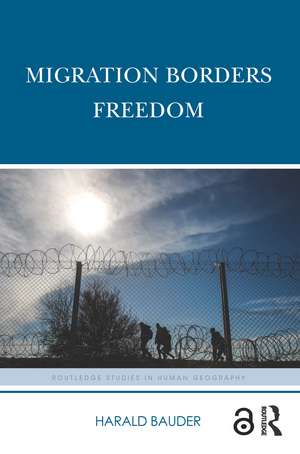
Migration Borders Freedom: Routledge Studies in Human Geography
Autor Harald Bauderen Limba Engleză Paperback – 23 ian 2018
In today’s world, national citizenship determines a person’s ability to migrate across borders. Migration Borders Freedom questions that premise. Recognizing the magnitude of deaths occurring at contemporary borders worldwide, the book problematizes the concept of the border and develops arguments for open borders and a world without borders. It explores alternative possibilities, ranging from the practical to the utopian, that link migration with ideas of community, citizenship, and belonging. The author calls into question the conventional political imagination that assumes migration and citizenship to be responsibilities of nation states, rather than cities. While the book draws on the theoretical work of thinkers such as Ernst Bloch, David Harvey, and Henry Lefebvre, it also presents international empirical examples of policies and practices on migration and claims of belonging. In this way, the book equips the reader with the practical and conceptual tools for political action, activist practice, and scholarly engagement to achieve greater justice for people who are on the move.
Din seria Routledge Studies in Human Geography
-
 Preț: 467.54 lei
 - 18%
 Preț: 1254.81 lei
 - 18%
 Preț: 1305.19 lei
 - 15%
 Preț: 474.49 lei
 - 15%
 Preț: 424.63 lei
 - 18%
 Preț: 759.11 lei
 - 18%
 Preț: 1251.35 lei
 - 18%
 Preț: 1249.78 lei
 -
 Preț: 310.56 lei
 - 15%
 Preț: 447.16 lei
 -
 Preț: 463.62 lei
 - 18%
 Preț: 1249.78 lei
 - 18%
 Preț: 1345.62 lei
 - 18%
 Preț: 1109.58 lei
 - 15%
 Preț: 470.40 lei
 - 18%
 Preț: 1249.78 lei
 - 18%
 Preț: 1248.98 lei
 - 18%
 Preț: 1252.71 lei
 - 18%
 Preț: 1313.95 lei
 -
 Preț: 416.82 lei
 - 15%
 Preț: 464.25 lei
 - 18%
 Preț: 770.35 lei
 -
 Preț: 494.42 lei
 - 18%
 Preț: 1260.39 lei
 -
 Preț: 412.99 lei
 - 18%
 Preț: 1252.16 lei
 - 18%
 Preț: 1259.34 lei
 - 18%
 Preț: 1252.01 lei
 - 15%
 Preț: 438.34 lei
 - 18%
 Preț: 788.92 lei
 -
 Preț: 466.69 lei
 - 15%
 Preț: 539.70 lei
 -
 Preț: 460.32 lei
 - 18%
 Preț: 1347.10 lei
 -
 Preț: 471.36 lei
 - 18%
 Preț: 1439.41 lei
 - 18%
 Preț: 1253.07 lei
 -
 Preț: 456.57 lei
 -
 Preț: 462.43 lei
 - 18%
 Preț: 1252.93 lei
 - 18%
 Preț: 1251.67 lei
Preț: 472.40 lei
Puncte Express: 709
Carte tipărită la comandă
Livrare economică 07-21 decembrie
Livrare prin curier în România Termenul estimat este afișat lângă disponibilitate.
Transport gratuit pentru acest produs Plată online sau ramburs, în funcție de opțiunile comenzii.
Retur gratuit în 14 zile Comandă securizată și suport în română.
Specificații
ISBN-13: 9781138544994
ISBN-10: 113854499X
Pagini: 150
Ilustrații: 1 Line drawings, black and white; 9 Halftones, black and white; 10 Illustrations, black and white
Dimensiuni: 156 x 234 x 22 mm
Greutate: 0.28 kg
Ediția:1
Editura: Taylor & Francis
Colecția Routledge
Seria Routledge Studies in Human Geography
Locul publicării:Oxford, United Kingdom
ISBN-10: 113854499X
Pagini: 150
Ilustrații: 1 Line drawings, black and white; 9 Halftones, black and white; 10 Illustrations, black and white
Dimensiuni: 156 x 234 x 22 mm
Greutate: 0.28 kg
Ediția:1
Editura: Taylor & Francis
Colecția Routledge
Seria Routledge Studies in Human Geography
Locul publicării:Oxford, United Kingdom
V-ar putea interesa
-
 Preț: 375.74 lei
 -
 The Oxford Handbook of British PoliticsMatthew Flinders-26%Preț: 405.34 lei546.52 lei
 -
 The Political Responsibilities of Everyday BystandersStephen L. EsquithPreț: 267.41 lei
 -
 Barrio Democracy in Latin AmericaEduardo CanelPreț: 267.63 lei
 -
 Rights: A Critical IntroductionTom CampbellPreț: 440.10 lei
 -
 Measuring Human RightsTodd LandmanPreț: 459.02 lei
 -
 Preț: 465.84 lei
 -
 -15%Preț: 468.95 lei551.71 lei
 -
 -15%Preț: 526.40 lei619.29 lei
 -
 Unspeakable Truths: Transitional Justice and the Challenge of Truth CommissionsPriscilla B. HaynerPreț: 496.75 lei
 -
 Black Politics Today: The Era of Socioeconomic TransitionTheodore J. Davis Jr.Preț: 472.05 lei
 -
 Many Minds, One HeartWesley C. HoganPreț: 351.02 lei
 -
 Freedom with ViolenceChandan ReddyPreț: 253.11 lei
 -
 The Politics of European CitizenshipPeo HansenPreț: 264.11 lei
 -
 -18%Preț: 759.07 lei925.70 lei
 -
 WITH LIBERTY AND JUSTICE FOR SOMEGlenn GreenwaldPreț: 128.98 lei
 -
 Peace and Democratic SocietyAmartya SenPreț: 152.84 lei
Public țintă
Postgraduate and UndergraduateCuprins
1. Introduction. Part I: Diagnosis. 2. Borders in Perspective. 3. Access Denied! 4. From Utopia to Possibilia. Part II: Solutions. 5. Mobility and Domicile. 6. Sanctuary City. 7. Right to the Future. 8. Conclusion. Index
Notă biografică
Harald Bauder is Professor in the Department of Geography and Environmental Studies, and the Graduate Program for Immigration and Settlement Studies (ISS) at Ryerson University in Toronto, Canada, and the founding Academic Director of the Ryerson Centre for Immigration and Settlement (RCIS).
Recenzii
"Freedom, however, is in the realm of possiblia (I gladly adopt this term) and thus in the realm of the not-yet-thinkable and of practice. It is good that Bauder does not go too far here. The result is a truly good book on open borders and contingent possibilities. It would be great if many activists and students, but also municipal dignitaries and politicians, would read it. An inspiration for upcoming tasks." - Forschungsgesellschaft Flucht & Migration Online, November 2016
"[t]he book deserves praise for managing, in little more than a hundred pages, not only to introduce the open borders option but also to tackle the different arguments for and against the option, and to clearly locate open borders between utopia and what is a possibility for tomorrow or the future." - Djordje Sredanovic, Wiley, Migrations Asylum Multiculturalism/Group for Research on Ethnic Relations, Migration & Equality/Université Libre de Bruxelles, Brussels, Belgium, December, 2016
"Bauder intelligibly takes full advantage of the three concepts of migration, borders and freedom to discuss many conceivable possibilities and contradictions that counter walls, borders, lines, and divides.Bauder introduces relevant and provocative policy measures on migrant rights to work and stay, by referring to restrictions imposed to citizenship, territoriality, and the nation-state."- Sutapa Chattopadhyay, Interface, Vol 9, Nov/Dec 2017
"Bauder does not leave it at moral accusations and anti-negative political criticism. The critical border and migration researcher wants to develop fresh ideas that are challenging outdated visions and practices of border policy (31). His stated aim, as outlined in the Introduction, is to explore possible ways to a future world in which "humanity can exercise freedom of migration "(10). He wants to contribute to the search for currently practicable as well as future solutions (x) by exploring concepts and methods for their usability in this project. Bauder achieves this claim through the founded review of classical and current theories in a theoretically sophisticated and yet reader-friendly manner." - William Mitchell, Berlin
"[t]he book deserves praise for managing, in little more than a hundred pages, not only to introduce the open borders option but also to tackle the different arguments for and against the option, and to clearly locate open borders between utopia and what is a possibility for tomorrow or the future." - Djordje Sredanovic, Wiley, Migrations Asylum Multiculturalism/Group for Research on Ethnic Relations, Migration & Equality/Université Libre de Bruxelles, Brussels, Belgium, December, 2016
"Bauder intelligibly takes full advantage of the three concepts of migration, borders and freedom to discuss many conceivable possibilities and contradictions that counter walls, borders, lines, and divides.Bauder introduces relevant and provocative policy measures on migrant rights to work and stay, by referring to restrictions imposed to citizenship, territoriality, and the nation-state."- Sutapa Chattopadhyay, Interface, Vol 9, Nov/Dec 2017
"Bauder does not leave it at moral accusations and anti-negative political criticism. The critical border and migration researcher wants to develop fresh ideas that are challenging outdated visions and practices of border policy (31). His stated aim, as outlined in the Introduction, is to explore possible ways to a future world in which "humanity can exercise freedom of migration "(10). He wants to contribute to the search for currently practicable as well as future solutions (x) by exploring concepts and methods for their usability in this project. Bauder achieves this claim through the founded review of classical and current theories in a theoretically sophisticated and yet reader-friendly manner." - William Mitchell, Berlin
Descriere
This book questions the idea that mobility of people should be controlled, either at the international border or based on the national citizenship with which a person was born. The book describes the magnitude of the deadly results of contemporary borders worldwide, problematizes the concept of the border and then develops arguments for a world without borders. It uses a dialectical approach to contemplate alternative possibilities, ranging from practical and feasible to the utopian distant future, drawing on the theoretical work of thinkers such as Ernst Bloch, David Harvey, and Henry Lefebvre, with international empirical examples of policy practices on migration and claims of belonging.