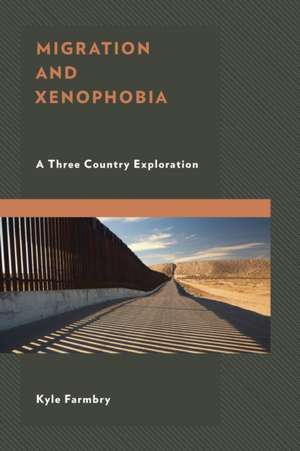
Migration and Xenophobia: A Three Country Exploration
Autor Kyle Farmbryen Limba Engleză Paperback – 19 oct 2020
Preț: 270.83 lei
Preț vechi: 369.45 lei
-27%
Puncte Express: 406
Carte tipărită la comandă
Livrare economică 03-17 decembrie
Livrare prin curier în România Termenul estimat este afișat lângă disponibilitate.
Transport gratuit de la 400.00 lei Plată online sau ramburs, în funcție de opțiunile comenzii.
Retur gratuit în 14 zile Comandă securizată și suport în română.
Specificații
ISBN-13: 9781498553377
ISBN-10: 1498553370
Pagini: 236
Ilustrații: 1 textboxes;
Dimensiuni: 151 x 222 x 18 mm
Greutate: 0.35 kg
Editura: Bloomsbury Publishing
Colecția Lexington Books
Locul publicării:New York, United States
ISBN-10: 1498553370
Pagini: 236
Ilustrații: 1 textboxes;
Dimensiuni: 151 x 222 x 18 mm
Greutate: 0.35 kg
Editura: Bloomsbury Publishing
Colecția Lexington Books
Locul publicării:New York, United States
Cuprins
1.Introduction
2.Theoretical Context for Racism(s) and Xenophobia
3.Migration and Conceptualizations
4.Case 1 - South Africa: Aspiration Meets Human Condition
5.Case 2 - Malta: Towards an Integrative Strategy
6.Case 3 - The United States: History Repeats
7.Conclusion
8.Appendix I - 1951 Convention Relating to the Status of Refugees
9.Appendix II - 2016 New York Declaration for Refugees and Migrants
10.Appendix III - 2018 Global Compact for Safe, Orderly and Regular Migration
11.Appendix IV - 2018 Global Compact on Refugees
2.Theoretical Context for Racism(s) and Xenophobia
3.Migration and Conceptualizations
4.Case 1 - South Africa: Aspiration Meets Human Condition
5.Case 2 - Malta: Towards an Integrative Strategy
6.Case 3 - The United States: History Repeats
7.Conclusion
8.Appendix I - 1951 Convention Relating to the Status of Refugees
9.Appendix II - 2016 New York Declaration for Refugees and Migrants
10.Appendix III - 2018 Global Compact for Safe, Orderly and Regular Migration
11.Appendix IV - 2018 Global Compact on Refugees
Recenzii
Farmbry's timely Migration and Xenophobia offers a wealth of historical context to anyone concerned with the responses to and representations of the current migrant/refugee crisis. Weaving together three distinct national experiences of migration-South Africa, Malta and the United States-Farmbry contextualizes migration and both its causes and responses as ongoing cultural dynamics, embedded within such texts as sacred books, oral traditions and reactionary legal code, rather than a sudden emergent crisis. Farmbry's valuable contribution to this crucial conversation can aid all stakeholders craft a more humane and sustainable response to the ongoing global discourse on migration and its representations.
Dr. Farmbry's Migration and Xenophobia: A Three Country Exploration has the reader go straight to the questions that many of us observe today: namely, why are more people from other shores coming into my community, or alternatively, why are more people within my community pressed to leave? In exploring these questions from his lived experience, that of his adopted land, South Africa, to a site of field research, Malta, and finally to his birth place, the United States, Dr. Farmbry offers his readers rich and raw insights on race and xenophobia in a more mobile world. As complex connections unfold, so too does a compelling clarity of thought and feeling rooted in the author's own journey. This book and its personal framing are important and timely contributions encouraging us all to consider migration as the story of ourselves. Migration and Xenophobia: A Three Country Exploration's exciting potential will be in its legacy for prompting others into similar self-reflection, and ultimately stimulating genuine and inclusive public discourse in changing communities, where as Dr. Farmbry accurately describes, a growing number grapple with "wavering degrees of hospitality".
Farmbry provides a riveting account of the causes of migration and xenophobia. It pins the narrative with a fundamental question missed by many - "Why do people leave?" Often mired in controversy, and fueled by fiery rhetoric, migration is the subject that rattles the status quo. The author neatly unpacks a complex phenomenon laden with tragedies, and presents a compelling case for legality and humanity. The result is an informed and scholarly argument on migration, and an attempt to explain the human toll of looking the other way. At the heart of this book is the study of human struggle for survival and adjustment, for adaptation and acceptance, of strife and renewal, of loss and hope. This is a much needed account. Non-Government Organizations, policy-makers, academics, practitioners, and the general audience, should find this book compelling, gripping and insightful. Indeed a timely contribution."
Dr. Farmbry's choice of three countries and three continents South Africa (Africa), Malta (Europe) and the United States (North America) each characterized by histories of migration and resistance to migrations that is hostile if not anti-human in its othering, offers a thought provoking nuanced critical analysis, that makes for an interesting if not unique contribution to growing studies of the complex dynamics of human movements across history. It certainly also as he suggests sets up the basis for a study of why people in circumstances that induce migration choose to stay.
"Shaped in equal parts by intellectual curiosity and an unsettled humanity, Farmbry's careful comparative account reveals what is most fundamental about migration in the 21st Century. He reminds readers that what matters is not the number of migrants, but why they move and how communities and countries respond to new arrivals. These reactions reflect openness and welcome, but also legacies of colonialism, imperialism, and resurgent racism. In an entangled and mobile era, protection and enclosure not only threaten migrants, but practices of tolerance, accommodation, and accountability necessary for democratic institutions to survive."
Dr. Farmbry's Migration and Xenophobia: A Three Country Exploration has the reader go straight to the questions that many of us observe today: namely, why are more people from other shores coming into my community, or alternatively, why are more people within my community pressed to leave? In exploring these questions from his lived experience, that of his adopted land, South Africa, to a site of field research, Malta, and finally to his birth place, the United States, Dr. Farmbry offers his readers rich and raw insights on race and xenophobia in a more mobile world. As complex connections unfold, so too does a compelling clarity of thought and feeling rooted in the author's own journey. This book and its personal framing are important and timely contributions encouraging us all to consider migration as the story of ourselves. Migration and Xenophobia: A Three Country Exploration's exciting potential will be in its legacy for prompting others into similar self-reflection, and ultimately stimulating genuine and inclusive public discourse in changing communities, where as Dr. Farmbry accurately describes, a growing number grapple with "wavering degrees of hospitality".
Farmbry provides a riveting account of the causes of migration and xenophobia. It pins the narrative with a fundamental question missed by many - "Why do people leave?" Often mired in controversy, and fueled by fiery rhetoric, migration is the subject that rattles the status quo. The author neatly unpacks a complex phenomenon laden with tragedies, and presents a compelling case for legality and humanity. The result is an informed and scholarly argument on migration, and an attempt to explain the human toll of looking the other way. At the heart of this book is the study of human struggle for survival and adjustment, for adaptation and acceptance, of strife and renewal, of loss and hope. This is a much needed account. Non-Government Organizations, policy-makers, academics, practitioners, and the general audience, should find this book compelling, gripping and insightful. Indeed a timely contribution."
Dr. Farmbry's choice of three countries and three continents South Africa (Africa), Malta (Europe) and the United States (North America) each characterized by histories of migration and resistance to migrations that is hostile if not anti-human in its othering, offers a thought provoking nuanced critical analysis, that makes for an interesting if not unique contribution to growing studies of the complex dynamics of human movements across history. It certainly also as he suggests sets up the basis for a study of why people in circumstances that induce migration choose to stay.
"Shaped in equal parts by intellectual curiosity and an unsettled humanity, Farmbry's careful comparative account reveals what is most fundamental about migration in the 21st Century. He reminds readers that what matters is not the number of migrants, but why they move and how communities and countries respond to new arrivals. These reactions reflect openness and welcome, but also legacies of colonialism, imperialism, and resurgent racism. In an entangled and mobile era, protection and enclosure not only threaten migrants, but practices of tolerance, accommodation, and accountability necessary for democratic institutions to survive."