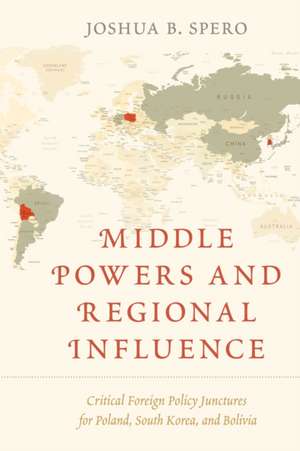
Middle Powers and Regional Influence: Critical Foreign Policy Junctures for Poland, South Korea, and Bolivia
Autor Joshua B. Speroen Limba Engleză Hardback – 16 noi 2018
For this book's three case studies and their first-term leadership's critical junctures-from first term post-communist Poland, post-authoritarian/post-ruling party South Korea, and post-colonial Bolivia-we have the antecedents for contemporary middle powers essential for realizing the regional evolution for cooperative change with greater powers systemically; we may then grasp today why those historical foreign policies, albeit not so long ago, give us crucial antecedents for adapting and trying, yet again, to resolve seemingly perennial power dilemmas regionally, peacefully.
Here are why middle power impact matters, not only regionally for stronger, dominant greater power neighbours, but also for transformative middle power leaderships which proved pivotal geopolitically for their region's challenges and changes.
Preț: 692.21 lei
Preț vechi: 1111.49 lei
-38%
Puncte Express: 1038
Carte tipărită la comandă
Livrare economică 20 noiembrie-04 decembrie
Livrare prin curier în România Termenul estimat este afișat lângă disponibilitate.
Transport gratuit pentru acest produs Plată online sau ramburs, în funcție de opțiunile comenzii.
Retur gratuit în 14 zile Comandă securizată și suport în română.
Specificații
ISBN-13: 9781786609885
ISBN-10: 1786609886
Pagini: 186
Dimensiuni: 160 x 228 x 20 mm
Greutate: 0.42 kg
Editura: Bloomsbury Publishing
Colecția Rowman & Littlefield
Locul publicării:New York, United States
ISBN-10: 1786609886
Pagini: 186
Dimensiuni: 160 x 228 x 20 mm
Greutate: 0.42 kg
Editura: Bloomsbury Publishing
Colecția Rowman & Littlefield
Locul publicării:New York, United States
Cuprins
Introduction: Setting the Scene for Three Pivotal Middle Powers
Chapter One: Bridging Europe's Divide: Post-Communist Poland (1989-1991)
Chapter Two: Bridging Asia's Divide: Post-Authoritarian, Post-Ruling Party South Korea (1998-2003)
Chapter Three: Bridging South America's Divide: Post-Colonial Indigenous Ruling Bolivia (2006-2009)
Conclusion: Middle Powers do Matter Regionally
Bibliography
Chapter One: Bridging Europe's Divide: Post-Communist Poland (1989-1991)
Chapter Two: Bridging Asia's Divide: Post-Authoritarian, Post-Ruling Party South Korea (1998-2003)
Chapter Three: Bridging South America's Divide: Post-Colonial Indigenous Ruling Bolivia (2006-2009)
Conclusion: Middle Powers do Matter Regionally
Bibliography
Recenzii
Joshua Spero's illuminating study takes a fresh look at international power's complexities with distinctly different nations from different continents, convincingly explaining how each became key players regionally. Where attention increasingly fixates on reemerging "Great Power" competition, this excellent, well-written book reminds us that seemingly less powerful countries in every region geo-politically "punch above their weight," always remaining key during foreign policy formulation.
It's hard to find a more-timely study given emerging challenges to the post-WWII liberal international order. Spero's analysis provides especially important power models to consider for strategic bridging roles by medium-size states, offering readers not only deep scholarship, but many years of senior-level governmental experience as national security policy expert. This book is a must read for foreign policy and national security practitioners, scholars, and students alike.
Professor Spero's controversial text discusses Evo Morales's foreign policy impact to evaluate the tense, difficult feedback for conjunctural politics - based on a leader's personal, historic, substantive influence for middle power Bolivia's national interest.
This book develops analytic tools to work through how most nations can function and succeed. His gripping case studies shed light on impressive achievements by intelligent, moderate middle power leaderships, despite seemingly insurmountable obstacles by their larger neighbors.
This formidable account offers some astutely selected countries' rise to middle powers status. Josh Spero's treatment of 'policy junctures' and 'other-help bridging' as crucial explanatory devices in regional geopolitics is highly imaginative and illustrative. These case studies make for a fascinating read on regional players usually not in the limelight of global attention.
Spero's insightful analysis demonstrates securing relations with Russia, Ukraine, united Germany, and Visegrad cooperation allowed Poland to lead Central Europe into NATO and the EU. His lessons learned remain very relevant for present geopolitical crises.
It's hard to find a more-timely study given emerging challenges to the post-WWII liberal international order. Spero's analysis provides especially important power models to consider for strategic bridging roles by medium-size states, offering readers not only deep scholarship, but many years of senior-level governmental experience as national security policy expert. This book is a must read for foreign policy and national security practitioners, scholars, and students alike.
Professor Spero's controversial text discusses Evo Morales's foreign policy impact to evaluate the tense, difficult feedback for conjunctural politics - based on a leader's personal, historic, substantive influence for middle power Bolivia's national interest.
This book develops analytic tools to work through how most nations can function and succeed. His gripping case studies shed light on impressive achievements by intelligent, moderate middle power leaderships, despite seemingly insurmountable obstacles by their larger neighbors.
This formidable account offers some astutely selected countries' rise to middle powers status. Josh Spero's treatment of 'policy junctures' and 'other-help bridging' as crucial explanatory devices in regional geopolitics is highly imaginative and illustrative. These case studies make for a fascinating read on regional players usually not in the limelight of global attention.
Spero's insightful analysis demonstrates securing relations with Russia, Ukraine, united Germany, and Visegrad cooperation allowed Poland to lead Central Europe into NATO and the EU. His lessons learned remain very relevant for present geopolitical crises.