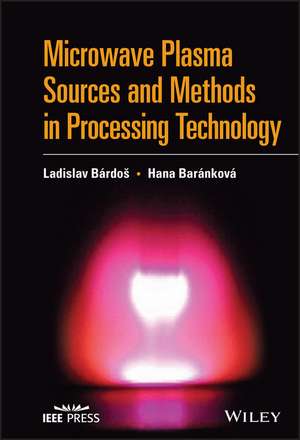
Microwave Plasma Sources and Methods in Processing Technology
Autor Bardosen Limba Engleză Hardback – 3 mar 2022
În cadrul programelor academice de fizică aplicată și inginerie electronică, studiul plasmei generate prin microunde ocupă un loc central datorită versatilității sale în procesarea materialelor. Găsim în lucrarea Microwave Plasma Sources and Methods in Processing Technology, publicată de Wiley, un ghid riguros care face trecerea de la principiile fundamentale ale propagării undelor în ghiduri de undă la implementări industriale complexe. Ne-a atras atenția modul în care autorul Bardos reușește să sintetizeze fizica descărcărilor în gaze — incluzând coeficienții Townsend și curba Paschen — cu aplicații directe în tehnologii de vârf.
Textul se distinge prin abordarea practică a sistemelor de putere și a componentelor de microunde, oferind claritate asupra modului în care plasma interacționează cu suprafețele solide și gazele. Considerăm că prezența celor peste 130 de diagrame color este esențială pentru înțelegerea fenomenelor de oxidare, pulverizare și activare a suprafețelor. Cartea explorează, de asemenea, nișe de cercetare recente, cum ar fi plasmele în lichide sau interacțiunile cu flăcările de combustie, oferind o perspectivă extinsă asupra domeniului.
Această lucrare completează perspectiva oferită de Microwave Excited Plasmas de M. Moisan, adăugând o metodologie aplicată mai pronunțată în zona tehnologiilor de procesare la presiuni diferite, față de abordarea axată pe chimie analitică și spectroscopie a titlului menționat. De asemenea, spre deosebire de Compact Plasma and Focused Ion Beams, care se concentrează pe depășirea limitelor geometrice ale ghidurilor de undă, volumul de față oferă o bază mult mai largă pentru proiectarea sistemelor de procesare industrială la scară largă.
Preț: 857.52 lei
Preț vechi: 942.32 lei
-9%
Carte tipărită la comandă
Livrare economică 10-24 iulie
Specificații
ISBN-10: 111982687X
Pagini: 208
Dimensiuni: 152 x 229 x 13 mm
Greutate: 0.45 kg
Editura: Wiley
Locul publicării:Hoboken, United States
De ce să citești această carte
Recomandăm această carte inginerilor și cercetătorilor care au nevoie de o fundamentare solidă în utilizarea plasmei pentru procesarea materialelor. Cititorul câștigă o înțelegere clară a sistemelor de microunde, de la generatoare la aplicatori, și primește soluții concrete pentru procese precum depunerea chimică din fază de vapori (CVD) sau gravarea materialelor. Este un instrument de referință pentru optimizarea proceselor industriale care necesită precizie și eficiență energetică.
Despre autor
Echipa de autori, condusă de Bardos, este formată din cercetători premiați, cu o vastă experiență în domeniul fizicii plasmei și al ingineriei microundelor. Contribuția lor în literatura de specialitate este recunoscută prin capacitatea de a traduce fenomenele fizice complexe în soluții tehnologice viabile. Expertiza lor acoperă întreg spectrul cercetării descărcărilor în gaz la diverse presiuni, fiind figuri de referință în comunitatea științifică internațională pentru inovațiile aduse în procesarea materialelor prin tehnologii non-termice.
Cuprins
Descriere
A practical introduction to microwave plasma for processing applications at a variety of pressures
In Microwave Plasma Sources and Methods in Processing Technology, an award-winning team of researchers delivers a comprehensive introduction to microwaves and microwave-generated plasmas. Ideal for anyone interested in non-thermal gas discharge plasmas and their applications, the book includes detailed descriptions, explanations, and practical guidance for the study and use of microwave power, microwave components, plasma, and plasma generation.
This reference includes over 130 full-color diagrams to illustrate the concepts discussed within. The distinguished authors discuss the plasmas generated at different levels of power, as well as their applications at reduced, atmospheric and higher pressures. They also describe plasmas inside liquids and plasma interactions with combustion flames.
Microwave Plasma Sources and Methods in Processing Technology concludes with an incisive exploration of new trends in the study and application of microwave discharges, offering promising new areas of study.
The book also includes:
- A thorough introduction to the basic principles of microwave techniques and power systems, including a history of the technology, microwave generators, waveguides, and wave propagation
- A comprehensive exploration of the fundamentals of the physics of gas discharge plasmas, including plasma generation, Townsend coefficients, and the Paschen curve
- Practical discussions of the interaction between plasmas and solid surfaces and gases, including PVD, PE CVD, oxidation, sputtering, evaporation, dry etching, surface activation, and cleaning
- In-depth examinations of microwave plasma systems for plasma processing at varied parameters
Perfect for researchers and engineers in the microwave community, as well as those who work with plasma applications, Microwave Plasma Sources and Methods in Processing Technology will also earn a place in the libraries of graduate and PhD students studying engineering physics, microwave engineering, and plasmas.
Notă biografică
Ladislav Bárdoa is Professor at the Department of Electrical Engineering at Uppsala University. He received his PhD from the Institute of Plasma Physics at the Czech Academy of Sciences in 1978 and DrSc from the Charles University Prague in 1995. He was awarded the Plasma Physics Innovation Prize 2019 by the European Physical Society. Hana Baránková is Professor at the Department of Electrical Engineering, Uppsala University. She received her PhD from the Institute of Radio Engineering and Electronics at the Czech Academy of Sciences in 1981. She was awarded the Plasma Physics Innovation Prize 2019 by the European Physical Society. She is Secretary of the Board of Directors at the Society of Vacuum Coaters in the US.