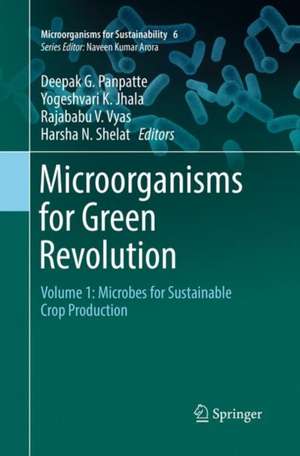
Microorganisms for Green Revolution: Volume 1: Microbes for Sustainable Crop Production: Microorganisms for Sustainability, cartea 6
Editat de Deepak G. Panpatte, Yogeshvari K. Jhala, Rajababu V. Vyas, Harsha N. Shelaten Limba Engleză Paperback – 12 dec 2018
A healthy, balanced soil ecosystem provides a habitat for crops to grow without the need for interventions such as agro-chemicals. No organism in an agro-ecosystem can flourish individually, which is why research on the interaction of microorganisms with higher forms of life has increasingly gained momentum in the last 10-15 years. In fact, most of plants’ life processes only become possible through interactions with microorganisms. Using these “little helpers” as a biological alternative to agro-chemicals is a highly contemporary field of research.
The information presented here is based on the authors’ extensive experience in the subject area, gathered in the course of their careers in the field of agricultural microbiology. The book offers a valuable resource for all readers who are actively involved in research on agriculturally beneficial microorganisms. In addition, it will help prepare readers for the future challenges that climate change will pose for agriculture and will help to bridge the current gaps between different scientific communities.
Din seria Microorganisms for Sustainability
- 24%
 Preț: 859.45 lei
 - 18%
 Preț: 919.93 lei
 - 24%
 Preț: 1117.23 lei
 - 24%
 Preț: 1170.91 lei
 - 18%
 Preț: 1172.17 lei
 - 18%
 Preț: 1062.99 lei
 - 18%
 Preț: 1216.73 lei
 - 18%
 Preț: 1086.15 lei
 - 18%
 Preț: 912.85 lei
 - 18%
 Preț: 1181.26 lei
 - 24%
 Preț: 902.63 lei
 - 18%
 Preț: 1338.68 lei
 - 18%
 Preț: 965.96 lei
 - 18%
 Preț: 1340.72 lei
 - 24%
 Preț: 970.13 lei
 - 24%
 Preț: 874.17 lei
 - 15%
 Preț: 623.13 lei
 - 18%
 Preț: 911.78 lei
 - 18%
 Preț: 914.22 lei
 - 15%
 Preț: 622.54 lei
 - 18%
 Preț: 910.89 lei
 - 24%
 Preț: 923.15 lei
 - 18%
 Preț: 938.08 lei
 - 18%
 Preț: 1329.89 lei
 - 24%
 Preț: 858.74 lei
 - 18%
 Preț: 917.07 lei
 - 24%
 Preț: 1180.21 lei
 - 24%
 Preț: 1293.76 lei
 - 24%
 Preț: 1334.83 lei
Preț: 1134.11 lei
Preț vechi: 1492.25 lei
-24%
Puncte Express: 1701
Carte tipărită la comandă
Livrare economică 14-21 septembrie
Livrare prin curier în România Termenul estimat este afișat lângă disponibilitate.
Transport gratuit pentru acest produs Plată online sau ramburs, în funcție de opțiunile comenzii.
Retur gratuit în 14 zile Comandă securizată și suport în română.
Specificații
ISBN-13: 9789811348365
ISBN-10: 9811348367
Pagini: 443
Ilustrații: XIV, 443 p. 90 illus., 38 illus. in color.
Dimensiuni: 155 x 235 mm
Ediția:Softcover reprint of the original 1st ed. 2017
Editura: Springer Nature Singapore
Colecția Springer
Seria Microorganisms for Sustainability
Locul publicării:Singapore, Singapore
ISBN-10: 9811348367
Pagini: 443
Ilustrații: XIV, 443 p. 90 illus., 38 illus. in color.
Dimensiuni: 155 x 235 mm
Ediția:Softcover reprint of the original 1st ed. 2017
Editura: Springer Nature Singapore
Colecția Springer
Seria Microorganisms for Sustainability
Locul publicării:Singapore, Singapore
V-ar putea interesa
-
 Soil Microbiology, Ecology and BiochemistryEldor Paul-31%Preț: 511.38 lei745.83 lei
 -
 Adventures in FermentationJohnny DrainPreț: 143.41 lei
 -
 Microbes in Soil & their Agricultural ProspectsKaushal Kishore Choudhary Ph.D.-26%Preț: 2071.94 lei2817.96 lei
 -
 Microbial Probiotics for Agricultural Systems: Advances in Agronomic UseDoris Zúñiga-Dávila-24%Preț: 845.31 lei1112.24 lei
 -
 Microbial Services for Cereal Crops: Reducing Costs and Environmental ImpactEverlon Cid Rigobelo-18%Preț: 908.31 lei1107.70 lei
 -
 NanobiostimulantsVandana Singh-18%Preț: 1024.32 lei1249.17 lei
 -
 -18%Preț: 1194.38 lei1456.56 lei
 -
 Greenhouse Gas Regulating Microorganisms in Soil EcosystemsSantosh R. Mohanty-18%Preț: 1014.51 lei1237.21 lei
 -
 -24%Preț: 1447.01 lei1903.95 lei
 -
 -18%Preț: 912.85 lei1113.23 lei
 -
 -18%Preț: 1501.25 lei1830.80 lei
 -
 Rhizosphere MicrobesSushil Kumar Sharma-24%Preț: 1170.91 lei1540.67 lei
 -
 -18%Preț: 1342.63 lei1637.36 lei
 -
 Microbial Technology for Sustainable EnvironmentPankaj Bhatt-24%Preț: 1366.41 lei1797.91 lei
 -
 Advances in Agricultural and Industrial MicrobiologySuraja Kumar Nayak-20%Preț: 610.73 lei763.41 lei
 -
 Beneficial Microorganisms in AgricultureRam Prasad-24%Preț: 1289.43 lei1696.62 lei
 -
 -18%Preț: 1348.07 lei1643.99 lei
 -
 Plant-Microbe Interaction and Stress ManagementPuneet Singh Chauhan-18%Preț: 971.82 lei1185.15 lei
 -
 -24%Preț: 1146.22 lei1508.19 lei
 -
 -18%Preț: 1178.99 lei1437.79 lei
Cuprins
Chapter 1. Wonders of Microbes in Agriculture- For Sustainability and Productivity.- Chapter 2. Microbial Biofertilizer: A Potential Tool for Sustainable Agriculture.- Chapter 3. Potentials of Microbial Inoculants in Soil Productivity: An Outlook on African Legumes.- Chapter 4. Endophytic Microorganisms- Promising Candidate as Biofertilizer.- Chapter 5. Azotobacter -A Potential Bio-Fertilizer and Bio Inoculants for Sustainable Agriculture.- Chapter 6. Rhizobacterial Phosphate Solubilizers in Sustainable Agriculture - Concepts and Prospects.- Chapter 7. Potassium Solubilizing Microbes: Diversity, Distribution and Role in Plant Growth Promotion.- Chapter 8. Bacterial Volatile Organic Compounds – A New Insight for Sustainable Agriculture.- Chapter 9. Perspectives of Plant-Methylotrophic Interactions in Organic Farming.- Chapter 10. Trichoderma as a plant growth promoting rhizosphere microorganism with biocontrol activity.- Chapter 11. Biofertilizer Application in Horticultural Crops.- Chapter 12. Fermentation - A Process for Biofertilizers Production.- Chapter 13. Cyanobacteria - A Source of Organic Fertilizers for Plant Growth.- Chapter 14. Application of Bioinoculants for Seed Quality Improvement.- Chapter 15. Role of Biofertilizers in Sustainable Agriculture under Abiotic Stresses.- Chapter 16. Endophyte Microbes- A Weapon for Plant Health Management.- Chapter 17. Efficacy of Entomopathogenic Fungi as Green Pesticides: Current and Future Prospects.- Chapter 18. Premier biocontrol Traits of Pseudomonads: Siderophores, Phenazines or what else?.- Chapter 19. Rhizosphere Microorganisms: Application of Plant Beneficial Microbes in Biological Control of Weeds.- Chapter 20. Biological Nitrogen Fixation:The Role of Underutilised Leguminous Plants.
Notă biografică
Dr. Deepak G. Panpatte is a Research Scholar working for the past 7 years. His research interests include agriculturally beneficial microorganism viz. biofertilizers, biopesticides and biodegraders. Done pioneering work for development of fortified biocontrol bacterial consortium with phyto-extracts for management of phytopathogenic nematodes and fungi. He has received 2 awards for presentation of research outcomes in International conferences and Rastiya Gaurav Award for outstanding contribution in agriculture. His publication profile includes, 13 research papers, 4 book chapter with springer publishing house, 1 practical manual, 24 popular articles and 2 editorial pages.
Dr. Yogeshvari K. Jhala is an Assistant professor having 10 years of teaching and research experience. Her field of interest is agriculturally beneficial microorganisms’ viz. biofertilizers, biopesticides and biodegraders. She had world over first time reported 5 unique strains of methanotrophic bacteria. For her outstanding research work of methanotrophic bacteria she was honored with All India Best Research Award and Young Faculty Award. Her publications includes 17 research papers, 6 book chapters, 2 teaching manuals, 18 popular articles, 2 editorial pages.
Prof. Rajababu V. Vyas, M. Sc. (Micro), Ph D., serving as Research Scientist & Head, Dept. of Agril. Microbiology, AAU, Anand. Working on Agriculturally beneficial microorganisms on isolation and characterization, development of mass production technique, laboratory and field testing of biofertilizers for crop production, developed native microbial agents for biological control of insect pests and plant parasitic nematodes for crop protection and PGPR for bioremediation of methane and agro-waste, to support organic farming approach, since 31 years. Publication assortment includes research publications 112; review papers 2; books and manuals 4; training manuals 5; book chapters 8, two in CAB international and Michigan State University Press, USA publications. Recipient of six prestigious awards. Instrumental for technology patenting, commercialization, licensing and services.
Mrs. Harsha N. Shelat is a Associate Research Scientist and award winning researcher at Anand Agricultural University, Anand, India. She has professional skill of 33 years in the field of agriculturally advantageous microbes chiefly bio fertilizers, bio degraders and microbial pesticides. Her contribution in society is development and dissemination of Liquid Biofertilizer Technology for the benefit of farming community. Written books (2) and book chapter (5) published more than 35 research papers in national as well as international journals.
Dr. Yogeshvari K. Jhala is an Assistant professor having 10 years of teaching and research experience. Her field of interest is agriculturally beneficial microorganisms’ viz. biofertilizers, biopesticides and biodegraders. She had world over first time reported 5 unique strains of methanotrophic bacteria. For her outstanding research work of methanotrophic bacteria she was honored with All India Best Research Award and Young Faculty Award. Her publications includes 17 research papers, 6 book chapters, 2 teaching manuals, 18 popular articles, 2 editorial pages.
Prof. Rajababu V. Vyas, M. Sc. (Micro), Ph D., serving as Research Scientist & Head, Dept. of Agril. Microbiology, AAU, Anand. Working on Agriculturally beneficial microorganisms on isolation and characterization, development of mass production technique, laboratory and field testing of biofertilizers for crop production, developed native microbial agents for biological control of insect pests and plant parasitic nematodes for crop protection and PGPR for bioremediation of methane and agro-waste, to support organic farming approach, since 31 years. Publication assortment includes research publications 112; review papers 2; books and manuals 4; training manuals 5; book chapters 8, two in CAB international and Michigan State University Press, USA publications. Recipient of six prestigious awards. Instrumental for technology patenting, commercialization, licensing and services.
Mrs. Harsha N. Shelat is a Associate Research Scientist and award winning researcher at Anand Agricultural University, Anand, India. She has professional skill of 33 years in the field of agriculturally advantageous microbes chiefly bio fertilizers, bio degraders and microbial pesticides. Her contribution in society is development and dissemination of Liquid Biofertilizer Technology for the benefit of farming community. Written books (2) and book chapter (5) published more than 35 research papers in national as well as international journals.
Textul de pe ultima copertă
This book addresses basic and applied aspects of two nexus points of microorganisms in agro-ecosystems, namely their functional role as bio-fertilizers and bio-pesticides. Readers will find detailed information on all of the aspects that are required to make a microbe “agriculturally beneficial.”
A healthy, balanced soil ecosystem provides a habitat for crops to grow without the need for interventions such as agro-chemicals. No organism in an agro-ecosystem can flourish individually, which is why research on the interaction of microorganisms with higher forms of life has increasingly gained momentum in the last 10-15 years. In fact, most of plants’ life processes only become possible through interactions with microorganisms. Using these “little helpers” as a biological alternative to agro-chemicals is a highly contemporary field of research.
The information presented here is based on the authors’ extensive experience in the subject area, gathered in thecourse of their careers in the field of agricultural microbiology. The book offers a valuable resource for all readers who are actively involved in research on agriculturally beneficial microorganisms. In addition, it will help prepare readers for the future challenges that climate change will pose for agriculture and will help to bridge the current gaps between different scientific communities.
A healthy, balanced soil ecosystem provides a habitat for crops to grow without the need for interventions such as agro-chemicals. No organism in an agro-ecosystem can flourish individually, which is why research on the interaction of microorganisms with higher forms of life has increasingly gained momentum in the last 10-15 years. In fact, most of plants’ life processes only become possible through interactions with microorganisms. Using these “little helpers” as a biological alternative to agro-chemicals is a highly contemporary field of research.
The information presented here is based on the authors’ extensive experience in the subject area, gathered in thecourse of their careers in the field of agricultural microbiology. The book offers a valuable resource for all readers who are actively involved in research on agriculturally beneficial microorganisms. In addition, it will help prepare readers for the future challenges that climate change will pose for agriculture and will help to bridge the current gaps between different scientific communities.
Caracteristici
Discusses two major aspects of Agricultural Microbiology –bio-fertilizers and bio-pesticides – and their mechanisms of action in a single book Includes contributions by reputed national and international scientists to bridge the knowledge gap Explores the possibility of developing agro-chemical-free, sustainable agriculture based on agriculturally beneficial microorganisms